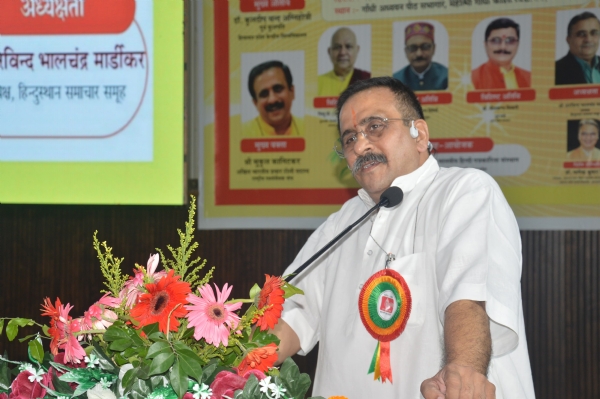
Varanasi, 13 September (H.S.): Indian knowledge tradition can provide a new direction to the global discourse on knowledge by offering a broader understanding of knowledge, Mukul Kanitkar, member of the Akhil Bharatiya Prachar Toli of the Rashtriya Swayamsevak Sangh (RSS), said on Sunday.
Addressing the Bharatiya Bhasha Samagam-2026 organised by Hindusthan Samachar at the Gandhi Study Centre auditorium of Mahatma Gandhi Kashi Vidyapeeth on the eve of Hindi Diwas, Kanitkar spoke on “Indian Knowledge Tradition, Regional Languages, and a Prosperous India”.
He said the world had generally viewed knowledge as a process of discovering or creating something new, whereas the Indian tradition viewed knowledge as a process of realising an eternal truth. Recognising unity amid diversity was knowledge, while understanding the different forms in which that unity manifested itself was science, he said.
Kanitkar said Indian scholarship was traditionally associated with the humility of acknowledging that a truth had not been created by an individual but realised through the study of knowledge already present in the scriptures and tradition. Referring to Swami Vivekananda and Ved Vyasa, he said the Indian approach emphasised understanding, realising and transmitting knowledge to subsequent generations.
He said the concept of “Sarve Bhavantu Sukhinah” reflected the Indian outlook of universal welfare. The Indian peace tradition extended the wish for peace beyond human beings to nature and the entire creation, he said.
Describing the knowledge tradition as a continuous stream, Kanitkar said the Gurukul system had survived in various forms. He said research into the tradition had identified hundreds of functioning gurukuls, including more than 150 associated with Dhanurveda.
He described Kashi as a living symbol of India’s thousands of years of knowledge journey and said the city could become a bridge between Indian knowledge traditions and modern science and technology.
On Indian languages, Kanitkar said they should not be viewed merely as “regional” languages. Tamil, Telugu, Kannada, Marathi, Gujarati, Assamese, Hindi and other Indian languages may differ in expression, but the cultural and civilisational sentiment expressed through them remains connected to India, he said.
He described language as a journey from “I” to “we”, saying that genuine communication begins when hearts connect. He also traced the journey of the written word from manuscripts and teleprinters to computers, the internet, mobile phones and artificial intelligence.
Kanitkar described Hindusthan Samachar’s multilingual news service as a unique example of linguistic journalism and said efforts to promote Indian languages and knowledge traditions through modern technology could strengthen their place in global discourse.
---------------
Hindusthan Samachar / Jun Sarkar
18 Aug 2026