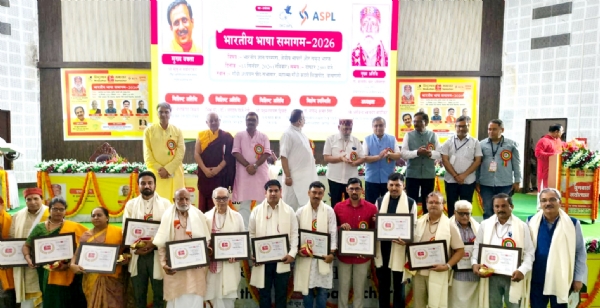
Varanasi, 13 September (H.S.): Former Vice-Chancellor of Central University of Himachal Pradesh Dr Kuldeep Chand Agnihotri on Sunday said India needs to bridge the gap between its ancient knowledge tradition and modern knowledge systems to make the country’s intellectual heritage relevant to the present generation.
Addressing the Bharatiya Bhasha Samagam-2026 organised by Hindusthan Samachar at the Gandhi Study Centre auditorium of Mahatma Gandhi Kashi Vidyapeeth on the eve of Hindi Diwas, Agnihotri said the biggest challenge was to connect the two streams of knowledge rather than simply looking back thousands of years.
Speaking on “Indian Knowledge Tradition, Regional Languages, and a Prosperous India”, he said Indian knowledge tradition should not be confined to philosophy, spirituality or the concepts of the soul and the Supreme. India had made significant contributions to mathematics, chemistry, botany, medicine and astronomy, and there was a need to study these contributions and evaluate them in a contemporary context.
Agnihotri said Kashi could emerge as a centre for connecting Indian knowledge tradition with modern knowledge. He called for a major initiative from the city to take ancient knowledge to the younger generation by linking it with present-day science and education.
He said language could play an important role in building this bridge. A large part of India’s ancient knowledge is preserved in Sanskrit, while specialists in modern disciplines often do not have sufficient knowledge of Sanskrit. Similarly, Sanskrit scholars may not have expertise in subjects such as physics or chemistry. Bringing language and subject experts together was therefore necessary, he said.
Agnihotri said merely introducing Indian knowledge tradition into university curricula would not be sufficient. Each discipline should also examine India’s contributions in that particular field. He cited the need for Sanskrit and science experts to jointly study ancient texts relating to subjects such as chemistry.
On Indian languages, he said greater importance should be given to the content and ideas expressed through a language rather than the language itself. Referring to Tulsidas’ Ramcharitmanas, he said its acceptance by society demonstrated the importance of ideas expressed in the language of the people.
Agnihotri called for a change in the mindset that considers an English-speaking person more learned while viewing those speaking Indian languages as inferior. He said Assamese, Punjabi, Bengali, Tamil, Telugu, Marathi, Gujarati, Hindi and other Indian languages were important carriers of India’s knowledge and cultural traditions.
He said Hindusthan Samachar’s initiative to connect Indian knowledge tradition with its heritage and take it to the younger generation was significant. He expressed confidence that Kashi could become a centre for rebuilding the bridge between India’s ancient and contemporary knowledge traditions.
---------------
Hindusthan Samachar / Jun Sarkar
18 Aug 2026