-A confluence of knowledge streams carried by languages from Kashmir to Kanyakumari, presenting a magnificent embodiment of India’s unity in diversity
-Kashi bears witness to Bharatiya Bhasha Samagam-2026 on Indian Knowledge Traditions, Regional Languages and a Prosperous India
VARANASI, September 13 (H.S.): The world of Indian languages, extending from Kashmir to Kanyakumari, is as diverse and rich as the vast horizon of possibilities for a developed India. Indian languages are not merely mediums of communication and expression; for thousands of years, they have served as custodians and carriers of knowledge, philosophy, science, literature, art, folk traditions and distinctive ways of life. By connecting the knowledge preserved in these languages with modern education, research, technology and innovation, India’s knowledge power can be elevated to new heights.
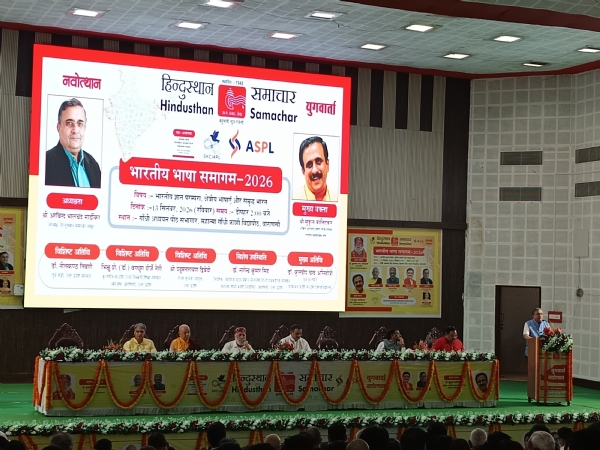
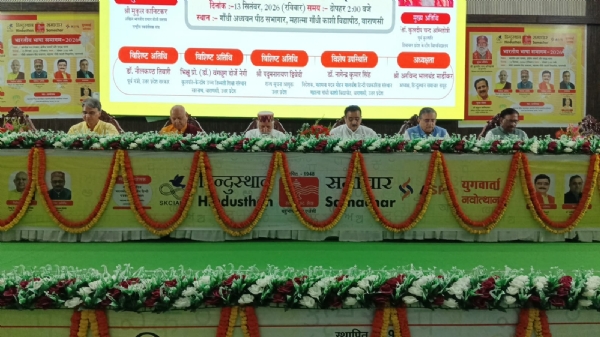
A grand manifestation of this immense potential of Indian languages was witnessed on Sunday in Kashi, one of the world’s oldest continuously inhabited cities. The Bharatiya Bhasha Samagam-2026 was organised by the multilingual news agency Hindusthan Samachar at the Gandhi Adhyayan Peeth auditorium of Mahatma Gandhi Kashi Vidyapith on the theme, “Indian Knowledge Traditions, Regional Languages and a Prosperous India.” The conclave deliberated on integrating the diverse knowledge traditions embedded in Indian languages with the vision of Viksit Bharat and strengthening India’s role in the global knowledge economy.
The conclave was inaugurated jointly by the chief guest, Dr. Kuldeep Chand Agnihotri, former Vice-Chancellor of Central University of Himachal Pradesh; chief speaker Mukul Kanitkar, member of the Akhil Bharatiya Prachar Toli of the Rashtriya Swayamsevak Sangh; distinguished guest Bhikkhu Prof. (Dr.) Wangchuk Dorjee Negi, Vice-Chancellor of the Central Institute of Higher Tibetan Studies, Sarnath, Varanasi; State Information Commissioner Padumnarayan (P.N.) Dwivedi; and Dr. Neelkanth Tiwari, former Minister of Tourism and Culture in the Uttar Pradesh Government. Amid the chanting of Vedic mantras, the guests garlanded and offered flowers at the portrait of Maa Bharati.
The ceremony was presided over by Arvind Bhalchandra Mardikar, Chairman of the Hindusthan Samachar Group. Dr. Rajesh Tiwari, Chief Coordinator and Regional Editor for Uttar Pradesh, Uttarakhand, Bihar and Jharkhand, welcomed the guests. Dr. Nagendra Kumar Singh, Director of the Mahamana Pandit Madan Mohan Malaviya Hindi Journalism Institute, Mahatma Gandhi Kashi Vidyapith, was also present on the occasion. The proceedings were moderated by Jitendra Tiwari, Editor at Hindusthan Samachar.
Kashmir to Kanyakumari: One Knowledge Family
The Bharatiya Bhasha Samagam presented a remarkable portrait of India’s linguistic diversity, in which the distinct identity of individual languages coexisted with the country’s shared cultural consciousness. From Kashmir to Kanyakumari, knowledge streams preserved in different languages converge and connect with one another, collectively contributing to the vast Indian knowledge tradition whose roots stretch back thousands of years.
Bringing languages together means far more than merely exchanging words and literature. In a broader sense, it also means carrying the knowledge, experiences and traditions developed in one region to another. When knowledge available in local and regional languages is integrated with modern technology, digital platforms, education and research, India’s linguistic diversity can evolve into an extensive knowledge network.
The conclave emphasised that Indian languages should not be viewed merely as legacies of the past; instead, they must be transformed into engines of development for the future. Making the knowledge preserved in languages relevant and applicable in contemporary contexts can become an important link in the making of Viksit Bharat.
From Heritage to Knowledge, Knowledge to Innovation, and Innovation to the Economy
The literature, folk wisdom, traditional knowledge, philosophy and lived experiences preserved in Indian languages are not merely cultural treasures. They hold immense potential for contemporary research, innovation and the creation of new knowledge products. The need of the hour is to systematically collect, preserve and integrate this knowledge with modern systems of science and learning.
Artificial intelligence, digital technologies and modern translation systems have opened up new possibilities in this direction. Through these technologies, material available in regional languages can be made accessible to a wider section of society and to audiences across the world. This will not only help reduce linguistic barriers but also bring new dimensions of the Indian knowledge tradition to the forefront.
India’s Emerging Identity in the Global Knowledge Economy
In the global economy of the 21st century, knowledge, talent and innovation have emerged as decisive sources of power. In this context, alongside India’s young talent, its multilingual and multi-layered knowledge traditions constitute a formidable strength. The Bharatiya Bhasha Samagam highlighted a pathway for harnessing this strength and connecting it with the vision of Viksit Bharat.
If India’s linguistic diversity is integrated with education, research, technology and innovation, this diversity can strengthen the country’s distinctive identity and competitive capabilities at the global level. The digitisation of knowledge available in regional languages and its application in contemporary contexts can also play a significant role in expanding India’s intellectual property.
Indian Languages to Become the Knowledge Powerhouse of Viksit Bharat
The central message of the conclave was that merely preserving Indian languages as a legacy is not enough. They must be connected with knowledge, research, technology and the economy. When the knowledge accumulated in Indian languages reaches India and the world through modern technology, these languages, which have long served as carriers of culture, can evolve into powerful engines of knowledge creation.
Connecting the cultural capital embedded in Indian languages with the modern knowledge economy can give a new direction to the intellectual and economic strength of Viksit Bharat. The Bharatiya Bhasha Samagam-2026, organised in Kashi, underscored this immense possibility and presented linguistic diversity not as a weakness, but as a powerful national asset for knowledge, innovation and global leadership.
---------------
Hindusthan Samachar / Jun Sarkar
18 Aug 2026