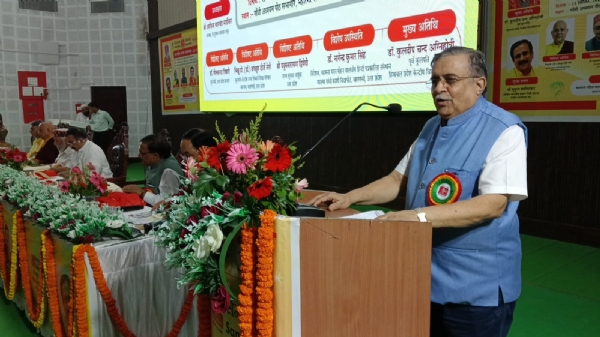
Varanasi/Delhi, 13 September (H.S.): Hindusthan Samachar has made India’s linguistic diversity a strength of its journalism and continues to remain rooted in its “Nation-First” vision, Chairman of the Hindusthan Samachar Group Arvind Bhalchand Mardikar said on Sunday.
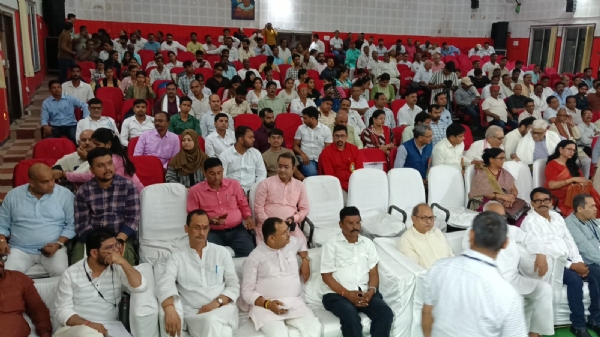
Addressing the Bharatiya Bhasha Sammelan-2026, organised by Hindusthan Samachar on the eve of Hindi Diwas at the Gandhi Study Centre auditorium of Mahatma Gandhi Kashi Vidyapeeth, Mardikar said the news agency provides news in 15 languages, including 14 Indian languages and English.
Speaking on “Indian Knowledge Tradition, Regional Languages, and a Prosperous India”, he said the primary objective of Hindusthan Samachar was to provide accurate and precise information to citizens in their own languages. The organisation’s journey, which began after Independence, has now continued for nearly eight decades, he said.
Mardikar said Indian languages were not merely mediums of communication but carried the country’s knowledge tradition, culture, history and social experience. Hindusthan Samachar had sought to make this linguistic diversity its strength by connecting different linguistic communities through a common information platform.
He recalled that the organisation was founded by Shivram Shankar Apte with the objective of providing correct information to citizens in their own languages, with Swatantraveer Vinayak Damodar Savarkar among its sources of inspiration.
Referring to the agency’s evolution, Mardikar highlighted its role during important events, including the 1962 China War, and the introduction of teleprinters in Devanagari. He also recalled the difficulties faced by the organisation during the Emergency and the financial crisis that followed, before its subsequent revival after a legal battle.
Mardikar said Hindusthan Samachar was now working to expand its presence beyond India. He said efforts were underway to strengthen international ties, including work with a Russian news agency and discussions with a Japanese agency. He also said the organisation hoped to explore opportunities associated with BRICS.
He said Prasar Bharati, Doordarshan, news portals and around 350 newspapers were among those using Hindusthan Samachar’s services. The organisation has also expanded its digital presence and publishes the Hindi monthly magazine “Indian Culture” and fortnightly “Yugvarta”.
Mardikar called for journalism to expand beyond politics and crime and give greater space to education, culture, social work, innovation, art and development. He also urged the younger generation to engage with India’s history and knowledge tradition.
He said Hindusthan Samachar still had a long journey ahead, with its objective remaining credible journalism while keeping the nation first.
Hindusthan Samachar / Abhishek Awasthi
18 Aug 2026