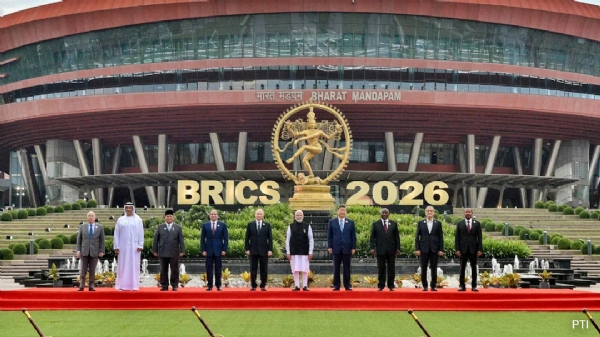
NEW DELHI, Sept 13 (H.S.) — The 18th BRICS Summit, held under India’s leadership, provided an avenue for dialogue and diplomacy among opposing parties involved in ongoing global conflicts across the Globe.
The summit in India’s capital, New Delhi, saw the presence of top leadership from countries engaged in active conflicts or disputes: Iran and the United Arab Emirates (UAE) from the West Asia region, China and the Philippines from East Asia, as well as Egypt and Ethiopia from Africa. These are among the 60 major or minor conflicts going around the world.
Amid heightened tensions in West Asia, a meeting held last night on the sidelines of the summit between Iranian President Masoud Pezeshkian and the Crown Prince of Abu Dhabi, Sheikh Khaled bin Mohamed bin Zayed Al Nahyan, is being viewed as globally significant. The Iranian Embassy confirmed this bilateral meeting on social media. This marks the first high-level meeting between the leadership of both nations since the escalation of the West Asia conflict. Additionally, informal discussions took place among leaders from China, the Philippines, Egypt, and Ethiopia.
Notably, this meeting between the President of Iran and the Crown Prince of Abu Dhabi comes amid reports that Iran is planning discussions with Iraq and members of the Gulf Cooperation Council (GCC) regarding transit through the Strait of Hormuz. A major source of tension between Iran and the UAE remains a decades-old sovereignty dispute over three strategic islands in the Persian Gulf—Abu Musa, Greater Tunb, and Lesser Tunb. Furthermore, regional competition persists over the UAE's normalization of ties with Israel via the Abraham Accords and their support for opposing factions in the Yemeni civil war. This interaction raises hopes for opening pathways toward peace and the safe passage of commercial vessels through the Persian Gulf and the Strait of Hormuz.
Diplomatic analysts believe that the greatest strength of India's diplomatic style has emerged as its policy of multi-alignment. Bringing strategically opposing nations onto a shared platform and creating a conducive environment for dialogue has become a hallmark of Indian foreign policy. This dynamic was on display during the BRICS Summit in New Delhi, where leaders of nations with conflicting interests and sharp regional tensions met face-to-face.
This is not the first time India has facilitated such a diplomatic platform amid global tensions. Earlier, in March 2023, during the G20 Foreign Ministers' Meeting, India demonstrated its diplomatic neutrality and strategic balance by bringing U.S. Secretary of State Antony Blinken and Russian Foreign Minister Sergey Lavrov under one roof despite intense global friction over the Russia-Ukraine war.
The joint presence of top leaders from China and the Philippines at the BRICS venue also drew international attention amid ongoing tensions in the South China Sea. The Philippines was represented at the 18th BRICS Summit by President Ferdinand Marcos Jr., who arrived in India leading a high-level delegation that included Secretary of Foreign Affairs Maria Theresa P. Lazaro. The Philippines is not a permanent member of BRICS; it attended the summit as an 'Outreach Country' and in its capacity as the Chair of ASEAN.
The primary dispute between China and the Philippines centers on sovereignty over maritime features such as Second Thomas Shoal and Scarborough Shoal. China asserts sweeping claims over nearly the entire South China Sea based on its 'nine-dash line' map, whereas the Philippines rejects these claims, citing the 2016 international arbitral tribunal ruling.
Similarly, despite their ongoing dispute over the sharing of Nile River waters, top leaders from two major African nations—Egypt and Ethiopia—attended the summit in Delhi. Egyptian President Abdel Fattah el-Sisi and Ethiopian Prime Minister Dr. Abiy Ahmed Ali arrived to represent their respective governments.
Both nations became full members of BRICS in January 2024. The core of their dispute is the massive Grand Ethiopian Renaissance Dam (GERD) constructed by Ethiopia on the Nile River. Egypt, which relies on the Nile for over 90 percent of its water needs, views the dam as an existential threat to its national security, while Ethiopia considers the project essential for its economic development and energy capacity.
Amid these complex and historical disputes, the BRICS Summit and its side-line informal meetings offered a rare opportunity for opposing parties to convene and deliberate. Through this successful hosting, India has once again demonstrated its capability to bring the Global South and emerging global powers onto a neutral and trusted platform despite deep geopolitical differences.
---------------
Hindusthan Samachar / Sachin Budhauliya
18 Aug 2026