New Delhi, 13 September (H.S.): BRICS leaders have called for the preservation of cultural heritage, including the protection of cultural heritage in conflict-affected areas. They also stressed the need for the repatriation to their countries of origin of antiquities as well as objects of spiritual, ancestral, historical and cultural significance.
In the ‘New Delhi Declaration’ adopted on the first day of the two-day BRICS Summit being hosted under India’s chairmanship, the grouping also welcomed the adoption of the Bhopal Declaration at the 11th Meeting of BRICS Ministers of Culture. The declaration reaffirmed the important role of culture in strengthening people-to-people cooperation and deepening ties among member states.
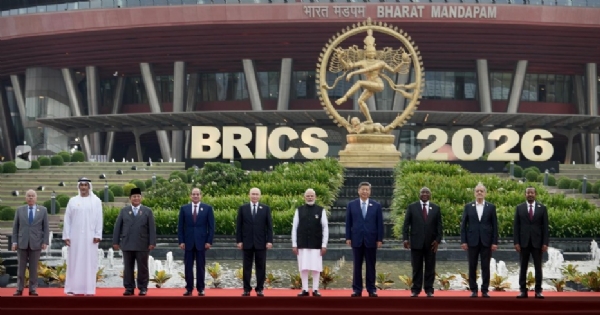
Prime Minister Narendra Modi announced the adoption of the declaration at the conclusion of the first day’s deliberations. Chinese President Xi Jinping, Russian President Vladimir Putin, Iranian President Masoud Pezeshkian, Abu Dhabi Crown Prince Mohamed bin Zayed Al Nahyan and other senior leaders of the grouping were present on the occasion.
The declaration states, “We call for the preservation of cultural heritage in all areas, including conflict-affected regions, in order to prevent the destruction and illicit trafficking of cultural property. This is important for preserving the history and identity of affected communities. At the same time, we emphasise the need to return cultural heritage, antiquities, and objects of spiritual, ancestral, historical and cultural significance to their countries of origin.”
The leaders also called for promoting cooperation among BRICS countries through the exchange of information and documentation, as well as institutional collaboration among museums, archives, libraries and other relevant cultural institutions.
The New Delhi Declaration states, “We encourage the exchange of information and sharing of best practices in the cultural and creative industries, including in the areas of training and capacity building for artists and professionals engaged in the cultural sector.”
Encouraging Opportunities
The declaration states, “We encourage exploring the possibilities of joint multinational nominations on a voluntary basis under relevant UNESCO conventions and programmes. We encourage further cooperation among BRICS countries, including through relevant multilateral platforms, for the development of cultural industries and resources.”
Member states welcomed the organisation of the BRICS Culture Festival and the ‘WAVES Bazaar’.
BRICS Member Countries
BRICS comprises Brazil, Russia, India, China and South Africa. The grouping expanded in 2024 with the inclusion of Egypt, Ethiopia, Iran, the United Arab Emirates and Saudi Arabia. Indonesia joined the grouping in 2025. Belarus, Bolivia, Kazakhstan, Cuba, Malaysia, Nigeria, Thailand, Uganda, Uzbekistan and Vietnam became BRICS partner countries last year.
Two Decades, Two Commemorative Postage Stamps
It may be noted that two commemorative postage stamps were released on September 12 during the 18th BRICS Summit at Bharat Mandapam in New Delhi to mark two decades of BRICS. Both stamps also reflect the priorities of India’s BRICS chairmanship in 2026, under the theme: “Building for Resilience, Innovation, Cooperation and Sustainability.”
One of the stamps depicts the emergence of BRICS as a platform founded on mutual respect, understanding and solidarity, while the other showcases India’s vision and logo for its chairmanship, centred on the principles of “Humanity First” and a “People-Centric” approach.
---------------
Hindusthan Samachar / Jun Sarkar

18 Aug 2026