Prayagraj, 12 Sept (HS): Speaking on the concluding day of
the two-day International Seminar on Indigenous Knowledge Traditions (September
11-12, 2026) held at Ishwar Sharan PG College, Prayagraj, Prof. Shweta Prasad,
Member of the Executive Council of Banaras Hindu University (BHU) and
Chairperson of the Department of Sociology, stated that reviving indigenous
knowledge is not an exercise in historical nostalgia, but an imperative for
sustainable development, ecological survival, and social justice. She stated
that India's academic world needs to engage with indigenous peoples at the
level of their lives, cultures, and values to rediscover indigenous knowledge
systems. This work has grown rapidly in the fields of social sciences and
humanities in recent years.
Speaking at the closing session, Prof. Yogendra Pratap
Singh, Director, Govind Ballabh Pant Institute of Social Sciences, said that
the Indian knowledge tradition is actually the indigenous or indigenous
knowledge tradition, and the vision of the National Education Policy 2020
includes that the indigenous knowledge tradition and its creation should be
made a part of the education system, curriculum and pedagogy.
Delivering the presidential address at the closing session,
College Principal Professor Anand Shankar Singh raised the question, Can
we revive indigenous knowledge traditions using government databases,
university libraries and laboratories, or modern technologies? The answer
is no. He outlined the way forward, asking, How will this
revival happen? To do so, we must go back to the very ground where it
originated, where it is preserved, the language in which it was named, and the
communities that are accustomed to living with it.
But we have to transfer this knowledge tradition into the
hands of those young people who, instead of transforming it exactly, should
recreate it by making slight modifications as per the times and needs; this is
actually the revival of indigenous knowledge.
On the second day of the seminar, the first plenary session
was chaired by R. Shiva Prasad, former Professor, Department of Anthropology,
University of Hyderabad. Professor B.K. Nagla, Professor of Sociology, MD
University, Rohtak, and Professor S.N. Chaudhary, former Tagore National Fellow
and a renowned sociologist of the country, gave their research and scholarly
presentations on indigenous knowledge traditions, sustainable development and
environmental heritage.
The third plenary session of the seminar was chaired by
Prof. Manish Kumar Verma, former Dean, Ambedkar School of Social Sciences, Baba
Saheb Bhimrao Ambedkar University, in which Prof. Pramod Kumar Shukla, Indian
Council of Sociology, Dr. Sumit Saurabh Srivastava, Associate Professor, Centre
for Development Studies, Allahabad University, Dr. Manish Mishra, Senior
Fellow, Indian Council of Social Science Research, and Dr. Umesh Chandra,
Assistant Professor, Department of English, Allahabad University enriched the
seminar with their research interventions on decolonization of knowledge
traditions.
On the second day of the seminar, the online international
plenary session was chaired by Associate Professor Man Bahadur Khatri,
Department of Anthropology, Tribhuvan University, Kathmandu, in which Prof.
Elisabetta Marino, Department of English, University of Rome, Dr. Sayan Dey,
Assistant Professor, Department of English, Bayan College, Oman, and Dr.
Priyanka Dutta, Assistant Professor, Department of English, Mount Carmel
College, Bengaluru, made academic contributions to the seminar with their
research papers.
The second online international plenary session was chaired
by Professor Diana J. Fox of the Department of Anthropology, Bridgewater State
University, USA, and featured Dr. Eugenia Flynn, Assistant Professor,
Department of Languages, Monash University, Australia, Flix Padel, an academic
from the UK, and Professor Andrew Davis, Director of the Edward Cadbury Centre,
University of Birmingham, on the datafication of living knowledge traditions,
Aboriginal literature, and patterns of development.
On the final day of the seminar, social scientists and
researchers from across the country presented a total of 150 research papers in
two parallel technical sessions. Rawat Publications of Jaipur, Lokbharati and
Rajkamal Publications of Allahabad, and Samvad Publications of Meerut also
organized exhibitions of research and reference books in the fields of
literature and social sciences.
On this occasion, Dr. Ankit Pathak, Assistant Professor in
the Department of Political Science, presented a brief report on the two-day
international seminar. He reported that a total of 700 research papers were
presented online and offline during these two days. The closing session was
moderated by Dr. Ragini Rai, Assistant Professor in the Department of Ancient
History, Culture, and Archaeology. The vote of thanks was delivered by Dr.
Vikas Kumar, Coordinator of the Seminar, Coordinator of the Center for Tribal
Studies, and Assistant Professor in the Department of Sociology.
Hindusthan Samachar / Abhishek Awasthi
18 Aug 2026
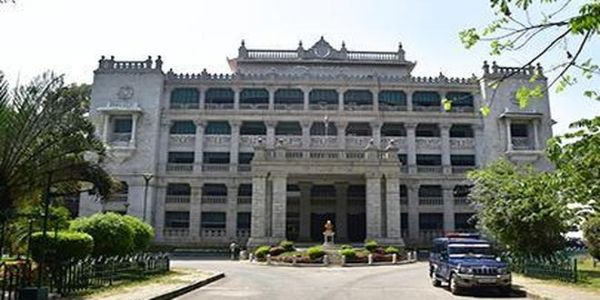
ED raids KPSC office, 20 other locations over Karnatak veterinary recruitment scam
ED raids KPSC office, 20 other locations over Karnatak veterinary recruitment scam..