Immense potential for textile industry in Uttar Pradesh: Deputy
Chief Minister Brajesh Pathak
On conclusion of UPTEX-2026, Deputy Chief Minister calls upon industry
and investors to increase investment in state
Industrial clusters for handlooms, technical textiles,
protective and defence textiles and sports goods, modern testing labs and
emphasis on skill development
Uttar Pradesh becoming major destination for technical and
defence textiles: Rakesh Sachan
Lucknow, 10 Sept (HS): The Yogi government is continuously taking
concrete steps to develop Uttar Pradesh as the country's leading textile and
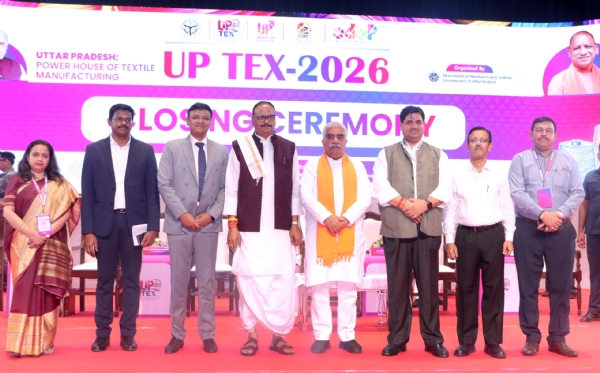
apparel manufacturing center. In this sequence, the two-day UPTEX-2026
organized in the same sequence concluded with great pomp in the Jupiter Hall of
Indira Gandhi Pratishthan, Gomti Nagar, Lucknow. Deputy Chief Minister of the
state Brajesh Pathak was present as the chief guest in the closing ceremony,
while Handloom and Textile Industry Minister Rakesh Sachan was present with
great respect. On this occasion, Letters of Comfort, cheques for financial
incentives and MoUs were exchanged with various industrial units.
On the second day of the program, various high-level sessions
were held on sports textiles, sports goods, protective and defense textiles,
handicraft exports, and Textile Policy 2027. Industry experts, investment
promotion organizations, senior officials from the Government of India and the
Government of Uttar Pradesh, and entrepreneurs participated in these sessions
and shared ideas on strategies to make the state a leader in the textile and
technical textiles sectors.
At the closing ceremony, Deputy Chief Minister Brajesh Pathak
said that Uttar Pradesh is a state with immense potential, and under the
leadership of the Yogi government, every sector is progressing rapidly. The
textile industry is also poised to become an important pillar of the state's
development. Textiles are a basic necessity for human life, and over time, this
sector has undergone extensive technological changes. Today, textiles are also
being produced from natural resources like bamboo. He described the discussions
and various sessions held at UPTEX-2026 as a milestone for Uttar Pradesh's
textile industry.
The Deputy Chief Minister said that Uttar Pradesh has a rich
tradition of handloom, but previously, weavers lacked adequate markets,
resources, subsidies, and government protection. The Yogi government has
revitalized the handloom and textile sectors through new policies, incentives,
subsidies, concessions, and a single-window system. As a result, major industrial
companies are coming forward to invest in Uttar Pradesh. He said that any
industry brings with it employment opportunities. Students in the textile
sector are gaining education and skills at NIFT and various training institutes
in the state. These young people can establish their own industries in the
future and advance their lives by finding employment in the large industries
being established in the state. The Yogi government is continuously providing
opportunities to advance the state's youth.
Deputy Chief Minister Pathak said that Uttar Pradesh's
population of approximately 250 million provides a large market. A large
quantity of textiles comes into the state from outside, increasing
transportation costs. Promoting textile production within the state could not
only meet the needs of the local market but also increase the reach of Uttar
Pradesh-made textiles in national and international markets. He urged
industrialists from India and abroad to invest in Uttar Pradesh and take
advantage of the state's industrial policies.
The Deputy Chief Minister said that Uttar Pradesh is playing a
key role in fulfilling Prime Minister Narendra Modi's vision of a developed
India. Under the leadership of the Yogi government, the state is rapidly
advancing in the areas of infrastructure, industry, and investment. In the
textile sector, too, new possibilities are being realized through continuous
dialogue between the government and industry.
Citing the Uttar Pradesh government's industrial policies and
the investment-friendly environment being developed under the Chief Minister's
leadership, Handloom and Textiles Minister Rakesh Sachan said the state is
emerging as a leading destination for the technical textiles and defense
textiles industries in the country. He detailed schemes such as capital grants,
employment generation incentives, training assistance, and research and
development support.
Discussion on the potential of Uttar Pradesh in the field of sports
textiles and sports goods: On the second day of UPTEX-2026, a key session was
held on the topic Game Plan UP: Building India's Sports Textile and
Sports Goods Powerhouse. Prashant Ramesh, Production Process Leader,
Decathlon, moderated the session. He stated that post-COVID, sports activities
have become an integral part of lifestyle, and India, especially Uttar Pradesh,
has the potential to become a major hub for global sports textile and sports
goods manufacturing.
Describing Meerut's sports goods industry, Kanpur's footwear
industry and Noida's apparel production system as the major strengths of the
state, he stressed on the need for synthetic fibres, testing laboratories,
plug-and-play clusters, R&D centres and skill development.
Rajesh Kumar, Managing Director of Trackways, stated that
state-of-the-art testing laboratories, Zero Liquid Discharge (ZLD)-based
clusters, and advanced processing infrastructure are needed to strengthen the
sports and technical textile industry. He added that despite the availability
of quality yarn, the lack of modern processing facilities holds the Indian
industry back from global competition, especially against China.
Manoj Chaudhary, Founder and Managing Director of Heka Fashions,
said that the global market for seamless garments and technical sportswear is
growing rapidly and plays a vital role in improving athlete performance. He
explained that seamless technology is still in its infancy in India, and the
lack of high-quality polyamide and polyester-based processing infrastructure is
hindering its progress. He stressed the need to establish integrated
plug-and-play facilities and modern processing units.
Dharmendra Narula, Director of Guru Kripa Enterprises, praised
the changing industrial climate in Uttar Pradesh, stating that confidence and
innovation are fundamental to success in any field. Citing China's sports
industrial model, he stressed the need to develop dedicated clusters for the
sports industry in Uttar Pradesh, providing a complete supply chain from raw
materials to finished products. He also praised the state government's
industry-friendly environment, security, and incentive schemes.
Discussion on the potential of Uttar Pradesh as a national hub
for protective and defence textiles: Dr. M.S. Parmar, Director General of
NITRA, moderated the session on Shield UP: Building a National Center for
Protective and Defense Textiles. He outlined 12 key areas of technical
textiles, explaining that protective textiles are used in numerous areas
related to defense, firefighting, chemical safety, nuclear safety, and law and
order. He highlighted the Center of Excellence and advanced testing facilities
available at NITRA and urged the industry to take advantage of them.
Prerna Sharma, ACEO of Invest UP and an IAS officer, said that
technical and defense textiles are not limited to the textile industry alone,
but are a vital tool for technological, defense, and strategic self-reliance.
Citing the Uttar Pradesh Defense Corridor, research and testing infrastructure,
and the potential for foreign technical collaboration, she emphasized the need
to adopt a global approach to attract investment.
Rakesh Gupta, General Manager, MKU Limited, shared the journey
of indigenous manufacturing in the Indian defense sector, noting that MKU has
played a key role in producing specialized snow boots, lightweight composite
armor, and ballistic protection equipment for the Indian Army. He emphasized
that world-class quality, participation in international exhibitions, strong
branding, and skilled human resources are essential for success in the global
market. Industries should train local youth to create a global workforce.
UKS Director Kumar Abhishek stated that Uttar Pradesh and Bihar
are key sources of human resources for the country's industrial growth. A large
number of skilled workers could return to their home states if adequate
employment opportunities and appropriate wages were available. He highlighted
the potential for self-reliance in parachute fabric, high-altitude garments,
and other technical textiles and suggested developing specialized training
programs in collaboration with industry-based skill development, the National
Technical Textiles Mission, and higher education institutions.
Bhaskar Kalra, a senior official with the Ministry of Textiles,
Government of India, described the technical textiles sector as a
high-value-added and rapidly growing sector of the textile industry. He noted
that demand for technical textiles is steadily increasing in sectors such as
healthcare, defense, infrastructure, and transportation. He outlined various
initiatives by the Government of India for research, innovation,
standardization, skill development, and industry promotion under the National
Technical Textiles Mission.
Experts suggest measures to make Uttar Pradesh a global textile
hub: During panel discussions, experts offered several key suggestions for
making Uttar Pradesh a global hub for sports, protective, and defense textiles.
These included the establishment of dedicated industrial clusters for sports
and technical textiles, the development of advanced testing laboratories and
research centers, the creation of a complete industrial ecosystem for synthetic
fibers and technical textiles, greater coordination between the Defense
Corridor and the textile industry, the encouragement of global technology
partnerships and foreign investment, and the expansion of skill development,
training, and industry-based education programs.
Emphasis was also placed on promoting export-oriented production
based on high quality and global standards. Speakers expressed confidence that
through the combined efforts of the Uttar Pradesh government, industry,
educational institutions, and research organizations, the state will emerge as
a national and global hub for sports textiles, technical textiles, and protective
and defense textiles in the near future.
UPTEX-2026 will prove to be a boost for investment, employment
and exports: Through UPTEX-2026, the state's entire textile and apparel
industry, as well as emerging sectors such as technical textiles, sports
textiles, and protective and defense textiles, were discussed extensively. The
program placed special emphasis on strengthening coordination between the
government, industry, investors, training institutions, and research
organizations.
The exchange of Letters of Comfort, checks for financial
incentives, and Memorandums of Understanding (MoUs) with industrial units at
the event marked important initiatives in this direction. This has further
strengthened the state's prospects for investment, the establishment of
industrial units, employment generation, and export promotion.
The event was attended by several senior officials, industry
representatives, and dignitaries, including K. Vijayendra Pandian, Director of
the Department of Handlooms and Textiles, Seshamani Pandey, Special Secretary,
and Chandrima Chatterjee, General Secretary of the Confederation of Indian
Textile Industry (CITI). The program concluded with a vote of thanks, marking
the formal conclusion of the successful and historic UPTEX-2026.
Hindusthan Samachar / Abhishek Awasthi
18 Aug 2026
ED raids KPSC office, 20 other locations over Karnatak veterinary recruitment scam
ED raids KPSC office, 20 other locations over Karnatak veterinary recruitment scam..