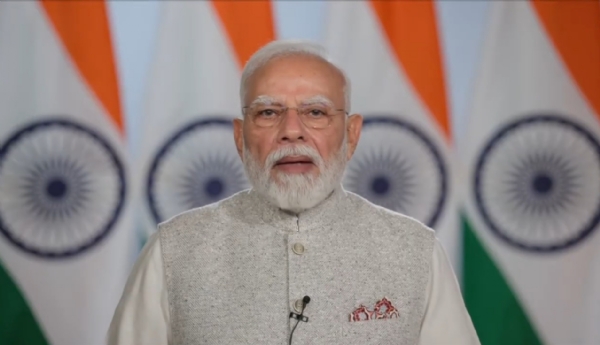
New Delhi, 10 September (H.S.): Amid rapidly expanding activities in outer space, Prime Minister Narendra Modi on Thursday called upon the global community to prioritise cooperation, sustainability and inclusiveness. He said that orbital space was becoming increasingly crowded, technologies were growing more powerful and the number of participants in the space sector was steadily increasing. In such circumstances, the world must choose cooperation over concentration, sustainability over short-term gains and inclusion over exclusion, he said.
Addressing the first International Space Summit in Paris through a video conference on Thursday, Prime Minister Modi said India supports a safe, secure, peaceful and sustainable space environment. Such an order, he stressed, should be founded on international law, dialogue and multilateral cooperation.
Modi said India’s approach to space is rooted in the spirit of “Vasudhaiva Kutumbakam” — one Earth, one family and one future. He said this philosophy should now extend beyond Earth into outer space as well.
Space has inspired human imagination for centuries, the Prime Minister said, but today its technologies are also playing an increasingly important role in improving and protecting life on Earth. Space-based technologies are being widely used for applications ranging from climate and crop monitoring to the observation of oceans and the well-being and security of communities.
The Prime Minister also outlined India’s long-term ambitions in space. He said India aims to establish its own space station by 2035 and send an Indian astronaut to the Moon by 2040. He emphasised that a clear guiding principle behind these efforts is that the benefits derived from space should reach all of humanity.
Highlighting the achievements of the Indian Space Research Organisation (ISRO), Modi said the organisation had earned a global reputation for excellence and cost-effective space missions. ISRO’s technologies are being used to support farmers and fishermen, improve weather forecasting, strengthen disaster management and provide navigation services, among other applications.
The Prime Minister said more than 430 satellites belonging to 34 countries had already been launched into space on Indian rockets, underlining India’s growing contribution to the global space ecosystem.
Referring to India’s major space missions, Modi said Chandrayaan-3 made India the first country to land near the Moon’s southern polar region. He also highlighted the Aditya-L1 mission, which is helping scientists deepen their understanding of the Sun and its various phenomena.
Modi further noted that an Indian astronaut had travelled to the International Space Station last year, describing it as another significant milestone in India’s expanding human spaceflight capabilities.
The Prime Minister also highlighted the rapid growth of India’s private space sector. He said the country’s entrepreneurial energy was increasingly combining with ISRO’s scientific excellence, creating new opportunities for innovation and expansion in the space economy.
Describing France as a trusted space partner for India, Modi said cooperation between the two countries was advancing across several areas, including Earth observation and advanced space technologies. He emphasised the importance of strengthening this partnership as both countries pursue new frontiers in space.
Calling upon France and other countries around the world to become partners in India’s next phase of space exploration, Modi said humanity must work together to explore, innovate and protect outer space for the benefit of present and future generations.
Hindusthan Samachar / Jun Sarkar

18 Aug 2026