गङ्गे च यमुने चैव गोदावरी सरस्वति।
नर्मदे सिन्धु कावेरी जलेऽस्मिन् सन्निधिं कुरु॥
Gange cha Yamune chaiva Godavari Saraswati ।
Narmade Sindhu Kaveri jalesmin sannidhim kuru॥
This mantra, recited daily in Indian households, is essentially a proclamation of a civilization that viewed rivers not as mere resources but as a mother; that regarded water not as a commodity but as life itself; and that connected the Ganga not just to the flow of water, but to the very ethos of its culture. Therefore, when someone dismisses the Ganga as merely flowing water, or argues that there is no law against eating chicken on the banks of the Ganga, the debate transcends the issue of food or arrests; it becomes a question of dialogue between India's cultural consciousness and its modern legal perspective.
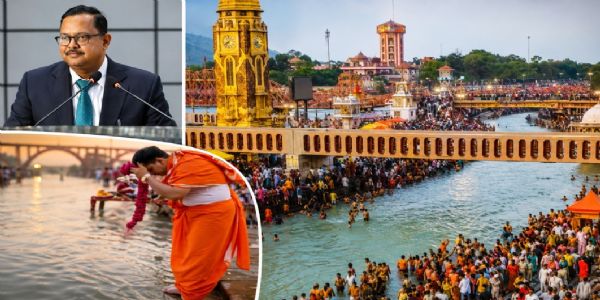
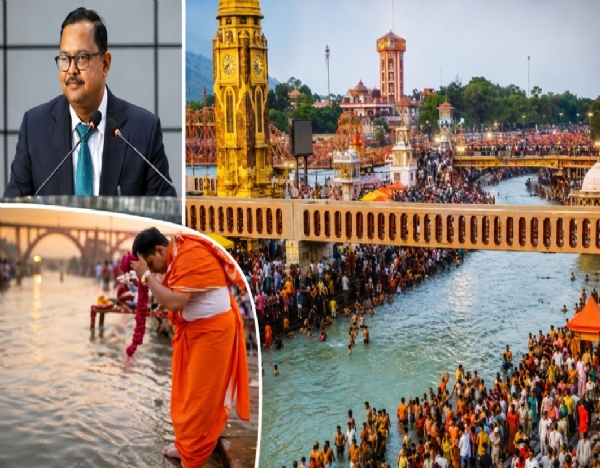
While referring to the Varanasi incident, where youths were arrested for breaking their fast (Iftar) with chicken biryani on the banks of the Ganga, Supreme Court Justice Ujjal Bhuyan advocated for the protection of personal liberty and freedom of expression. One could say he indirectly sought to put the UP government's police functioning and Chief Minister Yogi Adityanath in the dock over this issue. Law students listening to him might well accept his views as absolute truth, swayed by the weight of his office and stature! Yet, there is another side to this truth: does the Indian Constitution provide license to trifle with people's sentiments and faith?
Undoubtedly, this concern is significant in a democracy. A citizen's liberty should not be unnecessarily curtailed; however, the question remains: can the sanctity of a holy site be judged solely by the presence or absence of a penal law regarding it? Does that mean one is free to do whatever one pleases, such as dumping leftover food into the insacred waters revered by millions?
Just imagine how distressing this scene appears when you are a vegetarian who holds the river sacred, only to witness people consuming meat right over that very river and then discarding the remains into its holy waters. Here, such an act is being committed, while elsewhere, someone is sipping that same water with deep reverence, reciting the sacred 'purification mantra':
अपवित्रः पवित्रो वा सर्वावस्थां गतोऽपि वा ।
यः स्मरेत्पुण्डरीकाक्षं स बाह्याभ्यन्तरः शुचिः॥
Apavitrah pavitro va sarvavastham gato’pi va।
Yah smaretpundarikaksham sa bahyabhyantarah shuchih॥
That is, while chanting the names of Keshav, Narayana and Madhav three times alongside this mantra, they partake of the water. Consider this: can the person drinking this holy (Pavitra) water, after seeing videos of such meat consumption, retain the same sense of sanctity with which they had come to the Ganges for purification? Furthermore, many devotees collect this water in bottles to keep in their home shrines; in light of these circumstances and the associated imagery, is that water still fit to be kept in a place of worship? Naturally, the Hindu consciousness of India answers this question with a resounding no.
Laws govern society, but culture keeps society alive
If only someone would explain to Justice Ujjal Bhuyan that civilizations do not rest solely on the clauses of a constitution; they are also built upon shared memories, symbols, and faith. If the law were the absolute truth, concepts like ‘Maryada’ (propriety or dignified conduct) would not exist. People instinctively exercise restraint when entering a courtroom. They show respect for the national flag. They do not laugh loudly at memorials dedicated to martyrs. None of these actions require the constant presence of the police or the penal code.
The motto Yato Dharmastato Jayah (Where there is righteousness, there is victory) is inscribed beneath the emblem of the Supreme Court of India, because society is guided not merely by fear, but also by ‘Sanskars’ (cultural values and upbringing). In precisely the same way, the ghats of the Ganges are as sacred as temples to millions of people. Conduct there is not determined solely by legal provisions; cultural norms also play a significant role in defining it.
The Ganga: A Civilization Flowing Through India's Veins
The history of the Ganga begins with the Vedas. She is invoked in the ‘Nadi Sukta’ of the Rigveda. In the Valmiki Ramayana, she is the fruit of Bhagiratha’s penance. In the Mahabharata, she is the mother of Bhishma. The Vishnu Purana refers to her as ‘Vishnupadi’. The Skanda Purana makes an explicit declaration:
गङ्गा गङ्गेति यो ब्रूयाद् योजनानां शतैरपि।
मुच्यते सर्वपापेभ्यो विष्णुलोकं स गच्छति॥
He who utters 'Ganga, Ganga'- even from a distance of hundreds of ‘yojanas’, is absolved of all sins and attains the abode of Vishnu.
In Indian tradition, Ganga water is the one water kept in a vessel in every Hindu household. It is sprinkled during birth rituals. Marriage vows are taken in her presence. At the moment of death, it is the final drop one desires. Indeed, to call a river that accompanies a human from birth to death merely water is to deny the very realm of sentiment in which India has breathed for millennia.
Bhagwan Krishna himself has described the Ganga as one of his divine manifestations (Vibhuti). In the Shrimad Bhagavad Gita, Bhagwat Krishna says, Srotasam-asmi Jahnavi (Gita 10.31)- meaning, Among rivers, I am Jahnavi, that is, the Ganga. This statement undoubtedly establishes the Ganga as the supreme embodiment of divinity. Thus, if Indian society holds the Ganga in such extraordinary reverence, it is grounded in a philosophical tradition spanning thousands of years. Former Prime Minister Jawaharlal Nehru also bowed in reverence before the Ganga; in his will, he wrote, The Ganga is India's river... our racial memories, our hopes, our fears, our victories and our defeats are intertwined with it.
Although Nehru was a proponent of modern scientific thought, he too recognized the Indian consciousness reflected in the Ganga. While Nehru may face criticism on various fronts regarding his policies and other matters, his stance on the Ganga remained unequivocal: it is a sacred river and no one has the right to desecrate it.
If figures such as Nehru, Swami Vivekananda, Adhya Guru Shankaracharya, Sant Tulsidas, mahatma Kabir and Gandhi ji all regard the Ganga as the cultural axis of Bharat, the question arises: is there sufficient room for this cultural truth within modern legal discourse?
The Right to Freedom and the Obligation of Sensitivity
Democracy grants rights, but it also attaches responsibilities to them. Freedom of expression does not imply the disregard of society's deeply held beliefs. While the Constitution grants rights to citizens, it simultaneously expects every citizen to respect India's rich cultural heritage. This is why conduct at a religious (Dharma) site is not merely a matter of personal preference; it is linked to the collective interest.
Justice Bhuyan himself stated in a lecture that the true power of the judiciary lies neither in wealth nor in the sword, but in the trust of the people. Indeed, this principle applies aptly to the present context. Public trust is built not only through legal wisdom but also through the perception that the judiciary understands societal sentiments. The Indian judicial system will command greater respect only when it accords equal regard to India's cultural consciousness and pride alongside the letter of the Constitution.
To truly understand India, it is best to first understand the Ganga
The greatest irony today is that we have begun to view India solely through the prisms of law, economics and politics, whereas India’s true identity lies in its civilization. The Ganga traverses a journey of 2,525 kilometers across the country. Flowing from the Himalayas to the sea, she embodies a cultural consciousness that binds together North and South, East and West, diverse languages and castes-villages and cities into a unified whole.
It is worth noting that no law mandates touching a mother’s feet, yet Indians do so. Similarly, no statute requires one to bow before the Tricolour (Tiranga), yet patriotism compels such an act. In the same vein, reverence for the Ganga does not stem from any penal code; rather, it arises spontaneously from the Indian consciousness.
It would be beneficial for Justice Ujjal Bhuyan to deeply study the symbols of faith and the traditions of this land in order to understand India in its true sense. Undoubtedly, as Justice Bhuyan engages in this study, he will realize that India is not governed merely by the articles of the Constitution; among the many forces shaping the nation, the Ganga represents a vital current, one that flows through every Hindu home and heart across the country.
---------------
Hindusthan Samachar / Mayank Chaturvedi