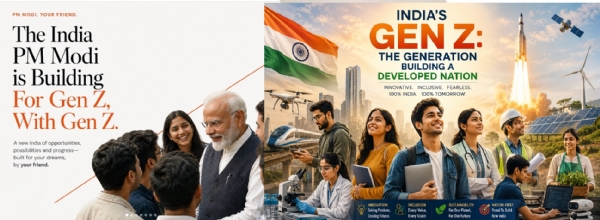
-India’s Gen Z: The Generation Building a Developed Nation
The biggest mistake being made today regarding India's youth is equating a small fraction of them with the entire generation. During the protests at New Delhi's Jantar Mantar concerning the National Eligibility cum Entrance Test (NEET), instances of abusive language and inappropriate behavior by some youths came to light. This is certainly a matter of concern and such conduct cannot be condoned in any civilized society. However, it would be an even greater error to regard those few thousand youths as representatives of India's entire Gen Z population.
The reality is that there are approximately 380 million Gen Z individuals in India, whereas the number of youths physically present at Jantar Mantar ranged between five thousand and ten thousand. In other words, this figure represented merely 0.0013 to 0.0026 percent of the country's total Gen Z population. While this percentage is too negligible to define the character of the entire generation, it is crucial to understand the psychology behind this seemingly insignificant number and its broader societal impact.
This can be understood through a simple example. If a small boil appears on a healthy body, it causes immense distress to the entire system, despite being minuscule in comparison to the body's overall size. Most people have experienced a painful boil (such as an abscess caused by an ingrown hair); if left untreated, it causes suffering to the whole body. A prudent person does not ignore such a boil but treats it promptly to maintain the body's overall health. Precisely this perspective needs to be adopted regarding India's Gen Z today.
It must be said that a nation, too, is like a living organism. If a deformity appears in any part of the body, it must be treated; however, the healthy and robust parts should not be neglected. To keep the body of the nation healthy, one must sometimes accept the bitterness of neem, the taste of bitter gourd and the medicinal properties of amla. This is precisely the role of values, discipline, dialogue and positive leadership within society.
The concern today is not that India's entire Gen Z is going astray; rather, the challenge lies in ensuring that the distortions visible in certain pockets are treated in time, preventing them from turning into a widespread social contagion. After all, there are millions of young people who are quietly contributing to nation-building every day without seeking publicity. Some stand guard at the borders, others develop new technologies in laboratories, some conduct research to boost agricultural productivity, while others raise the Tricolour high on sports fields; some create startups that provide employment to thousands and others engage in social service in remote villages. The reality is that the true face of India's Gen Z is reflected in these millions of young people.
The Privilege of Possessing the World's Largest Youth Force
India currently boasts the world's largest youth population. The estimated number of Gen Z individuals, those born between 1997 and 2012, ranges from 377 million to 380 million, constituting approximately 26 to 28 percent of the country's total population. If one considers the broader youth age bracket, this figure is even higher. Looking at both the present and the future, this generation is poised to shape the trajectory of India’s economy, science, technology, industry, security, culture and global leadership over the next two decades. Whether in the armed forces, sports, science, startups, technical research, voluntary organizations or social innovation, the immense energy of Gen Z is clearly visible.
The New Generation's Resolve in Border Security
Gen Z is playing an increasingly significant role in India's security apparatus. All 'Agniveers' recruited under the 'Agnipath Scheme' belong to this generation. Every year, approximately 45,000 to 50,000 young people join the Indian Army through this scheme, shouldering the responsibility of national defense. It is estimated that 20 to 25 percent of the Indian Army's 1.24 million active-duty soldiers belong to Gen Z. This new generation of officers and soldiers is becoming proficient in modern technology, cybersecurity, drone operations, artificial intelligence and network-centric warfare systems.
Senior Army leadership has acknowledged that this generation possesses exceptional aptitude for understanding digital technology. This explains why the Army received hundreds of thousands of applications for a limited number of technical internship positions. This can certainly be viewed as a testament to their desire to serve the nation rather than merely a quest for employment; after all, life is invaluable and those willing to put it on the line demonstrate a readiness to dedicate themselves to the service of the country.
Similarly, hundreds of thousands of young people are working to strengthen law and order within state police forces and central paramilitary forces. For millions of youths, the dream remains to wear the uniform and serve the nation. If this generation were limited merely to social media, we would not see millions of applications for security force recruitment exams every year.
India’s Evolving Identity on the Sports Field
If India is carving out a new identity on the global sports map today, Gen Z stands at the very heart of this transformation. Approximately 80 to 90 percent of active athletes at national and international levels belong to this generation. These are the young individuals who have moved beyond cricket to bring glory to India in sports such as athletics, shooting, wrestling, boxing, chess, badminton, archery, hockey and squash.
While Neeraj Chopra brought golden glory to India at the Olympics, Manu Bhaker scripted history in shooting. Names such as Aman Sehrawat, Praggnanandhaa, D. Gukesh, Aditi Swami, Shubman Gill, Yashasvi Jaiswal, Shafali Verma and Jemimah Rodrigues stand as testaments to this generation's potential. There are countless others whose achievements would require more words and paper than available to fully recount! By winning medals at recent international events, these young athletes have proven that India’s future is secure not only in IT companies but also on the sports field.
What is particularly remarkable is that these athletes are emerging from diverse backgrounds, ranging from major metropolises to small towns and villages. These young people are flying the Indian tricolor high on the world's biggest stages. This reflects the self-confidence that has empowered India's new generation to compete effectively on the global stage.
India Transforming through Startups and Innovation
Gen Z is writing the most exciting chapter of India's new economy. Today, thousands of young entrepreneurs have emerged within the country's startup ecosystem, bringing with them fresh ideas, new technologies, and innovative business models. Gen Z accounts for approximately 10 to 12 percent of all startup founders in the country. Among them are many young individuals who have built companies worth billions of rupees while still in their early twenties.
The creativity of Indian youth in sectors such as quick-commerce, fintech, artificial intelligence, cloud computing, health-tech, agritech and digital services is capturing global attention. Their goal is not only personal prosperity but also the creation of millions of new job opportunities. They also aim to enhance technological self-reliance and establish India as a global hub for innovation. This is the generation that dreams of becoming job creators rather than job seekers. It is a generation that is breaking traditional barriers and shaping the economic structure of a new India. Today, they number in the thousands.
Gen Z’s True Identity: Science, Social Service, and Nation-Building
To understand the direction in which India's future is heading, one should visit university laboratories, startup incubation centers, sports training centers, NSS camps, community service initiatives in villages, and environmental conservation campaigns. There, one will witness a long-term, dedicated effort toward nation-building. In many ways, this is the side of India that receives less public attention, yet it is the driving force behind the country's rapid progress toward becoming a developed nation.
A Generation Shaping the Future through Science and Research
Today, approximately 22 to 25 million Gen Z youths in India are directly or indirectly engaged in studies and research within the fields of Science, Technology, Engineering, and Mathematics (STEM). If students participating in school-level science innovations are also included, this figure rises to nearly 50 million.
Undoubtedly, such a vast number forms a robust foundation for India's scientific future. Examples include young scientist Jui Keskar developing a health device for Parkinson's patients; Rifath Sharook creating 'KalamSAT,' the world's lightest satellite; and Archit Patil inventing the 'PPH Cup,' a life-saving medical device that prevents excessive and fatal postpartum hemorrhage in mothers. Dr. Janti Zerodha has created an AI-based modern device capable of providing highly affordable, early-stage screening for oral cancer.
Indeed, the innovative experiments conducted by thousands of such young researchers across the fields of medicine, environment, and cyber technology demonstrate that India's new generation is poised to become a creator of knowledge.
Avyana Mehta, Ariana Agarwal, and Vivan Chhachharia, a team of three teenage scientists, won the prestigious global 'Earth Prize 2026.' They developed an organic powder named 'Plas-Stick' from tamarind seeds, which removes microplastics from water without the need for machinery. Vinisha Umashankar invented a solar-powered mobile ironing cart that completely eliminates the pollution caused by traditional coal-based ironing; she was also nominated for the global 'Earthshot Prize.'
Pranjal Srivastava is a Gen-Z achiever who made history as the only Indian mathematician to win three consecutive gold medals at the International Mathematical Olympiad (IMO). In the realm of digital, AI, and fintech innovation, Aadit Palicha and Kaivalya Vohra, co-founders of the quick-commerce company Zepto, built a multi-thousand-crore rupee startup at the age of just 21–22, leveraging advanced logistics, AI mapping and data science. Shashvat Nakrani is a co-founder of the fintech platform BharatPe; while still studying at IIT Delhi, he developed the country's first universal QR code for merchants and AI-driven merchant lending software. Advait Thakur, who began coding at the age of just 12, is now a leading young expert in AI automation, cloud computing and custom software solutions (SaaS) for enterprises.
It is evident that the participation of Indian youth is steadily increasing in fields such as artificial intelligence, robotics, cybersecurity, quantum computing, space science and biotechnology. Over the next 25 years, these sectors are set to become the foundation of the global economy and strategic power. In this context, it would be no exaggeration to say that India’s ‘Amrit Kaal’ is being shaped not only by political resolve but also by the talent of this Gen-Z generation working in laboratories.
The Spirit of Service Remains Alive
It is often assumed that the new generation thinks only of itself, yet statistics do not support this notion. Across the country, between 2.5 and 3 million Gen Z youths are active in various volunteer organizations, social institutions and service projects. If one includes the youth participating in the National Service Scheme (NSS), National Cadet Corps (NCC), Nehru Yuva Kendra and those contributing voluntary labor at the college level, this figure exceeds 15 million.
Some are bringing digital education to rural areas, others are connecting villages with specialist doctors via telemedicine; some are running educational campaigns for underprivileged children, while others work towards women's health and self-reliance. These are the young people who do not seek the limelight of cameras, yet their efforts strengthen the most vulnerable sections of society.
Indeed, the spirit of ‘Seva’ is a fundamental value of Indian culture and it remains vibrantly alive in India's new generation today. The work being carried out across the country by thousands of units of organizations like “Seva Bharati” and “Seva International” is truly remarkable. There are numerous other such organizations currently engaged in service activities.
A New Campaign to Protect the Environment and Nature
Climate change is one of the greatest challenges facing humanity today and India's Gen Z is seeking solutions to this challenge. An estimated one million young people are directly active in environmental and wildlife conservation efforts, while millions more are connected via digital platforms to campaigns focused on water conservation, tree plantation, plastic-free initiatives and biodiversity preservation.
Licypriya Kangujam, the youngest social activist to emerge as a powerful Indian voice for climate change and environmental protection on international platforms; Sandeep Kumar, founder of an affordable telehealth service that connects rural patients directly with specialist doctors in major cities via digital means. Meera runs an organization that distributes free organic wigs to women and girls battling cancer, offering them encouragement during their illness. Aditya Mukarji is an environmental warrior who successfully led a nationwide campaign against single-use plastic, removing millions of plastic straws from restaurants and commercial establishments. Gavita Gulhati is the founder of the Why Waste? organization, which inspires youth on a large scale to curb water wastage in hotels and homes through innovative ideas. Ridhima Pandey is a prominent activist fighting for the rights of children and youth against the climate crisis through legal petitions and grassroots campaigns.
In this way, numerous young environmental activists have demonstrated that significant change is possible by combining modern technology with social awareness. Meanwhile, the development of technologies, such as those for removing microplastics, by young scientists indicates that this generation is actively seeking solutions to problems.
Young people utilizing drones, artificial intelligence, data mapping and community participation in wildlife conservation are working to secure India's environmental future. This is the very generation often criticized for being engrossed in mobile phones, yet for them, the mobile phone has become a powerful tool for environmental conservation.
Education, Employment-Preparing for the Future
Approximately 40 to 45 percent of India's total Gen Z population is currently pursuing education. Millions of students are engaged in schooling, university studies and preparing for competitive examinations. Naturally, this demographic is poised to lead the nation in the coming years as doctors, scientists, teachers, administrators, soldiers, engineers and entrepreneurs.
About 41.7 percent of the youth have already joined the workforce. While many are in formal employment, a large number are carving out their own paths through startups, the gig economy, agriculture, small-scale industries and self-employment. It is true that challenges like educated unemployment exist, particularly among graduates, but it is equally true that this issue does not define the entire generation. Today, millions of young people are making serious efforts in the realms of policy, skill development and job creation.
All in all, India's youth seek opportunities, a platform and dignified employment; they have no interest in chaos, aimlessness, or despair. Therefore, it is essential for the government, the corporate sector, educational institutions, and society to come together and channel this generation's energy in the right direction.
This is India's true Gen Z
When looking at available data holistically, approximately 21 to 25 million young people are playing active roles in diverse fields such as innovation, science, sports, startups, social service, environmental conservation and nation-building. Around 35 percent of the youth are driving the national economy through various traditional and modern forms of employment, while approximately 40 to 45 percent of students are preparing for the future.
In this context, Indian society must understand that if any social aberration appears, it must be addressed with equal seriousness. Indian society has always taught that an ailment should be eradicated at its very onset. Values (sanskar), family, education, discipline, spiritual consciousness, positive dialogue and the awakening of a spirit of nationalism, these are, in fact, the natural remedies for such issues.
India's future holds great promise
India stands today at a historic juncture where its greatest strength is its youth population. It is true that this generation faces challenges such as the excesses of social media, mental stress, employment competition, and a consumerist culture. However, it is equally true that this very generation has held India's flag high at the Olympics, sparked a startup revolution, scaled new heights in science, guarded the borders in military uniform, set new benchmarks in social service and transformed environmental conservation into a mass movement. Therefore, India's Gen Z should not be judged by a single performance, a viral video or an isolated incident.
They should be evaluated based on the hard work, discipline, talent and patriotism of the millions of young people who are quietly building India's future every day. Today, the need is not to cast blame on a generation, but to focus on the outstanding contributions they are making, or can make, to society. Efforts should be made to address any aberrations in a timely manner. For only when every limb of the nation's body politic remains healthy can the dream of a developed India be realized.
---------------
Hindusthan Samachar / Mayank Chaturvedi