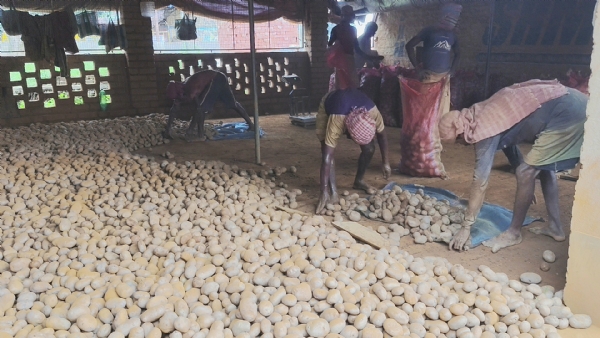
Hooghly, 05 August (H.S.): Despite record potato production and huge stocks in cold storages across West Bengal, farmers continue to struggle due to low farm-gate prices, while consumers are paying significantly higher rates in retail markets. Cold storage owners and traders have alleged that middlemen are reaping the benefits, leaving both farmers and consumers at a disadvantage.
According to industry representatives, potatoes are being sold from cold storages at around ₹8 per kilogram, but the same produce is reaching retail markets at nearly ₹16 per kilogram. They claim that transportation and handling costs alone cannot justify such a steep price difference.
Trader associations have blamed the previous state government for restricting potato exports to other states, saying the move resulted in the loss of key markets outside West Bengal. Although the new state government has lifted restrictions on interstate exports, traders say the promised subsidy for transporting potatoes has yet to be implemented.
State Agriculture Marketing Minister Dilip Ghosh had earlier announced that the government was considering a subsidy for cold storage owners to facilitate interstate potato exports. He said West Bengal had produced nearly 3 million metric tonnes more potatoes this year than last year and that efforts were underway to move the surplus to markets outside the state. However, officials of the Hooghly District Agricultural Marketing Department said no formal government notification regarding the subsidy has been issued so far.
West Bengal is one of India's largest potato-producing states, with Hooghly district accounting for a major share of the crop. This year, nearly 8 million metric tonnes (80 lakh MT) of potatoes were stored in cold storages across the state. As of June 30, only 28 percent of the stock had been sold, leaving 72 percent still in storage—about 8 percent lower sales than during the same period in previous years.
Cold storage owners and traders fear that if immediate measures are not taken, it will be impossible to clear the existing stock before the arrival of the new potato crop in December. This could create a severe storage crisis and force farmers to suffer heavy financial losses.
Farmer Sheikh Nasiruddin from Dadpur said that cultivating one bigha of potatoes costs nearly ₹30,000, but farmers are currently selling potatoes at just ₹120 per sack, making it difficult to recover production costs. He urged the government to waive agricultural loans to help growers survive.
Shubhajit Saha, President of the Cold Storage Association, said both farmers and traders were bearing the brunt of the surplus production and weak market demand. He urged the government to provide transport subsidies, increase potato procurement for government welfare schemes such as the Mid-Day Meal programme, and promote potato-processing industries to absorb the excess production.
Meanwhile, Lalu Mukhopadhyay, State Secretary of the Progressive Potato Traders' Association, called for a comprehensive strategy to manage the surplus, including direct procurement from farmers and subsidies on cold storage rentals.
Consumers have also voiced concern over rising retail prices, alleging that multiple layers of middlemen are responsible for the sharp increase. Trade bodies have urged the state government to intervene immediately to stabilise prices, protect farmers' incomes, and ensure affordable potatoes for consumers.
---------------
Hindusthan Samachar / Priyanka Pandey
05 Aug 2026