
-Dr. Mayank Chaturvedi
The global economy is currently passing through a period in which uncertainty has become the only real constant. High inflation, protectionist trade policies and sluggish economic growth have weakened the pace of development even in advanced economies. In such a challenging global environment, if there is one major economy that continues to advance at a remarkable pace, it is India. This is precisely why the International Monetary Fund (IMF) estimates that India could become a US$5.1 trillion economy by the financial year 2028–29.
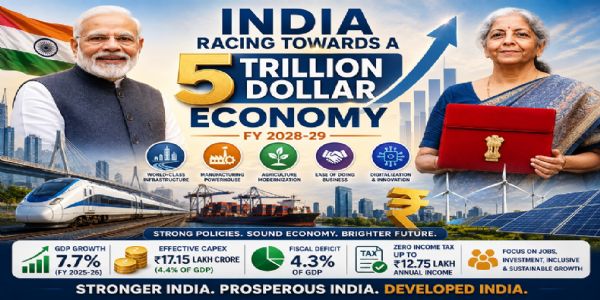
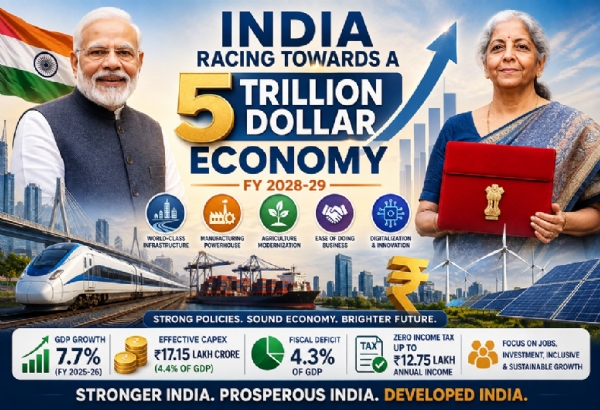
Indeed, the facts presented in Parliament today by Union Finance Minister Nirmala Sitharaman further reinforce this confidence. According to the Ministry of Statistics and Programme Implementation, India’s real GDP growth stood at 7.7 per cent in the financial year 2025–26, while growth in the fourth quarter was recorded at 7.8 per cent. This achievement has come at a time when many developed economies have been struggling to achieve even two to three per cent growth. Furthermore, India’s GDP performance has remained highly encouraging in the current financial year as well.
It can therefore be said that India’s growth momentum demonstrates that its development journey is not dependent upon any single sector. Rather, it is supported by several strong pillars, including domestic demand, the services sector, manufacturing, public investment and the digital economy. When we speak of India becoming a five trillion dollar economy, it does not merely refer to an increase in the size of its GDP. It signifies growing confidence among global investors in India, higher industrial production, rapidly expanding exports, millions of new employment opportunities, improved infrastructure and a far more influential role for India in global economic decision-making.
It is an established reality that the larger a nation’s economy, the stronger its global economic and strategic standing becomes. This is why India’s objective carries not only economic but also strategic and international significance. The most remarkable aspect of this goal is that the Government has laid a solid economic foundation to support it. In the Union Budget 2026–27, effective capital expenditure has been increased to ₹17.15 lakh crore, equivalent to approximately 4.4 per cent of GDP. Of this, ₹12.22 lakh crore will be allocated to roads, railways, ports, bridges, logistics and other infrastructure projects.
Institutions such as the World Bank, the OECD and the Asian Development Bank have consistently emphasised that investment in infrastructure generates the highest multiplier effect. It stimulates construction activity, creates employment, reduces industrial costs and encourages greater private investment. India’s current development strategy clearly appears to be based upon this sound economic principle.
The Government has also attached equal importance to fiscal discipline. The Budget’s commitment to limiting the fiscal deficit to 4.3 per cent, while targeting Central Government debt at around 50 per cent of GDP by 2031, indicates a determined effort to balance economic growth with financial stability. Indeed, this balance forms the foundation of the long-term credibility of any major economy.
The Income Tax Act, 2025 is another significant step towards strengthening domestic demand. Tax relief on annual incomes of up to ₹12.75 lakh is expected to enhance the purchasing power of the middle class. India’s greatest economic strength lies in its vast domestic market. As consumption rises, production expands, investment increases and new employment opportunities are created.
At the same time, India is making notable progress towards becoming a global manufacturing hub. The Production-Linked Incentive (PLI) Scheme, the Make in India initiative, the promotion of contract manufacturing, the expansion of the electronics industry and the India Semiconductor Mission 2.0 all indicate that India is preparing to emerge as a global centre for high-value manufacturing. As multinational companies diversify their supply chains, India is steadily emerging as one of their most reliable destinations. From mobile phone exports to electronics manufacturing, India’s growing global share already offers an early glimpse of this transformation.
The five pillars of development prioritised by the Government-infrastructure, manufacturing, agricultural modernisation, ease of doing business and digitalisation-are, in reality, the foundations of India’s future economy. Initiatives such as the PM Gati Shakti National Master Plan, the expansion of National Waterways, Digital Public Infrastructure, UPI, artificial intelligence, green energy and skill development demonstrate that India is investing with the competitive demands of the coming decades firmly in mind.
Particularly significant is the Government’s emphasis on the MSME sector. This sector generates the largest share of employment in India and also serves as a major contributor to exports. If small enterprises receive affordable finance, improved technology, simplified regulations and greater access to global markets, the goal of becoming a five trillion dollar economy can be achieved even more rapidly. This explains why the Budget places special emphasis on credit guarantee schemes, the revival of industrial clusters and expanding access to institutional finance.
It is true that India had originally aimed to become a five trillion dollar economy by the financial year 2024–25. However, the circumstances that emerged following the global pandemic, international conflicts, worldwide inflation and changes in the rupee-dollar exchange rate affected that timeline. What is important, however, is that the goal itself has not changed; only the timeline has. The direction and momentum of economic growth remain firmly intact. That, above all, is the hallmark of a resilient economy.
Undoubtedly, the road ahead will not be without challenges. Constant vigilance will be required regarding global uncertainties, energy prices, climate change and potential disruptions to international trade. At the same time, it must be ensured that the benefits of economic growth reach the last person in society. Economic growth becomes truly sustainable and meaningful only when it translates into employment generation, higher incomes for farmers, greater industrial competitiveness and a tangible improvement in the quality of life of citizens.
In this context, it can be said that the direction in which India is advancing today represents a broader process of redefining its role in the global balance of power. If the momentum of reforms, the flow of investment, fiscal discipline and an inclusive approach to development continue in the same manner, then achieving the milestone of a five trillion dollar economy in the financial year 2028–29 will be recognised as a historic testament to India’s economic strength, policy maturity and global leadership.
---------------
Hindusthan Samachar / Mayank Chaturvedi