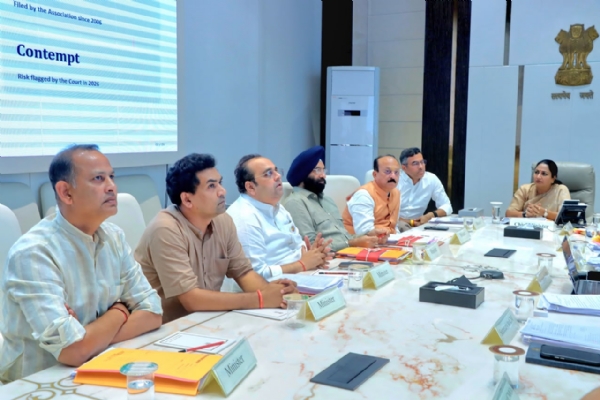
New Delhi, 05 August (H.S.): The Delhi Cabinet, chaired by Chief Minister Rekha Gupta, on Tuesday considered the draft of the ‘Delhi Ease of Doing Business Bill, 2026’ during its meeting.
The proposed legislation aims to introduce comprehensive reforms to make Delhi one of the easiest destinations in the country for establishing and operating businesses. The initiative is expected to encourage new investments, promote industrial expansion and generate employment opportunities on a large scale. After approval from the Lieutenant Governor of Delhi and the Delhi Cabinet, the Bill will be forwarded to the Ministry of Home Affairs for necessary further action.
In a statement issued on Wednesday, Chief Minister Rekha Gupta said that the proposed legislation has been prepared under the Government of India’s Compliance Reduction and Decriminalisation Initiative (Phase-II). It is aligned with the spirit of the Jan Vishwas Bill, 2023. She said the Delhi government is taking a significant step towards developing a modern, transparent and investor-friendly system for industries and investors.
The Chief Minister said that under the proposed law, businesses will no longer need to visit multiple departments for various approvals, registrations, licences, no-objection certificates (NOCs) and other permissions. A single-window system will be established, through which most business-related services will be made available on a unified online portal.
She said services including building approvals, factory licences, fire clearances, water, sewerage and electricity connections, RERA registrations and registration of cooperative societies will be provided through this portal within a fixed timeframe.
Chief Minister Gupta informed that the responsibility for implementing the entire system will be assigned to the Delhi State Industrial and Infrastructure Development Corporation (DSIIDC). The agency will act as the sole nodal authority responsible for the complete process, from receiving applications to granting final approvals. All concerned departments and civic agencies will coordinate through this mechanism.
One of the key features of the proposed legislation will be the provision of ‘deemed approval’. If a competent authority fails to take a decision on an application within the prescribed time limit, the relevant approval, registration or NOC will automatically be considered granted, and applicants will be able to download it directly from the online portal. This will help eliminate unnecessary delays and reduce pending files.
The Chief Minister said that a self-certification system will be introduced for low-risk activities. Under specified categories, processes related to fire safety, building plan approvals, pollution-related permissions and low-tension electricity connections can be completed through self-declaration. This will enable small and low-risk enterprises to begin operations without unnecessary delays.
She added that businesses already registered under GST, FSSAI, the MSME Development Act or Labour Codes will not be required to obtain separate trade licences, health trade licences, eating house licences or Shops and Establishments registrations.
The Chief Minister further stated that after new registration, regular inspections will not be carried out for three years under normal circumstances. Inspections will only be conducted in cases involving serious complaints. She also said that the government will not seek documents or information again from applicants if the same are already available with any Delhi government department.
She said that to encourage industrial expansion in notified industrial areas, the government has proposed removing several development control restrictions related to Floor Area Ratio (FAR), ground coverage, setbacks and building height. The responsibility for shared fire safety infrastructure will be assigned to DSIIDC instead of individual units, reducing the cost of industrial expansion.
Under the proposed law, regulations and conditions imposed on any enterprise will be proportionate to its actual risk level. The government may also notify a uniform validity period for all licences and NOCs wherever required. Services related to verification and certification may be provided by authorised professionals empanelled by the government, including professionals listed on panels in other states.
---------------
Hindusthan Samachar / Jun Sarkar
05 Aug 2026