'Project Mausam', 'Greater India' and 'Gyan Bharatam' Present India's Maritime Heritage, Civilisational Links and Knowledge Traditions to the World
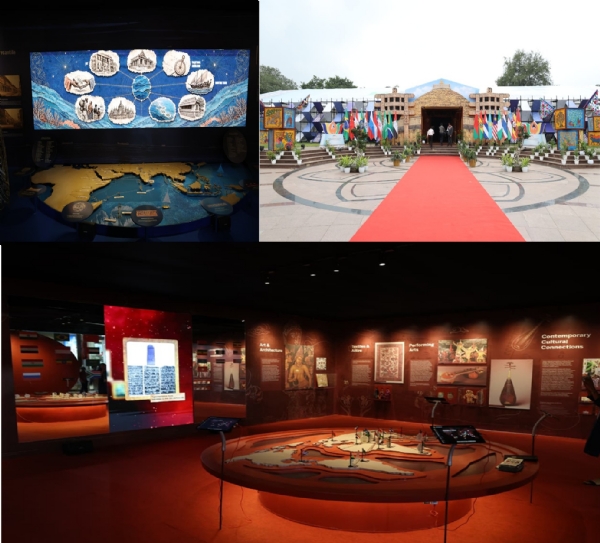
Bhopal, 05 August (H.S.): India's rich civilisational legacy, maritime history and intellectual traditions have taken centre stage at the BRICS Sanskriti Sammelan, currently underway at the Kushabhau Thakre International Convention Centre in Bhopal. Organised from 5 to 8 August, the international cultural gathering has become a vibrant platform for showcasing India's enduring contribution to world civilisation through three specially curated exhibitions, Project Mausam, Greater India, and Gyan Bharatam.
Together, these exhibitions offer an immersive journey through more than two millennia of India's maritime exchanges, cultural diplomacy, philosophical traditions and knowledge systems. They have emerged as major attractions for delegates from BRICS nations and international visitors, presenting India not merely as an ancient civilisation but as a continuing source of cultural dialogue, innovation and intellectual exchange.
In an effort to extend this experience beyond official delegates, the exhibitions will also remain open to the general public on 7 and 9 August, enabling citizens to explore India's cultural diversity and civilisational heritage through interactive displays, rare manuscripts and immersive digital experiences.
Project Mausam: Rediscovering the Indian Ocean's Shared Maritime Heritage
One of the highlights of the conference is the Project Mausam exhibition, developed by Design Factory India in collaboration with the Ministry of Culture and the Archaeological Survey of India (ASI).
The exhibition transports visitors across centuries of maritime history, illustrating how the seasonal monsoon winds transformed the Indian Ocean into one of the world's greatest corridors of trade, migration and cultural exchange. Rather than acting as barriers, the seas connected civilisations stretching from East Africa and the Arabian Peninsula to South-East Asia.
Project Mausam is a flagship initiative of the Ministry of Culture that seeks to revive these ancient links by documenting, preserving and promoting the shared maritime heritage of countries bordering the Indian Ocean. Through archaeological research, conservation, international collaboration and cultural diplomacy, the project aims to strengthen historic relationships that flourished long before the emergence of modern nation states.
Visitors begin their journey with a visually immersive film explaining how predictable monsoon winds enabled merchants, scholars, pilgrims and explorers to sail safely across vast oceans, facilitating exchanges in commerce, religion, science, architecture and art.
Interactive installations further enrich the experience. The popular 'Sail with the Monsoon' activity allows visitors to fold origami boats and write messages celebrating shared heritage, while the digital 'Discover Shared Heritage' platform enables exploration of common cultural sites spread across India and the wider Indian Ocean region.
A distinctive feature of the exhibition is its emphasis on a multinational UNESCO World Heritage nomination, highlighting the collective responsibility of nations to preserve ancient ports, coastal settlements, religious networks, trade routes and cultural landscapes as a shared legacy of humanity.
Through graphic panels and digital documentation, visitors gain insight into heritage mapping, GIS-based documentation, archaeological surveys, conservation practices, UNESCO nomination procedures and international capacity-building initiatives.
Greater India: A Story of Cultural Exchange, Not Political Expansion
Another compelling attraction is the exhibition titled Greater India, India's Cultural Connections and Shared Intangible Heritage with the World, which explores India's profound cultural influence across Asia, Africa and beyond over thousands of years.
The exhibition makes an important distinction: Greater India is presented not as an idea of territorial expansion but as a civilisation connected through ideas, spirituality, education, trade and artistic exchange.
Long before the establishment of modern political borders, Indian merchants, Buddhist monks, philosophers, craftsmen and travellers carried ideas rather than armies, creating enduring relationships founded upon mutual respect and cultural dialogue.
Historical narratives illustrate Emperor Ashoka's dissemination of Buddhism across Suvarnabhumi, the Kutai inscriptions of Indonesia, and the remarkable legacy of Malik Ambar, each demonstrating different dimensions of India's interactions with the wider world.
Visitors encounter vivid examples of India's civilisational influence through Indonesia's magnificent Prambanan Temple, the Wayang Kulit shadow-puppet tradition, Vietnam's Balamon Cham community, Thailand's enduring Vedic traditions and the cultural exchanges facilitated by the ancient Silk Road.
The exhibition also displays remarkable historical artefacts, including the Nalanda Copper Plate, ancient inscriptions and manuscripts that provide tangible evidence of centuries-old intellectual and cultural exchanges.
Among the most fascinating exhibits are the Hikayat Seri Rama, composed in Malaysia's Jawi script, and records documenting the construction of a monastery at Nalanda University by the Indonesian ruler Balaputradeva, highlighting the international prestige enjoyed by India's ancient centres of learning.
Music, dance and architecture form another captivating section of the exhibition. Traditional instruments such as China's Pipa, India's Veena, and the Sarod, which evolved from the Uzbek Rabab, illustrate centuries of artistic interaction. Classical performances including Thailand's Khon dance and Vietnam's Cham Apsara dance further reinforce the shared cultural threads that unite diverse societies.
Architectural masterpieces including Borobudur, My Son Sanctuary, the Taj Mahal and Humayun's Tomb demonstrate how artistic traditions evolved through centuries of cultural dialogue.
Throughout the exhibition, India's timeless philosophy of Vasudhaiva Kutumbakam- One Earth, One Family, One Future—serves as its guiding theme, emphasising culture as a bridge connecting humanity beyond geographical and political boundaries.
Gyan Bharatam: Digitising India's Intellectual Heritage
While Project Mausam explores maritime history and Greater India celebrates civilisational connections, Gyan Bharatam focuses on preserving India's extraordinary knowledge traditions for future generations through cutting-edge technology.
A flagship initiative of the Ministry of Culture, Gyan Bharatam is dedicated to the scientific preservation, AI-enabled digitisation and global dissemination of India's priceless manuscript heritage.
The scale of the initiative is unprecedented. More than 11.9 million manuscripts have already been documented under the programme, making it one of the world's largest knowledge preservation efforts. The exhibition employs interactive digital displays to introduce visitors to India's contributions in mathematics, linguistics, philosophy, astronomy, literature, spirituality and the Vedic sciences.
Rare manuscripts displayed include the 16th-century Lilavati, the celebrated mathematical treatise; the 18th-century Rekhaganita; Shri Kalika Kavacham; Sarvadeva Darshana Stotra; the 15th-century Panchatantra; and Nirukta, authored by Maharishi Yaska, one of the earliest works on etymology and linguistics.
One of the exhibition's most striking attractions is a version of the Shrimad Bhagavad Gita preserved on a silicon wafer, symbolising the remarkable convergence of ancient wisdom and modern technology. Collectively, these manuscripts illustrate India's enduring contributions to global knowledge in mathematics, philosophy, language, ethics and spirituality.
Madhya Pradesh Pavilion Highlights the State's Cultural Wealth
Complementing the three national exhibitions is a specially curated Madhya Pradesh Pavilion, inspired by the iconic Main Torana Gateway of the UNESCO World Heritage Sanchi Stupa. The pavilion introduces international delegates to the state's extraordinary tourism potential and cultural richness through immersive visual presentations.
Visitors are offered detailed insights into Madhya Pradesh's renowned tiger reserves, national parks, wildlife sanctuaries, waterfalls and eco-tourism destinations alongside globally recognised heritage sites including Khajuraho, Sanchi, Bhimbetka, Mandu, Gwalior, Orchha and Maheshwar.
Traditional artistic expressions such as Gond painting, terracotta craftsmanship, Nandana block printing and folk music are also being demonstrated live by artists Rahul Shrivas, Laxminarayan Prajapati, Akash Kumar, Jayanti Kushram, Vinod Malewar and Nandkumar Sahu before an international audience.
The pavilion further promotes products created by self-help groups, farmers and local entrepreneurs under the Vindhya Valley brand, highlighting Madhya Pradesh's growing emphasis on sustainable livelihoods and rural entrepreneurship.
A Celebration of India's Civilisational Vision
Together, Project Mausam, Greater India, Gyan Bharatam and the Madhya Pradesh Pavilion present a comprehensive portrait of India as a civilisation whose influence has extended far beyond its geographical frontiers through commerce, knowledge, spirituality and cultural exchange.
At the BRICS Sanskriti Sammelan, India's heritage is not merely being displayed, it is being interpreted as a living tradition that continues to inspire dialogue, cooperation and mutual understanding among nations. By embodying the ideals of Sarve Bhavantu Sukhinah and Vasudhaiva Kutumbakam, these exhibitions reaffirm India's belief that culture remains one of humanity's most enduring instruments for building peace, strengthening people-to-people ties and fostering a shared global future.
---------------
Hindusthan Samachar / Mayank Chaturvedi
05 Aug 2026