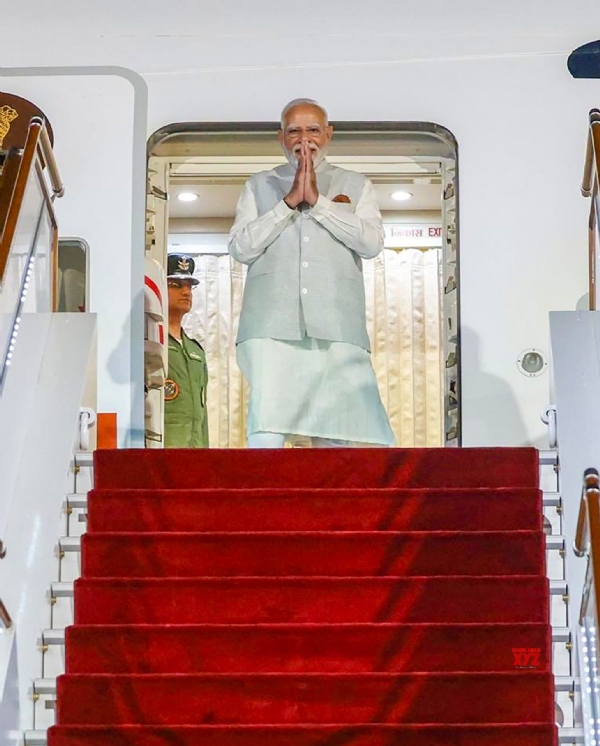
Bishkek /New Delhi, 31 August (H.S.): Prime Minister Narendra Modi arrived in Bishkek, Kyrgyzstan, on Sunday night to attend the 26th Shanghai Cooperation Organisation (SCO) Summit, after concluding a two-day state visit to Uzbekistan that resulted in several major agreements aimed at deepening India's strategic engagement with Central Asia.
PM Modi was welcomed in Bishkek by members of the Indian diaspora and watched cultural performances during a reception held in his honour. The SCO Summit is scheduled to begin on Monday, August 31.
The summit brings together leaders of SCO member states to discuss regional security, economic cooperation, connectivity and other shared challenges. India's participation is expected to focus on strengthening cooperation against terrorism and extremism while promoting greater connectivity and economic engagement across the region.
Earlier on Sunday, PM Modi concluded his visit to Uzbekistan after holding extensive discussions with Uzbek President Shavkat Mirziyoyev in Tashkent. The two leaders agreed to elevate India-Uzbekistan relations to a Comprehensive Strategic Partnership, marking a significant expansion in bilateral ties.
The two countries also set an ambitious target of increasing annual bilateral trade to $5 billion by 2030. Cooperation will be expanded in areas including trade, investment, infrastructure, defence, agriculture, healthcare, pharmaceuticals, digital public infrastructure, artificial intelligence, critical minerals, clean energy, space and education.
One of the key outcomes was the agreement to establish a framework for the long-term supply of uranium from Uzbekistan to India. The move is expected to strengthen India's access to nuclear fuel and support its long-term civil nuclear energy requirements.
India and Uzbekistan also agreed to expand cooperation in digital payments, with the Unified Payments Interface (UPI) being rolled out in Uzbekistan. The initiative is expected to facilitate digital transactions and strengthen economic and technological links between the two countries.
Defence cooperation was another important area of discussion. Modi said India and Uzbekistan would work towards establishing stronger direct linkages between their defence industries, including co-production and co-development of defence equipment.
Both sides also reiterated their commitment to combating terrorism, extremism and separatism and agreed that these threats require a coordinated regional response.
The two countries reached agreements to strengthen cooperation in traditional medicine, tourism, education and cultural exchanges. India will also work with Uzbekistan to preserve and promote its Buddhist heritage, particularly important archaeological and cultural sites.
In another significant development, Uzbekistan announced a 30-day visa-free regime for Indian citizens. The decision is expected to boost tourism, business exchanges and people-to-people contacts between the two countries.
During his visit, PM Modi was conferred Uzbekistan's highest state honour for foreign leaders, the Oliy Darajali Do’stlik Order, by President Mirziyoyev. The prime minister dedicated the honour to the enduring friendship between India and Uzbekistan.
Modi also paid floral tribute to former Prime Minister Lal Bahadur Shastri at his memorial in Tashkent and visited the Mahatma Gandhi Centre at Tashkent State University of Oriental Studies.
After completing his engagements in Uzbekistan, PM Modi departed for Kyrgyzstan on Sunday evening. His participation in the SCO Summit is expected to further India's engagement with Central Asian countries and provide an opportunity to discuss regional security, connectivity, trade and economic cooperation.
The visit to Uzbekistan and Kyrgyzstan, which began on August 29, is part of India's broader efforts to strengthen strategic partnerships in Central Asia and expand cooperation in security, energy, technology, commerce and cultural exchanges.
---------------
Hindusthan Samachar / Jun Sarkar
18 Aug 2026