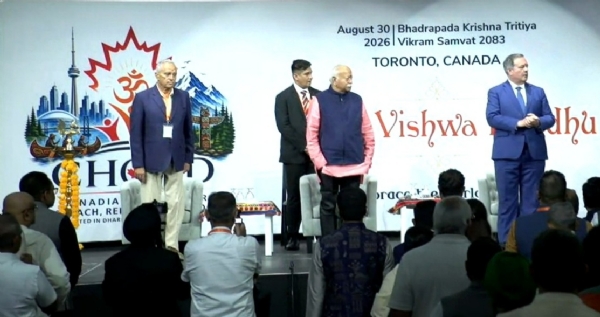
Toronto(Canada)/New Delhi, 31 August (H.S.): Rashtriya Swayamsevak Sangh (RSS) chief Mohan Bhagwat said India’s core cultural ethos is rooted in serving humanity and fostering global unity. He said Indian tradition has always viewed diversity as a natural expression of unity. Bhagwat made the remarks while addressing the ‘Hindu Vishwa Bandhu — Embracing the World in Friendship’ programme in Toronto, organised by Canadian Hindus for Outreach, Relations and Dialogue. The event began with a cultural presentation.
Speaking about India’s tradition of philanthropy and service, Bhagwat said India has never refused assistance when help has been sought from anywhere in the world and has often extended a helping hand even without being asked.
“Whenever help has been sought from India from anywhere in the world, India has never refused. Not only that, India has extended a helping hand even without being asked. This is our tradition. This is India’s DNA. That is why you may have heard the saying, ‘When Hindus awaken, the world awakens,’” he said.
Bhagwat also explained how India’s spiritual heritage promotes a sense of unity between humanity and nature. He said Indian tradition teaches people to regard both living and non-living entities as part of the same existence and to recognise unity in diversity.
“They regard both the living and the non-living as their own. They have been taught to see unity in diversity. That is why diversity has never been a problem for unity in India. Our tradition teaches us that there is not merely unity in diversity; diversity itself is a form of unity,” Bhagwat said.
He called upon the global community to embrace the ancient Indian philosophy of ‘Vasudhaiva Kutumbakam’, which means that the entire world is one family.
The RSS chief emphasised that true knowledge lies in recognising the underlying spiritual unity of humanity beyond external differences. He said open-minded and thoughtful people embrace the principle of ‘Vasudhaiva Kutumbakam’ and understand that the entire earth constitutes one family.
“Although people in the physical world may differ in their bodies, appearance, size and complexion, in reality, we are all one. Therefore, serving others is our duty. We have received this knowledge, and it always gives us happiness and fulfilment,” he said.
Bhagwat also explained how India became a ‘Vishwaguru’, or teacher to the world, through its character and civilisational ethos rather than by becoming a superpower.
“At that time, anyone could have called India a superpower, but it was not a superpower. It served the world. It became a Vishwaguru because of its character, not a superpower. Therefore, the rise of India means a more united world and greater humanity,” he said.
Recalling the efforts of India’s ancestors to share knowledge and civilisational values across the world, Bhagwat said they travelled to distant regions despite the absence of modern means of transportation.
“A long time ago, when there were no roads, boats, aeroplanes or motor vehicles, and people had only bullock carts and horses, our ancestors travelled from Mexico to Siberia and shared their knowledge. They crossed the Himalayas on foot and travelled to China, Siberia and Mongolia. They travelled to Southeast Asia in small boats. What did they do? They did not conquer any country. They did not convert anyone’s religion. Wherever they went, they shared knowledge. They shared astrology and Ayurveda and imparted the values of civilisation,” he said.
Bhagwat shared the stage with Jason Kenney, former Canadian Defence Minister and former Premier of Alberta. Kenney welcomed the renewed momentum in bilateral ties between Canada and India.
“It is very good to see new momentum in Canada-India relations. This will be evident later this year when Prime Minister Narendra Modi makes his second visit to Canada,” Kenney said.
Earlier, Bhagwat received a warm welcome upon his arrival in Toronto. Members of the Hindu community from across Canada gathered to greet him and described his visit as an important moment for promoting peace, cultural values and global harmony.
Kartik Trivedi, a former Royal Canadian Air Force officer who came to welcome Bhagwat, said he was proud of his Hindu identity and had served Canada for 15 years.
Rajendra Prasad of the Greater Toronto Area Hindu Sabha Temple said Bhagwat’s visit conveyed the message of ‘Vasudhaiva Kutumbakam’ and highlighted the ideal of considering the entire world as one family.
---------------
Hindusthan Samachar / Jun Sarkar
18 Aug 2026