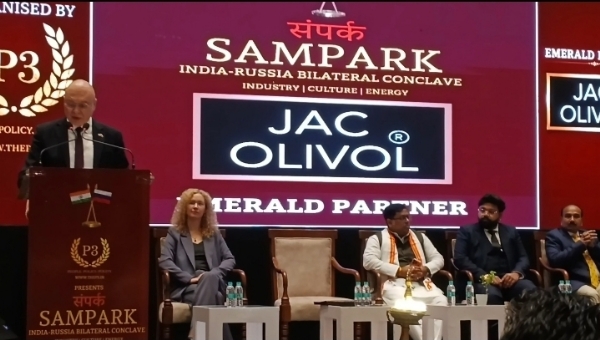
Kolkata, 31 August (H.S.) : India and Russia must move beyond the conventional technology-transfer model and build a deeper partnership based on co-development, localisation, joint research and the creation of solutions tailored to the needs of both countries, Debjit Chakraborty, Chief Executive Officer and Executive Director of the Indo-Russia “Innopraktika” Technology Hub, said on Monday.
Addressing the SAMPARK–India-Russia Bilateral Conclave in Kolkata, Chakraborty said the rapidly changing global technological and economic landscape had opened up significant opportunities for the two countries to expand cooperation in science, technology, innovation, research, academia and industry.
He stressed that the future of India-Russia technological cooperation should be based on mutual strengths and shared value creation rather than a one-sided model in which one country supplies technology and the other simply adopts it.
“We are looking at a partnership of equals. It is not simply about bringing a Russian technology into India or taking an Indian technology to Russia. The idea is to identify the right technologies, bring the right partners together and develop solutions that can create value in both countries,” he said.
Chakraborty highlighted the growing strength of India’s technology ecosystem, pointing to the country’s large pool of engineers, researchers, entrepreneurs and skilled professionals. He said India’s technological capabilities could complement Russia’s strengths in advanced science and technology.
He said the objective of the Innopraktika technology platform was to identify areas where Indian and Russian capabilities could be brought together to address practical technological and industrial challenges. Such cooperation, he added, could eventually result in products and solutions with applications beyond the two countries.
According to Chakraborty, technology partnerships should not be viewed merely in terms of importing or exporting finished products. Instead, both countries should focus on adapting, developing and commercialising technologies jointly.
He said a structured technology ecosystem involving companies, universities, research institutions, start-ups and government-supported innovation platforms could help identify promising technologies, test their applications and take them towards commercialisation.
“We are identifying technologies and looking at where Indian and Russian capabilities can complement each other. If there is a technology that can solve a particular problem in India, we should be able to bring the necessary partners together and work on it here,” he said.
Chakraborty also stressed the importance of linking academic research with industrial requirements. Universities and engineering institutions, he said, possess considerable scientific knowledge, technological expertise and human resources, but stronger mechanisms are needed to connect this potential with industry and real-world challenges.
He said pilot projects could play a crucial role in testing the feasibility of potential collaborations. Such projects would help determine whether a particular technology could be adapted successfully to Indian conditions and whether there was a viable market for the resulting product or solution.
The technology hub, he said, was working towards identifying technologies that could be adapted for the Indian environment and developing pilot projects to demonstrate their commercial and practical potential.
Chakraborty also called for greater opportunities for investment, manufacturing and product development in India. Rather than simply importing technologies or finished products, Indian companies could participate in the development and localisation of Russian technologies, creating a more sustainable industrial relationship.
“If an Indian company can invest, manufacture or develop a product based on a Russian technology and make it suitable for the Indian market, that creates a much stronger partnership than simply importing the product,” he said.
He noted that localisation could enable Indian companies to develop expertise around Russian technologies while giving Russian companies greater access to the Indian market.
Chakraborty emphasised that technological cooperation could succeed only when supported by a broader innovation ecosystem comprising industry, markets, academic institutions, skilled professionals and entrepreneurs.
“Technology by itself is not enough. You need the right industry, the right market, the right academic institutions and the right people. All of these elements have to come together,” he said.
He also highlighted the need for greater awareness of technological capabilities and opportunities available in both countries. Potential partners, he said, were often unaware of technologies, products and research capabilities available in the other country.
Better communication and information-sharing, he said, could help Indian companies, universities and institutions identify relevant Russian technologies and potential areas of collaboration.
Chakraborty placed particular emphasis on strengthening people-to-people and institution-to-institution engagement. Technological partnerships, he said, could not be sustained solely through government-level agreements and high-level meetings. Researchers, engineers, entrepreneurs, universities and businesses must have regular opportunities to interact.
He said greater interaction could facilitate the exchange of ideas, identification of joint projects and development of long-term partnerships between institutions and businesses.
Chakraborty also called for a shift from discussions and broad agreements towards actual implementation. While high-level meetings are important for setting priorities, he said the success of bilateral technology cooperation would ultimately be measured by the number of projects translated into tangible outcomes.
“We have had high-level meetings and discussions, but the important thing now is to convert those discussions into projects. We need to identify the problem, identify the technology, bring the partners together and actually build something,” he said.
He said the technology hub was working to facilitate this transition—from identifying technological requirements and matching them with appropriate technologies to bringing together stakeholders and developing pilot or commercial projects.
Chakraborty said India’s expanding technology ecosystem and large domestic market offer significant opportunities for Russian companies, while Russia’s scientific and technological strengths could complement India’s capabilities in engineering, manufacturing, entrepreneurship and human resources.
He said emerging areas of cooperation could extend beyond traditional sectors to include advanced technologies, hardware, engineering, materials, industrial applications and other emerging fields.
The bilateral technology partnership, he added, could also contribute to stronger economic engagement by encouraging greater private-sector participation and creating opportunities for companies from both countries to establish long-term partnerships.
According to Chakraborty, a successful technology partnership would require a combination of scientific expertise, entrepreneurial initiative, industrial capacity and market understanding. Building such an ecosystem would enable India and Russia to make better use of their respective strengths.
Concluding his remarks, Chakraborty said India-Russia technology cooperation should be viewed as a long-term partnership rather than a transactional relationship. He called for a new model based on shared knowledge, joint development, localisation, investment and access to wider markets.
“We should not look at this simply as a buyer and seller relationship. It has to be a partnership where both sides bring something to the table, develop together and create value together,” he said.
Hindusthan Samachar / Satya Prakash Singh
18 Aug 2026
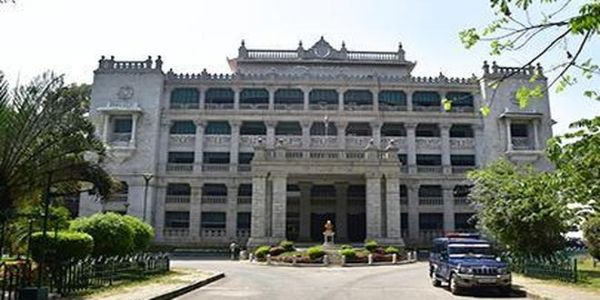
ED raids KPSC office, 20 other locations over Karnatak veterinary recruitment scam
ED raids KPSC office, 20 other locations over Karnatak veterinary recruitment scam..