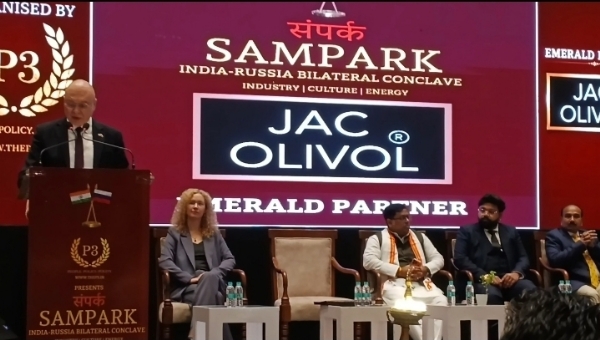
Kolkata, 31 August (H.S.): Strengthening cooperation between India and Russia in education, technology and professional development can create new opportunities for young people in both countries, while closer coordination among universities, students, technology institutions and industry can give a new direction to bilateral relations, Vladimir Gonchar said on Monday.
Gonchar said the movement of students between India, Russia and Europe over the years had laid a strong foundation for academic cooperation between the two countries. A large number of students have travelled to these countries for higher education and professional studies, and the existing academic linkages have significant potential to evolve into broader institutional and technological cooperation.
He said technological cooperation begins at universities and research institutions, where the foundations for developing new technologies and training skilled professionals are laid. India and Russia, therefore, need to focus on technology exchange and on creating new opportunities through joint initiatives.
Referring to Indian students pursuing education in Russia, Gonchar said more than 1,000 Indian students are currently studying in the country, with a significant number pursuing medical education. Thousands of others are also studying in various disciplines. These students, he said, can serve as an important bridge between India and Russia.
Students returning to India after completing their education in Russia can contribute to Indian society by bringing back modern technologies, work practices and professional experience, Gonchar said. He emphasised that bilateral cooperation should not remain confined to defence or strategic technologies, but should also extend to professional skills and technological fields that can directly benefit society and ordinary people.
Gonchar identified engineering education as another important area of India-Russia cooperation. According to him, around 20 Russian universities are already involved in academic cooperation at various levels. There are considerable opportunities for Indian students to pursue engineering, technological development and related disciplines in Russia.
He stressed that student exchanges should be two-way. While Indian students are travelling to Russia for education and training, greater opportunities should also be created for Russian students and professionals to study and train at Indian universities and institutions. Such exchanges would help both countries better understand each other's capabilities and build long-term partnerships.
Gonchar said his organisation's role extends beyond facilitating access to universities and professional education for students and professionals. It also seeks to provide young people with opportunities to develop technologies and work on innovative ideas.
He also emphasised the need for stronger links between educational institutions and industry. Ideas and technologies developed at research and technical institutions need engagement with businesses to be transformed into practical applications. Better coordination among universities, technology developers and industry can help move innovations from the research stage to real-world use.
Gonchar said greater coordination among universities, businesses and government institutions could create a favourable environment for innovation and economic development. Strengthening cooperation in technology, business and development would require sustained support and collaboration at multiple levels.
The ultimate objective of India-Russia cooperation, he said, should not be limited to strengthening institutional ties, but should focus on developing skills and opportunities for people. Stronger connections among students, universities, businesses and technology institutions can create new opportunities for young people while accelerating the economic and technological development of both countries.
Hindusthan Samachar / Satya Prakash Singh
18 Aug 2026