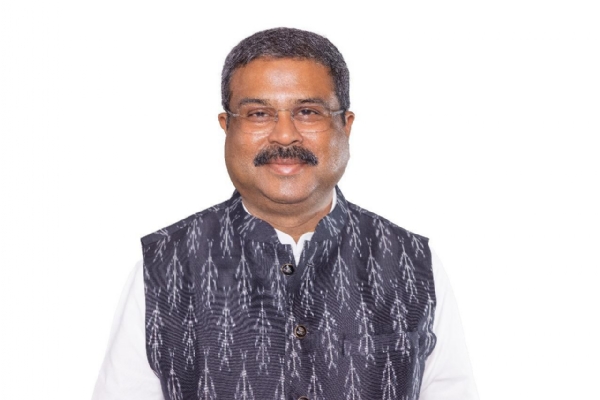
Bhubaneswar, 30 August (H.S.): Former Union Education Minister and Sambalpur MP Dharmendra Pradhan has strongly defended the Mines and Minerals (Development and Regulation) Amendment Act, 2026, asserting that the legislation will protect Odisha’s mining revenue, safeguard industries and promote long-term economic growth and employment in the state.
In a letter addressed to Odisha Leader of Opposition and former Chief Minister Naveen Patnaik, Pradhan rejected concerns raised over the MMDR Amendment Act and accused the opposition of “concealing facts” and creating “unfounded fear” among the people of Odisha.
Pradhan said the primary responsibility of Odisha’s MPs was to protect the state’s long-term economic and structural interests while contributing to national development. He described the MMDR Amendment Act as a “historic step” aimed at promoting economic growth and infrastructure development while protecting state revenues and local industries.
Responding to concerns over Odisha’s share of mining revenue, Pradhan claimed that approximately 90 per cent of total mining-sector revenues would continue to accrue directly to state treasuries under the amended legislation.
He said Odisha would retain 110 per cent of its auction premiums, 15 per cent of royalties and collections under the District Mineral Foundation (DMF) framework.
Pradhan also highlighted the growth in Odisha’s mining revenue over the past decade. He alleged that before 2014, mining concessions were distributed through non-transparent mechanisms, resulting in annual mining revenue remaining at around ₹5,000 crore.
According to Pradhan, the MMDR reforms introduced by the Narendra Modi government in 2015 brought mandatory transparent e-auctions and increased the ad-valorem royalty rate from 10 per cent to 15 per cent.
He claimed that these reforms helped Odisha’s mining revenue rise nearly tenfold to around ₹50,000 crore annually.
On the issue of taxation on mineral-bearing land, Pradhan argued that arbitrary and multiple levies could adversely affect Odisha’s industrial ecosystem.
He said mining and manufacturing operations in districts including Keonjhar, Sundargarh, Jharsuguda, Angul and Jajpur could face severe financial pressure if open-ended levies were imposed.
According to him, higher input costs would eventually affect industries producing steel, cement, power and coal and could increase the financial burden on ordinary households through higher construction costs, electricity tariffs and prices of essential commodities.
Pradhan said Section 9D of the amended legislation establishes a ceiling on such levies while protecting basic state revenues.
Pradhan also invoked the District Mineral Foundation mechanism, stating that more than ₹37,000 crore had been generated in Odisha under the framework for development in mining-affected districts.
He said the funds were intended for projects related to drinking water, healthcare, education and rural infrastructure.
At the same time, Pradhan cited CAG audit observations to allege irregularities in the utilisation of DMF funds during the previous state government’s tenure. He claimed that ₹1,983 crore had been spent in 976 non-affected villages, while 584 directly affected villages received no project funding.
He further alleged that 1,730 projects were implemented without following the Gram Sabha process.
Pradhan also criticised the previous BJD government over the Orissa Rural Infrastructure and Socio-Economic Development (ORISED) Act, 2004.
Referring to the High Court’s decision to strike down the legislation in 2005, he alleged that the matter remained pending in the Supreme Court for 18 years without the state government introducing validation legislation in the Assembly to address the legal shortcomings.
Pradhan said MPs from Odisha supported the MMDR Amendment Bill, 2026, in Parliament in what he described as the larger interest of the state and its people, particularly the youth.
Urging Patnaik to support the legislation, Pradhan said the amended mining law would strengthen Odisha’s industrial and economic growth while helping secure long-term employment opportunities for the state’s youth.
The letter comes amid a political debate in Odisha over the implications of the MMDR Amendment Act, with the ruling BJP and opposition BJD taking contrasting positions on its impact on the state’s mining revenue, industries and mineral-bearing communities.
Hindusthan Samachar / Monalisa Panda
18 Aug 2026
ED raids KPSC office, 20 other locations over Karnatak veterinary recruitment scam
ED raids KPSC office, 20 other locations over Karnatak veterinary recruitment scam..