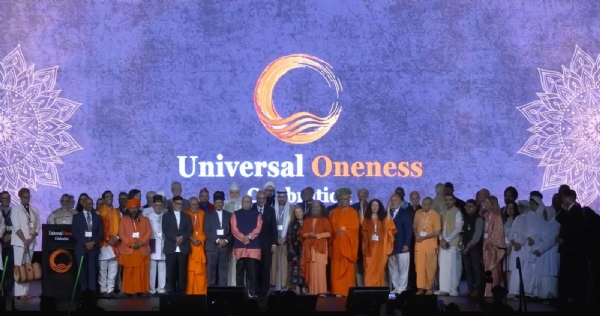
New Delhi/New York, 30 August (H.S.): Religious leaders from across the world have firmly stated that religion cannot be used to justify hatred, humiliation, dehumanisation or violence. The message was delivered during the Universal Oneness Celebration organised by the AHEAD Forum in Manhattan, New York, an event attended by Rashtriya Swayamsevak Sangh chief Mohan Bhagwat.
Amid growing global tensions, violence and social polarisation, religious leaders adopted a resolution at the “One World: One Humanity Summit”, pledging to stand up for the dignity and safety of every community. They noted that while faith has often served as a means of healing and reconciliation, it has also been misused to legitimise division and violence.
The five-point resolution outlined a framework for religious and community leaders to promote harmony, mutual respect and responsible action.
The first point called for introspection within communities. Religious groups were urged to examine their own teachings and practices, unequivocally reject hatred, dehumanisation and violence committed in the name of religion, and promote respect for people with different beliefs and perspectives.
The second point focused on standing with communities facing a crisis. The resolution called on people to support any individual or community that becomes a target of hatred, discrimination or violence. It emphasised that the suffering of others cannot be ignored simply because they belong to a different community.
The third point stressed dialogue and youth participation. Religious and cultural communities were encouraged to come together across traditional boundaries without waiting for another tragedy to occur. Particular emphasis was placed on involving young people in such initiatives to challenge prejudice and build relationships based on shared humanity.
The fourth point called for collective service. Religious communities were urged to work together to support displaced people, victims of violence, patients and marginalised sections of society. The resolution also encouraged organisations to support existing humanitarian efforts without seeking credit or recognition for their contributions.
The fifth point focused on responsibility towards the future. Religious leaders called for greater attention to the ethical implications of issues including war, peace, poverty alleviation and emerging technologies such as artificial intelligence. They stressed that technological advancement should strengthen human dignity, truth and freedom.
The participants underlined that any global declaration can have meaning only when it is translated into concrete action at the local level. Representatives were therefore encouraged to bring together groups that do not ordinarily engage in dialogue and to undertake service initiatives jointly with people from different faiths and cultural backgrounds.
The message acknowledged that religious leaders cannot single-handedly end every war or eliminate all forms of injustice. However, it stressed that they are not powerless and can play an important role in building a future founded on shared dignity and mutual responsibility.
The gathering brought together around 6,000 representatives from 39 US states and 853 cities, along with more than 250 university students and representatives of over 250 organisations. Religious leaders from 30 countries also participated in the programme and announced the five-point action plan aimed at establishing a greater sense of responsibility towards the future.
---------------
Hindusthan Samachar / Jun Sarkar

18 Aug 2026