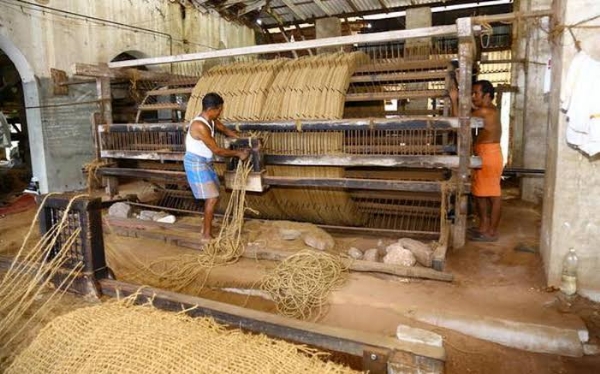
Alappuzha, 03 August (H.S.): Kerala’s centuries-old coir industry, once identified mainly with hand-spun yarn, ropes and traditional floor coverings, is increasingly reinventing itself through value-added products, mechanisation and new export markets, while continuing to provide livelihoods to lakhs of workers, particularly women in rural and coastal areas.
Coir remains one of Kerala’s most important traditional industries and a significant source of foreign exchange. According to the Kerala government, more than four lakh people are employed in the coir and allied sectors in the State, with women accounting for around 80 per cent of the workforce. The industry earns more than Rs 800 crore annually for Kerala through foreign exchange, underlining its continuing importance to the State economy.
The sector has its strongest concentration in Alappuzha, historically regarded as the nerve centre of the Indian coir industry. Government data show that about two lakh workers are associated with the industry in Alappuzha district alone, around 84 per cent of them women. Of the 9,078 coir units registered with the Coir Board in Kerala, 7,584 are located in Alappuzha.
The industry has gradually moved beyond conventional coir yarn, mats, mattings and ropes. Manufacturers are increasingly concentrating on products that command higher prices in domestic and overseas markets, including coir geotextiles, rubberised coir, coir tiles, rugs, carpets, erosion-control materials and horticultural products.
Coir geotextiles have emerged as one of the sector’s promising value-added segments. Made from biodegradable natural fibre, they are used for soil conservation, erosion control, slope stabilisation and landscaping. The material helps slow surface water flow, retain soil moisture and eventually decomposes into organic matter. Kerala has been promoting geotextiles for infrastructure and environmental applications, while mats and mattings continue to find markets in European countries.
The broader Indian coir export industry has developed a substantial global footprint. Coir Board figures for 2024-25 show that the United States was the largest market by value, purchasing products worth about Rs 1,062.42 crore, followed by China at about Rs 959.72 crore. The Netherlands, Spain, the United Kingdom, South Korea, Peru and Australia were among the other major destinations.
Kerala, with its long-established manufacturing, processing and exporting base, remains deeply linked to this international trade. Kochi Port data provide another indication of the scale of the business: the quantity of coir products handled at the port rose from 296,137 tonnes in 2023-24 to 351,471 tonnes in 2024-25, an increase of 18.69 per cent.
Industry diversification is also changing the economics of coconut husk, once treated largely as a low-value agricultural residue. Coir pith and other processed coconut-fibre materials are increasingly used as growing media in horticulture, while technological improvements are opening opportunities in environmentally sustainable products as global buyers seek alternatives to synthetic materials.
The State government has been attempting to combine mechanisation with protection of traditional employment. Financial assistance is being extended to co-operative societies through production and marketing incentives, while income-support and price-stabilisation measures are intended to protect workers and producers. Efforts are also being made to develop products suited to changing consumer preferences and international markets.
The sector’s social importance is particularly significant because of its dependence on women workers. Fibre processing, spinning, weaving and associated activities have traditionally provided employment close to workers’ homes, making coir a crucial component of the rural economy in Kerala’s coconut-growing and coastal regions.
The State says procurement and sales of coir products have crossed Rs 200 crore under its development initiatives, while the number of profit-making groups has risen to 325. Annual worker income under the sector’s programmes has also increased substantially, according to government figures.
With global demand growing for biodegradable and sustainable materials, Kerala’s challenge now is to convert its historic advantage in coir into a modern, high-value industry. Greater product diversification, improved design, technology, branding and access to overseas markets could help the State generate more revenue from each coconut husk while preserving a labour-intensive industry that continues to support hundreds of thousands of families.
---------------
Hindusthan Samachar / Arun Lakshman

03 Aug 2026
Kerala’s coir industry weaves export growth,value-added products and livelihood for lakhs
Kerala’s coir industry weaves export growth,value-added products and livelihood for lakhs..