Dr. Mayank Chaturvedi
India is not merely a modern political entity; it is one of the world’s oldest living civilisations, where collective consciousness has been nurtured for thousands of years through spiritual traditions, cultural symbols, festivals, rituals and shared memories. The Constitution provides India with political unity, but its civilisational heritage provides the deeper consciousness of the national self.
Therefore, whenever political conflicts begin to exploit sacred cultural symbols for short-term electoral or ideological battles, the issue moves beyond ordinary political disagreement. It touches upon the sentiments, identity and historical consciousness of millions of people.
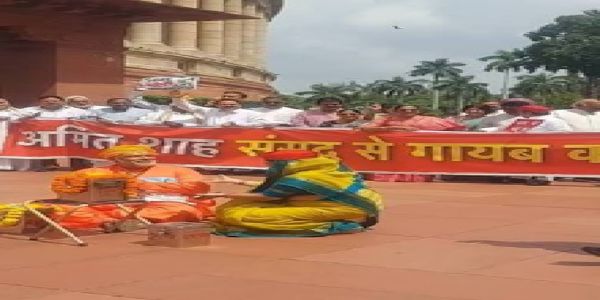
Recent events inside the Parliament complex have once again raised a serious question: how far can political opposition go before it crosses the boundary between democratic dissent and the deliberate use of religious symbols as political props?
The opposition has every constitutional right to question the government. In fact, a strong opposition is essential for a healthy democracy. It must raise concerns, demand accountability and challenge decisions through facts, evidence and parliamentary procedures. However, there is a fundamental difference between legitimate criticism and symbolic political theatre designed to provoke emotions rather than promote meaningful debate.
The controversy surrounding certain opposition MPs entering the Parliament premises wearing saffron attire and carrying a donation box while raising allegations related to offerings connected with the Ram Mandir has brought this distinction into sharp focus.
If there are genuine concerns regarding financial irregularities involving any institution, trust or organisation, the democratic process provides clear mechanisms. Questions can be raised in Parliament, documents can be examined, investigations can be demanded and legal procedures can be followed. These are the established foundations of constitutional democracy.
However, transforming the attire of a spiritual tradition into a political costume risks reducing a deeply respected cultural symbol into a tool of satire and confrontation.
The issue is not merely about a colour or a piece of clothing. It is about understanding the civilisational meaning attached to saffron, or Bhagwa, in Indian tradition.
The significance of Bhagwa was not created by any political organisation or contemporary ideology. Its roots lie deep within India's spiritual history. The very first hymn of the Rigveda is dedicated to Agni, the sacred fire. The colour of fire became associated with purity, sacrifice, discipline and dedication. In Indian philosophy, fire represents the transformation of the individual from personal desire towards collective welfare.
The Upanishadic tradition presents the ascetic as one who burns away selfishness to illuminate society. Saffron robes therefore represent renunciation, self-control and service. A person adopting the life of a sannyasi traditionally accepts a commitment to rise above personal ambitions and dedicate life towards a higher purpose.
The Mahabharata’s Anushasana Parva also describes renunciation as one of the highest forms of self-discipline. In Indian society, therefore, Bhagwa robes have never been regarded merely as a costume or a theatrical symbol. They represent a spiritual responsibility.
This explains why millions of Indians view saffron with reverence. Its association extends across different streams of Indian civilisation. From the flag of Lord Ram and Arjuna’s Kapidhvaja in the Mahabharata to Adi Shankaracharya’s spiritual journeys, from Swami Vivekananda’s historic message at the Parliament of the World’s Religions to Chhatrapati Shivaji Maharaj’s Jaripatka, saffron has represented courage, sacrifice, self-confidence and dedication.
Even beyond Hindu traditions, saffron and similar shades hold significance in several Indian spiritual paths. Buddhist monks wear the Kashaya robes, Jain ascetics follow traditions of renunciation, and Sikhism has its own association with the saffron Nishan Sahib. Thus, Bhagwa is not merely the symbol of a political party, organisation or sect; it forms part of the broader spiritual heritage of the Indian civilisation.
This raises an important question about political consistency and secular values.
If democracy demands equal respect for all religions, would political actors use the sacred symbols and traditional attire of every faith in the same manner for political criticism? Would similar symbolic demonstrations be staged using the religious clothing associated with churches, mosques or other places of worship?
The principle of secularism does not mean selective sensitivity. It means equal respect for all traditions and equal responsibility while dealing with matters of faith.
India has witnessed serious controversies and criminal cases involving individuals and institutions belonging to different communities. Such issues must always be addressed through law, investigation and justice. However, political discourse cannot selectively treat one community’s religious symbols as acceptable targets while considering others beyond criticism.
A mature democracy requires consistency.
The saffron colour has also played a significant historical role during periods of social and political struggle. Across centuries, saints, warriors and spiritual leaders associated it with courage, resistance and sacrifice. During challenging periods of foreign aggression, the Bhagwa flag became a symbol of cultural defence and collective determination.
This historical memory explains why any attempt to trivialise saffron attire can generate strong emotional reactions among those who see it not merely as fabric but as a representation of centuries of spiritual continuity.
The recent objections raised by religious organisations and spiritual leaders reflect this sentiment. Their concern is not about preventing criticism of any government. Democracies survive because governments can be questioned. Their concern is about the transformation of sacred symbols into instruments of political mockery.
Parliament is often described as the temple of democracy. Just as a person maintains dignity and restraint while entering a temple, similar seriousness and responsibility are expected inside Parliament. Debate can be intense, criticism can be sharp and opposition can be aggressive, but democratic disagreement must not become an excuse for disrespecting symbols deeply connected with the cultural emotions of millions.
Political parties will change. Governments will come and go. Leaders will rise and disappear from public life. But the civilisational symbols that have carried India’s identity for thousands of years will continue to remain.
The responsibility of Parliament is not only to represent political interests but also to protect the dignity of national institutions and social harmony. Religious and cultural symbols belonging to any faith should not become weapons in partisan battles.
The real strength of Indian democracy lies in the ability to disagree without destroying respect, to debate without humiliation and to criticise without attacking the foundations of civilisational identity.
Because the ultimate loss from such political misuse is not suffered by one party or one community. It affects the deeper national consciousness that has kept India alive as a civilisation through countless generations.
(The author is a senior journalist and a former member of the Film Censor Board Advisory Committee)
---------------
Hindusthan Samachar / Mayank Chaturvedi
03 Aug 2026
Kerala’s coir industry weaves export growth,value-added products and livelihood for lakhs
Kerala’s coir industry weaves export growth,value-added products and livelihood for lakhs..