Raksha Bandhan, Eid Milad-un-Nabi and Janmashtami as
occasions to celebrate harmony, service and shared cultural values
Prayagraj, 27 Aug (HS): India’s cultural landscape has
always been enriched by its festivals. Beyond rituals and religious traditions,
festivals have the unique ability to bring people together, strengthen social
bonds and remind communities of shared human values. This spirit was at the
heart of the message delivered by honorable Indresh Kumar, senior RSS pracharak
and guide of the Muslim Rashtriya Manch, during the organisation’s monthly
online meeting.
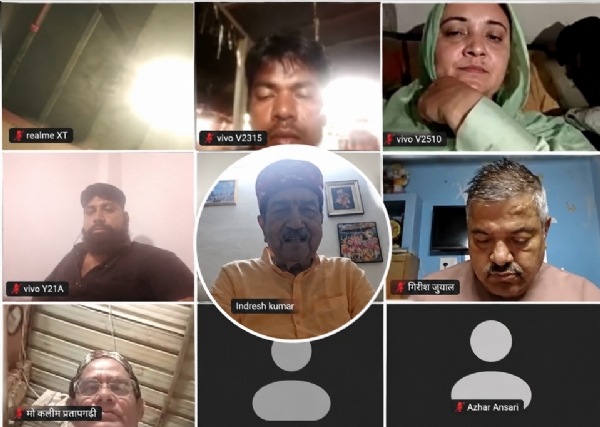
The meeting brought together hundreds of office-bearers and
workers from national, regional, state and district levels through digital
platforms. The central theme of the discussion was the need to transform
festivals into occasions for social awareness, environmental responsibility,
respect for women, cultural harmony and national unity.
Dr. Indresh Kumar emphasised that India is fundamentally a
culture of celebration. In such a diverse society, festivals can become
powerful bridges between communities. They should therefore not remain confined
to rituals, but should also communicate values that strengthen society and
deepen mutual understanding.
Raksha Bandhan: From a Family Bond to a Social Commitment -
Raksha Bandhan, traditionally associated with the bond between brothers and
sisters, can also be understood as a broader social commitment to respect,
dignity and mutual protection. Dr. Indresh Kumar suggested that the festival
should be given a wider social meaning by encouraging men and women to
symbolically tie rakhi to one another, conveying a message of equality and
mutual respect.
He also connected Raksha Bandhan with environmental
responsibility. He called upon workers to tie a rakhi to a tree and take a
lifelong pledge to protect it. In this way, the festival can become a reminder
that protecting nature is also a collective responsibility. Referring to
Shamparsi village in Uttar Pradesh, he highlighted the recent celebration of
Raksha Bandhan by Hindu and Muslim Gujjar communities together. Such examples,
he said, demonstrate how local traditions can become powerful expressions of
friendship, trust and social harmony.
Eid Milad-un-Nabi: Turning Celebration into Service - The
message of Eid Milad-un-Nabi, commemorating the birth of Prophet Muhammad, was
presented through the values of love, service and humanity. Dr. Iindresh Kumar encouraged participants to use the
occasion to reach out to society through acts of public service. During
Juloos-e-Mohammadi, he suggested arrangements for drinking water, sharbat and
refreshments for people along the route.
The idea is simple but meaningful: service should become one
of the most visible expressions of celebration. He also stressed that
programmes should be organised peacefully and responsibly, with discipline and
respect for people of all communities. Such celebrations, he said, should
convey a message of peace, goodwill and mutual respect.
Janmashtami: Celebrating the Spirit of Cultural Harmony -
The discussion then turned towards Shri Krishna Janmashtami, which was
described as an important expression of India’s cultural heritage and its
enduring message of love and harmony. Dr. Indresh highlighted the values of
love, service, peace and humanity associated with the life and teachings of
Lord Krishna. He called upon participants to take this message beyond religious
boundaries and share it with every section of society. India’s strength, he
emphasised, lies in its diversity. Its different faiths, traditions and
communities can coexist as pearls in a single garland, each retaining its
identity while contributing to the beauty of the whole.
From Festivals to Everyday Social Responsibility: The
meeting also underlined that social harmony cannot be achieved through
festivals alone. It requires continuous grassroots engagement, discipline and
accountability. Senior office-bearer Prof. Shahid Akhtar observed that the real
strength of an organisation is reflected in its work at the grassroots. He
encouraged every worker to remain active and connected with people in their
respective areas.
National Coordinator Mohammad Afzal stressed the importance
of organisational discipline and accountability. He urged workers to understand
their responsibilities and submit regular reports of their activities so that
progress could be assessed and future initiatives strengthened. Girish Juyal ji
focused on the growing influence of social media. He called for greater use of
digital platforms to promote positive, constructive and unity-oriented messages
and to share information about social initiatives in a timely manner.
Different Festivals, One Shared Message: The broader message
emerging from the meeting was that festivals may have different histories,
traditions and forms of celebration, but their social potential can lead
towards a common goal.
Love, brotherhood, service, respect, peace and national
unity can become the shared values connecting different celebrations. The
meeting concluded with a reaffirmation that the true strength of any social
organisation lies in grassroots work, discipline and accountability. The participants
also reiterated the idea that while festivals may be different, the message of
bringing hearts together remains one—love, brotherhood and peace. The programme
concluded with the National Anthem, symbolically bringing together the themes
of cultural diversity, social harmony and national unity.
Hindusthan Samachar / Abhishek Awasthi
18 Aug 2026
ED raids KPSC office, 20 other locations over Karnatak veterinary recruitment scam
ED raids KPSC office, 20 other locations over Karnatak veterinary recruitment scam..