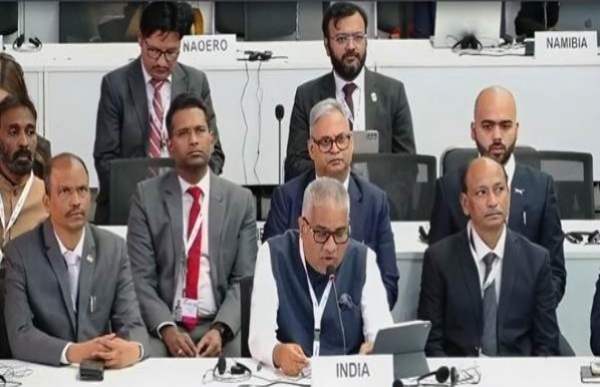
New Delhi, 26 August (H.S.): Union Minister for Environment, Forest and Climate Change Bhupender Yadav has stressed the need to place local communities at the heart of rangeland restoration efforts. Addressing the 17th Conference of the Parties (COP-17) of the United Nations Convention to Combat Desertification (UNCCD) in Ulaanbaatar, Mongolia, he said successful restoration begins by recognising pastoralists not merely as beneficiaries, but as custodians of natural resources.
According to the Union Ministry of Environment, Forest and Climate Change, Yadav made the remarks while addressing a ministerial dialogue on “Restoration of Rangelands and the Well-being of Pastoralist Communities” during UNCCD COP-17. He said India had developed considerable experience in conserving and restoring grasslands and rangelands through scientific planning and community participation.
Yadav said India’s rangelands extend from Himalayan pastures and the savanna landscapes of central India to the arid Thar region of Rajasthan, the Rann of Kutch and the shola landscapes of southern India. These ecosystems support the livelihoods of millions of people and sustain a substantial livestock population across the country.
He said integrating traditional knowledge with modern science can facilitate restoration that is environmentally sustainable, economically viable and socially inclusive. He noted that satellite-based desertification and land-degradation atlases are helping identify grasslands and facilitate scientific planning for their restoration. Recognition of grazing rights and Community Forest Resource rights, he added, is further strengthening the role of local communities.
The Union minister cited Rajasthan’s ‘Orans’ as an important example of traditional community-based conservation systems. There are around 25,000 such community-protected sacred groves across the country, covering approximately six lakh hectares. Protected with the participation of local communities, these areas also contribute to the conservation of rangelands and critical wildlife habitats. They include important habitats of endangered species such as the Great Indian Bustard.
Yadav said India was also working towards restoring open-forest and grassland ecosystems. He referred to the country’s cheetah reintroduction programme and the potential expansion of the initiative into grassland landscapes such as Banni in Gujarat.
He highlighted the crucial role of deep-rooted grasses in carbon sequestration in soil, facilitating water infiltration and replenishing groundwater. India has around 10 million hectares of permanent pastures and grazing lands, he said.
Yadav said India’s approach goes beyond land restoration by integrating landscape management, watershed development, sustainable grazing practices, fodder development and livelihood support. Community participation, he stressed, remains at the core of this integrated approach.
He said that as developing countries work towards achieving land degradation neutrality targets, improved access to finance, technology and knowledge is essential for restoring rangelands. India has called for dedicated and accessible financing for rangeland restoration and expressed its commitment to sharing its experience and solutions through South-South cooperation.
---------------
Hindusthan Samachar / Jun Sarkar

18 Aug 2026