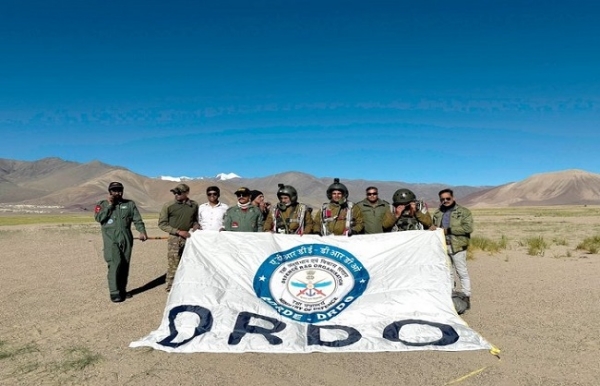
New Delhi, 26 August (H.S.): The Defence Research and Development Organisation (DRDO) has successfully tested its indigenous Military Combat Parachute System (MCPS) at one of the world’s highest-altitude drop zones in Ladakh. The trials were conducted at the Nyoma-Mudh Drop Zone in southeastern Ladakh, where temperatures fell to as low as minus 15 degrees Celsius. Three test jumpers leapt from an altitude of 22,000 feet and landed safely at an elevation of 13,700 feet.
The indigenous system will enable the Indian Armed Forces to undertake deployments at altitudes exceeding 25,000 feet, thereby reducing dependence on foreign systems.
According to the Ministry of Defence, the indigenous Military Combat Parachute System is an advanced parachute system jointly developed by the DRDO’s Air Delivery Research and Development Establishment (ADRDE) in Agra and BEML in Bengaluru. It is the only parachute system currently in service with the Indian Armed Forces capable of operations from altitudes above 25,000 feet. The system has already been successfully tested from altitudes of up to 32,000 feet.
With the successful trial of the MCPS in southeastern Ladakh, India has achieved another significant milestone in developing indigenous technology for military operations in extremely high-altitude regions.
The trial was conducted by ADRDE’s test jumpers—Wing Commander Rahul Jha, Chief Test Jumper RJ Singh and MWO Vivek Tiwari. All three jumpers used the MCPS along with its various subsystems during the exercise.
The system was successfully tested under challenging conditions at the Nyoma-Mudh Drop Zone, with temperatures reaching minus 15 degrees Celsius and the jump conducted from an altitude of 22,000 feet. Following the prescribed procedures, the test jumpers controlled their parachutes during the descent and made safe landings at approximately 13,700 feet.
According to the DRDO, the Military Combat Parachute System and its associated indigenous subsystems performed as expected despite the extreme altitude and extremely low temperatures.
The system is equipped with India’s indigenous satellite navigation technology, enabling precise navigation while providing protection against external interference and jamming. It features a low rate of descent, advanced steering control and several indigenous subsystems, including a specialised oxygen system and a para-computer.
During the trial, the indigenous para-computer, oxygen system and specialised jumpsuits, along with other associated systems, were also deployed. The exercise therefore enabled the overall integrated performance and reliability of the complete system to be assessed under extremely high-altitude conditions.
---------------
Hindusthan Samachar / Jun Sarkar

18 Aug 2026