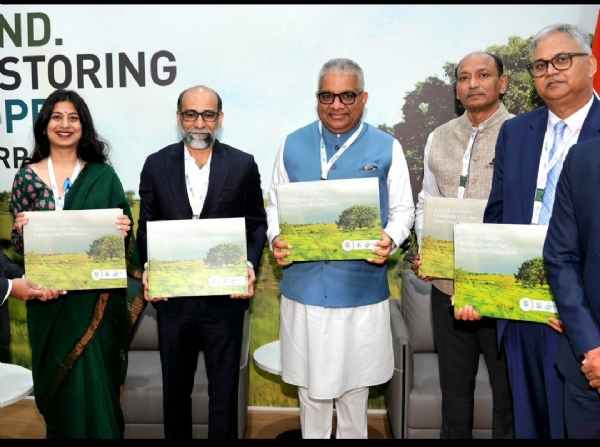
New Delhi, 25 August (H.S.): India has called for a global shift in the approach to tackling drought at the 17th Conference of the Parties (COP17) to the United Nations Convention to Combat Desertification (UNCCD). Union Minister for Environment, Forest and Climate Change Bhupender Yadav said drought should be treated not merely as a recurring disaster requiring relief, but as a predictable and preventable risk that demands long-term preparedness and resilience.
Addressing the Ministerial Dialogue on “Accelerating Measures to Combat Drought” in Ulaanbaatar, Mongolia, Yadav said drought was no longer merely a seasonal phenomenon but had emerged as a major challenge to water security, food systems, biodiversity and economic stability.
He said the global objective should be “preparedness before response, prevention before crisis management, and resilience before recovery.”
The minister said India was strengthening its drought-management efforts through rainfall monitoring, satellite-based drought assessment, early-warning systems and coordinated preparedness at the central and state levels. The objective, he said, was to take timely measures before a drought situation developed into a full-scale crisis.
Emphasising the close relationship between water and land, Yadav said the conservation of forests and watersheds helped improve water availability, reduce soil erosion and enhance groundwater recharge. India is also undertaking initiatives for river rejuvenation, conservation of traditional water bodies and broader water-conservation efforts, he said.
Yadav said communities across different parts of India were participating in the conservation of springs and groundwater recharge zones. At the same time, watershed programmes are being implemented across the country, particularly in rain-fed and degraded agricultural areas.
Crop insurance was also highlighted as an important measure to protect farmers from drought and other risks. During periods of crisis, vulnerable communities are supported through measures such as drinking-water supply, employment, fodder and emergency water arrangements.
India called on the international community to increase investment in ecosystem restoration, robust early-warning systems and coordinated action to address drought. Yadav said building drought resilience for the world's most vulnerable communities was not merely an option but a necessity for survival.
He also reaffirmed India's commitment to sharing its experience and capabilities in drought management, particularly its expertise in early-warning systems, with the global community.
---------------
Hindusthan Samachar / Jun Sarkar
18 Aug 2026