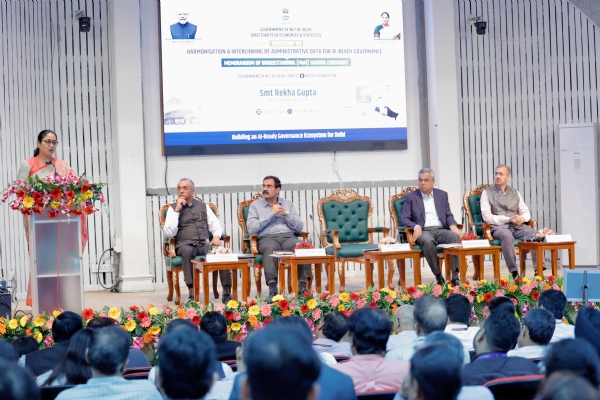
New Delhi, 25 August (H.S.): A high-level workshop on “Harmonisation and Interlinking of Administrative Data for AI-Ready Governance” was held on Tuesday under the chairmanship of Delhi Chief Minister Rekha Gupta, with all administrative secretaries, heads of departments and senior officials of the Delhi government participating in the session.
The workshop focused on strengthening evidence-based decision-making in Delhi through the effective use of data, enabling the government to anticipate citizens’ needs and deliver services proactively, and improving public service delivery.
The Chief Minister said the benefits of artificial intelligence should reach those who need them the most. “Data is the fuel for AI,” she said, emphasising the need to use data effectively to empower citizens. EkStep Foundation will share its open frameworks and expertise with the Delhi government as its knowledge partner.
During the workshop, the Planning Department of the Delhi government and EkStep Foundation also signed a Memorandum of Understanding (MoU) to collaborate in the field of administrative data. Under the agreement, the two organisations will work together to make Delhi government data ready for AI applications and develop various use cases aimed at improving citizen services through AI.
Secretary of the Ministry of Statistics and Programme Implementation Saurabh Garg, Delhi Chief Secretary Rajiv Verma, and EkStep Foundation Co-founder and CEO Shankar Maruwada were among those present.
EkStep Foundation made a presentation on “Data Dhara for an AI-Ready Delhi” during the workshop. The “Data Dhara” paper was also launched on the occasion. Data Harnessed for AI-Ready Advancements (DHARA) is an open-source, Digital Public Infrastructure-based methodology designed to help government departments and institutions prepare their data for AI applications.
DHARA has been developed as an open, pluggable, interoperable and cloud-deployable toolkit. It can also be deployed on-premises, depending on specific requirements.
During the technical session on “Data Creating Impact”, several examples were presented on how data can be leveraged to improve public services and ensure that government schemes reach intended beneficiaries more effectively. These included linking civil registration data with schemes such as the Pradhan Mantri Jeevan Jyoti Bima Yojana (PMJJBY) and Pradhan Mantri Suraksha Bima Yojana (PMSBY), using voice AI to provide government services to citizens in their own languages, improving investor support through investment facilitation, and making information about available incentives more accessible.
Other examples included improving the delivery of the Pradhan Mantri Matru Vandana Yojana and the Delhi Lakhpati Bitiya Scheme, identifying eligible beneficiaries and connecting them with government schemes, addressing gaps in enrolment, and ensuring that construction workers receive the benefits of various government welfare schemes.
The Chief Minister said the workshop was not merely a technology-focused initiative but an important step towards transforming the way the government understands challenges, makes decisions and delivers services to citizens. She noted that various government departments possess vast amounts of administrative data relating to citizens, beneficiaries, workers, students, health, education, employment and government schemes.
She said that while individual government departments maintain their own databases and records, citizens have only one government. Therefore, wherever legally permissible and technically feasible, data should be used securely and appropriately across departments.
The Chief Minister emphasised that merely connecting separate databases would not be sufficient. It would also be necessary to establish common definitions and standards for data, maintain uniform metadata, improve data quality, facilitate seamless data sharing between different systems, establish accurate identification mechanisms and assign clear responsibilities at every level.
She said Delhi needs a robust system in which data held by different government departments can work together seamlessly and effectively.
Gupta said artificial intelligence could enable more sophisticated analysis of government data, helping identify hidden patterns and anomalies, anticipate future requirements, improve grievance redressal, communicate with citizens in multiple languages and support better decision-making.
However, she cautioned that the full potential of AI could not be realised if data remained fragmented, outdated or inconsistent across systems. She said the Delhi government’s priority was therefore to build a strong data ecosystem in which information is reliable, high-quality and harmonised across departments.
---------------
Hindusthan Samachar / Jun Sarkar
18 Aug 2026
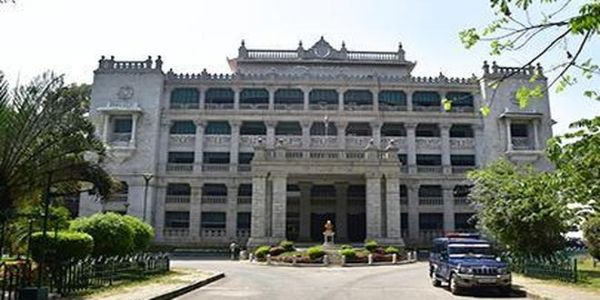
ED raids KPSC office, 20 other locations over Karnatak veterinary recruitment scam
ED raids KPSC office, 20 other locations over Karnatak veterinary recruitment scam..