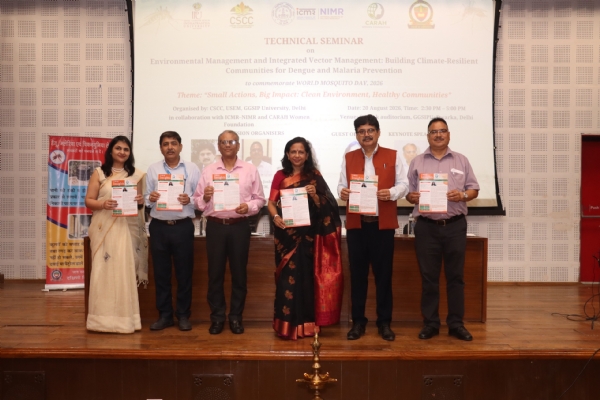
New Delhi, 22 August (H.S.): Guru Gobind Singh Indraprastha University (IPU) organised a technical seminar on the prevention and control of vector-borne diseases on the occasion of World Mosquito Day, under the theme “Clean Environment, Healthy Communities: Small Steps for Big Impact”. The seminar focused on the growing risks posed by vector-borne diseases such as malaria and dengue amid climate change and environmental transformations.
The programme was organised on Saturday by the Centre for Sustainability and Climate Change (CSCC), University School of Environment Management (USEM), IPU, in collaboration with the ICMR-National Institute of Malaria Research (NIMR), Kairah Women Foundation and the Municipal Corporation of Delhi. The seminar was chaired by Prof. Varun Joshi, Dean, USEM.
During the technical session, Dr Akash Srivastava of the National Centre for Disease Control (NCDC), Ministry of Health and Family Welfare, delivered the keynote address on “Climate-Driven Dengue and Malaria Risk: Impact of Global Warming”. Dr Roop Kumari of the Kairah Women Foundation highlighted the interlinkages between climate change, vector-borne diseases and integrated vector management.
The seminar also featured a panel discussion on “One Health in Action”. The session was chaired by Prof. Prodyut Bhattacharya, Head of CSCC, USEM, while Prof. N.C. Gupta served as co-chair. The discussion was moderated by Dr Rajni Kant, former Director of ICMR-RMRC, Gorakhpur, and Chairperson for Disease Elimination at the ICMR.
The panel included Dr Ramesh C. Dhiman, National Technical Lead at TCI Foundation and former Scientist G at NIMR; Dr Himmat Singh, Scientist G at NIMR-ICMR; and Dr Anjali of the Municipal Corporation of Delhi. The experts emphasised the need for an integrated approach combining vector control, climate action, urban environmental management and community participation.
During the programme, the Sir Ronald Ross Award was presented to Dr Tanu Jain, Director of the National Centre for Vector Borne Diseases Control, Delhi, for her notable contribution to malaria and vector-borne disease control. The Excellence in Vector Control Award was presented to Dr Surajita Banerjee, State Entomologist with the Integrated Disease Surveillance Programme (IDSP), West Bengal.
An interactive session and quiz competition were also organised for students. The programme concluded with the presentation of key recommendations and an award ceremony.
The seminar concluded with an appeal to strengthen collaboration among public health institutions, environmental experts, researchers, communities and urban authorities. Speakers stressed that timely, collective and environmentally sustainable action is essential to prevent vector-borne diseases and build climate-resilient and healthier communities.
---------------
Hindusthan Samachar / Jun Sarkar

18 Aug 2026
ED raids KPSC office, 20 other locations over Karnatak veterinary recruitment scam
ED raids KPSC office, 20 other locations over Karnatak veterinary recruitment scam..