Japan City to develop a major hub for automation, robotics
and precision engineering
By combining Japanese technology with UP's skills, global
supply chain will be strengthened: MSME Minister Bhupendra Chaudhary
Loans worth Rs 1.40 lakh crore disbursed to MSMEs in the
first quarter: Principal Secretary Shashi Bhushan Lal Sushil
There is already a strong connection between Japanese
companies and UP's MSMEs: Secretary Pranjal Yadav
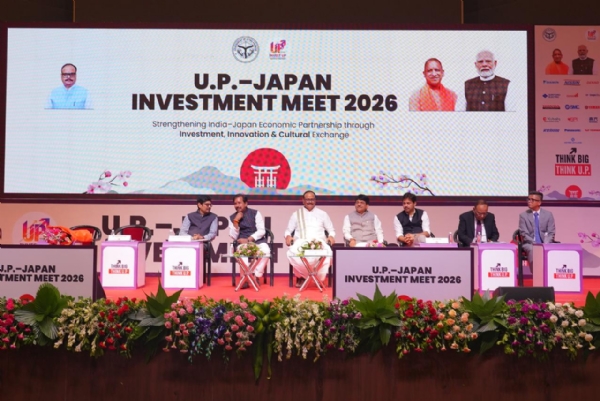
Lucknow, 21 Aug (HS): The Japan-UP MSME Partnership
Forum: Co-Creating the Next Growth Corridor was held on Friday in the
Mercury Hall of the Indira Gandhi Pratishthan in Lucknow. The forum discussed
in detail the possibilities of cooperation between Uttar Pradesh and Japan in
the fields of micro, small and medium enterprises (MSMEs), investment,
technology transfer, exports, startups, automobiles, textiles, handicrafts,
robotics, and employment.
Present at the event were MSME Minister Bhupendra Chaudhary,
Principal Secretary MSME Shashi Bhushan Lal Sushil, Secretary MSME and Export
Promotion Pranjal Yadav, senior administrative officials, the Japanese
delegation, academics, entrepreneurs, and representatives of industrial organizations.
Speakers said that Uttar Pradesh's vast MSME base and Japan's cutting-edge
technology can take the state to new heights in industrial development,
employment, and exports.
MSME Minister Bhupendra Chaudhary said that Uttar Pradesh
has over 9 million operational MSME units, accounting for approximately 14
percent of the country's total. The state government is pursuing a target of 15
percent annual growth rate in both MSME production and employment.
He stated that Uttar Pradesh is now a rapidly emerging state
for investment and industry. Improved law and order, modern infrastructure, and
a wide market offer immense investment potential for Japanese companies in the
state. He explained that a Japan City is being developed on
approximately 500 acres near the Jewar International Airport in Gautam Buddha
Nagar. This plug-and-play industrial ecosystem is an important step toward
becoming a major hub for cutting-edge fields like automation, robotics, and
precision engineering.
Bhupendra Chaudhary said that the quality improvement
methods of Japanese industries like Kaizen, 5S and Green Manufacturing will be
encouraged in the MSME units of the state. This will increase efficiency in the
production process, reduce costs and wastage and strengthen the global
competitiveness of the products of UP. He said that the state government is
giving a unique identity to the local products of all 75 districts through One
District One Product (ODOP). Self-employment and entrepreneurship opportunities
are being made available to the youth and traditional artisans through the
Chief Minister Yuva Swarojgar Yojana and Vishwakarma Shramik Samman Yojana.
Principal Secretary MSME Shashi Bhushan Lal Sushil said that
a strong financial base is being provided to the state's MSME sector. In the
first quarter of the current financial year alone, loans worth approximately Rs.
1.40 lakh crore have been distributed to MSME units. In the previous financial
year, this loan distribution was approximately Rs. 3 lakh crore. He said that
approximately 10 million MSME units in Uttar Pradesh provide employment to more
than 30 million people. The state's total exports exceed Rs. ₹2 lakh crore, of
which the MSME sector contributes approximately 45 percent.
Through the CM Yuva Abhiyan, financial assistance is being
provided to the youth for self-employment and setting up of enterprises. Till
now, interest-free loans of more than eight thousand crore rupees have been
given to about two lakh youths. A target has been set to provide loans to 10
lakh youths for setting up enterprises in the next ten years. Modern toolkits
have been provided to more than five lakh traditional artisans through ODOP and
Vishwakarma Shram Samman Yojana. This is helping in connecting traditional
skills with modern technology and market. One District One Cuisine Scheme is
also being taken forward in the state.
Uttar Pradesh's annual exports to Japan are approximately
$145 million. There is significant potential for expanding trade between the
two sides in sectors such as electrical machinery, organic chemicals, and
footwear, as well as food processing, handicrafts, and textiles. Five
plug-and-play factory complexes have been developed in the state, and
construction of similar industrial complexes is underway in other districts.
Pranjal Yadav, Secretary, Department of MSME and Export
Promotion, said that Uttar Pradesh is no longer known only for its large
population, but its global industrial profile has rapidly strengthened due to
strong law and order, modern infrastructure, and a large MSME base. He noted
that several major Japanese companies are already investing in Uttar Pradesh.
The presence of companies like Kubota, Escorts Kubota, and Minda Corporation
reflects the growing confidence of Japanese industries in the state.
Pranjal Yadav said that local MSME units like Albert Pistons
& Rings and Rednik Auto Exports of Ghaziabad are producing pistons, rings,
and auto parts and exporting them to Japanese companies like Honda and Yamaha. Additionally, several
smaller units in the state are manufacturing imitation jewelry and engineering
products and exporting them directly to Japan. He said that the Japan-UP MSME
Partnership Forum can act as an important bridge between the industrial
capabilities of the two countries. By adopting Japanese industrial technologies
and production systems, the state's MSME units can significantly increase their
efficiency, productivity, quality, and export potential.
Sudhir Rajgarhia, CEO of Rajgarhia Exports, Bareilly, stated
that Bareilly's nearly 1,200-year-old Zari-Zardozi art has been connected to
the global market through digital technology. He explained that his company,
which was started in 2018 with three people, now exports its products to over
200 countries. He added that working with international designers and adopting
digital technology has given local products a new identity in the global
market. Approximately 60 percent of the company's revenue goes to local
artisans. He added that Uttar Pradesh's digital revolution and ODOP policy have
played a crucial role in connecting small towns and local talent to the global
market. Technical and business partnerships with Japan can provide new markets
for many such local enterprises.
Dr. Mahip Singh, CEO of AKTU Innovation Hub, stated that Dr.
APJ Abdul Kalam Technical University is affiliated with over 760 institutions
and approximately 400,000 students. Uttar Pradesh boasts over 20,000 registered
startups and over 80 incubation centers. He added that centers of excellence
are being developed in the state in the fields of artificial intelligence,
cybersecurity, and robotics. There is vast potential for collaboration with
Japanese universities and industries in areas such as student exchange, joint
research and development, and semiconductor-robotics. He added that Uttar
Pradesh's technological and educational ecosystem can play a key role in
developing talented youth and innovation-based startups to meet the
technological needs of Japanese companies.
Yamini Bhushan Pandey, MD of the IIM Lucknow Enterprise
Incubation Center, stated that startups and entrepreneurship are rapidly
expanding in Uttar Pradesh. IIM Lucknow's incubation center has already
supported thousands of startups. She added that a soft landing
platform could be developed in Uttar Pradesh for Japanese MSMEs and
startups. This would help Japanese entrepreneurs understand the Indian market,
find local partners, and expand their businesses. She added that collaboration
between the Indian and Japanese startup ecosystems could lead to the
development of new business models, technological innovations, and investment
opportunities.
Lalit Thukral, Chairman of the Noida Apparel Export Cluster,
stated that approximately 1 million people are involved in Noida's garmenting
industry, and exports from here exceed Rs 50,000 crore. He added that India's
share in Japan's total readymade garment imports is currently approximately 1.2
percent, which has the potential to increase to 10 percent. The
international-level apparel park being developed in Noida, with approximately
225 factories, could play a significant role in additional exports and
employment generation. He added that improved trade relations with Japan and
the adoption of quality standards could further strengthen Uttar Pradesh's
textile and garment industry in the global market.
The forum noted that the proposed 500-acre Japan City near
Jewar Airport could play a significant role in reinvigorating industrial
relations between Uttar Pradesh and Japan. A plug-and-play ecosystem for
automation, robotics, precision engineering, and other modern industries is
being developed here. Concepts like Kaizen, 5S, and Green Manufacturing will be
encouraged to integrate the state's MSMEs with Japanese technology, quality
standards, and production methods. This will help reduce production costs,
improve quality, reduce waste, and strengthen export competitiveness.
Hindusthan Samachar / Abhishek Awasthi
18 Aug 2026
ED raids KPSC office, 20 other locations over Karnatak veterinary recruitment scam
ED raids KPSC office, 20 other locations over Karnatak veterinary recruitment scam..