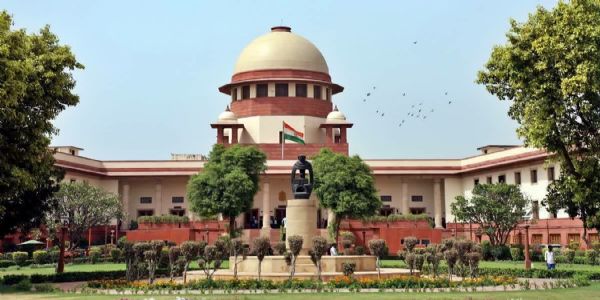
New Delhi, 19 August (H.S.): The Supreme Court has directed the National Testing Agency (NTA) to institutionalise the reforms introduced in the National Eligibility-cum-Entrance Test (NEET) examination system. A Bench headed by Justice P.S. Narasimha observed that although the system appeared robust on paper, it was essential to make the reforms permanent and institutionalised.
During the hearing on Wednesday, Solicitor General Tushar Mehta gave the court a detailed account of the examination process. Mehta said the NTA’s existing system was “almost impregnable”, although the possibility of human error or human intervention could not be completely ruled out.
He explained that for each subject, several moderators prepare a question bank of around 500 questions so that no single individual can determine which 100 questions will ultimately appear in the examination. Subsequently, another group of moderators selects 100 questions each and prepares four different question papers. Of these, two question papers are selected by the NTA Director General for the examination. Mehta said that throughout the process, no single individual has complete information about the final question paper.
He said the question papers are sent in sealed envelopes to two separate authorised printing presses, where they remain under CCTV surveillance and the watch of the Central Industrial Security Force (CISF). The boxes are opened using a digital code, the details of which are not known in advance to the concerned personnel.
After printing, the question papers are placed in specially sealed boxes whose seals cannot be reused. The questions are arranged in different sequences, and separate packets are prepared for every group of 24 students. Each packet carries a watermark number, city code, centre code and packet number.
The question papers are then placed inside iron boxes that can only be opened by breaking the lock. They are transported to strong rooms in GPS-enabled vehicles, with the entire movement monitored from the NTA headquarters.
After hearing Mehta’s detailed explanation, Justice P.S. Narasimha observed that several aspects of the examination system had already been placed before the Radhakrishnan Committee. He said that new personnel and new systems would come into an institution over time, but merely creating procedures would not resolve the underlying problem.
The court observed that the issue was procedural in nature and that institutionalising the system was of paramount importance. It further questioned the NTA on key institutional aspects, including the number of officials working in the agency, the location of its offices, the number of employees and the security arrangements in place, stressing that these aspects needed to be clearly defined.
---------------
Hindusthan Samachar / Jun Sarkar
18 Aug 2026