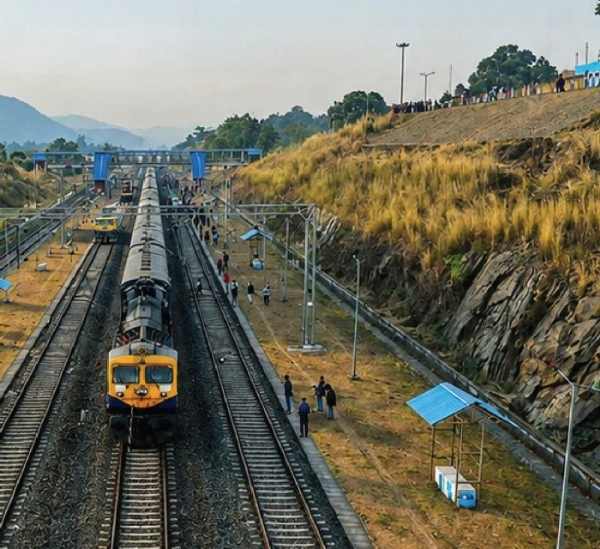
New Delhi, 19 August (H.S.): The Union Cabinet has approved four multitracking railway projects spread across eight districts in West Bengal, Odisha, Tamil Nadu and Andhra Pradesh. The projects will add approximately 410 kilometres to the Indian Railways network at an estimated total cost of Rs 9,450 crore. They are targeted for completion by 2030-31.
The Cabinet Committee on Economic Affairs, chaired by Prime Minister Narendra Modi, approved the four projects proposed by the Ministry of Railways on Wednesday. The multitracking projects are expected to improve connectivity for around 6,448 villages with a combined population of approximately 60 lakh.
The approved railway projects are the Kharagpur-Bhadrak (Ranitāl) fourth line in West Bengal and Odisha, covering 173 kilometres; the Bhadrak-Haridaspur fourth line in Odisha, covering 75 kilometres; the Gummidipundi-Gudur third and fourth lines across Andhra Pradesh and Tamil Nadu, covering 90 kilometres; and the Cuttack-Paradip (Badabandha) third and fourth lines in Odisha, covering 72 kilometres.
Union Minister Ashwini Vaishnaw provided details of the projects at a press conference held at the National Media Centre on Wednesday. He said the proposed capacity enhancement would improve rail connectivity to several major tourist destinations across the country.
The proposed projects are also vital routes for transporting commodities such as coal, iron ore, cement, iron and steel, containers, automobiles and food grains. The capacity augmentation works are expected to create an additional freight-handling capacity of 76 million tonnes annually.
Vaishnaw said railways, being an environment-friendly and energy-efficient mode of transport, would contribute to achieving the country’s climate goals while helping reduce logistics costs. The projects are also expected to reduce oil imports by approximately 130 million litres and cut carbon dioxide emissions by around 650 million kilograms annually, equivalent to the impact of planting approximately 26 crore trees.
The major tourist destinations that are expected to benefit from improved rail connectivity include Kuldiha Wildlife Sanctuary, Bhitarkanika National Park, Maa Bhadrakali Temple, Maa Dhamrai Temple, Panchalingeswar Temple, Talsari-Udaypur and Chandipur beaches, Pulicat Lake, Nelapattu Bird Sanctuary, Bhagavan Veeraraghava Perumal Temple, Gada Kujanga Jagannath Temple, Sarala Temple, Dhabaleswar Temple and Lalitgiri, an important Buddhist site.
---------------
Hindusthan Samachar / Jun Sarkar
18 Aug 2026