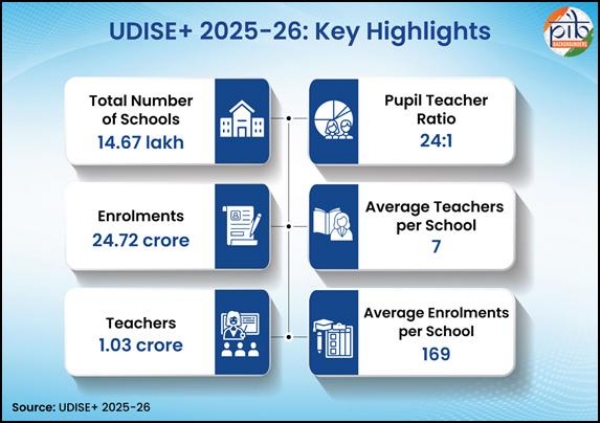
New Delhi, 18 August (H.S.): India’s school education system is witnessing significant transformation not only in terms of the number of classrooms but also in teaching quality, gender parity and basic infrastructure. The 2025-26 report released through the Union Education Ministry’s digital portal, Unified District Information System for Education Plus (UDISE Plus), is based on an assessment of 1.467 million schools, 10.3 million teachers and 247.2 million students across the country. In line with the National Education Policy (NEP) 2020, the data indicates that Indian schools are becoming more inclusive, better equipped and increasingly student-centric.
One of the most crucial factors in improving learning outcomes is the pupil-teacher ratio. According to the report, the pupil-teacher ratio (PTR) has improved considerably from the foundational to the secondary level. The ratio stands at 10:1 at the foundational level, meaning one teacher for every 10 students, 12:1 at the preparatory level, 17:1 at the middle level and 21:1 at the secondary level. This balanced ratio enables teachers to provide greater individual attention to students and encourages interactive, dialogue-based learning in classrooms.
The dropout rate, which has traditionally remained one of the major challenges facing India’s school education system, has also continued to decline. The dropout rate has fallen to 1.8 per cent at the preparatory level and 7.0 per cent at the secondary level. At the same time, retention figures show that 98.5 per cent of students at the primary level, 91.1 per cent at the preparatory level and 83.7 per cent at the middle level continue their education. The transition rates further reinforce continuity in access to education, with 99.2 per cent of students moving from the foundational to the preparatory stage and 93.8 per cent progressing to the middle level.
In terms of the Gross Enrolment Ratio (GER), the middle level continues to record a high ratio of 89.6 per cent, while the secondary-level GER has improved to 71.7 per cent. Of the total 247.2 million enrolments, the secondary stage accounts for 27.16 per cent, followed by the preparatory stage at 25.60 per cent, the middle stage at 25.58 per cent and the foundational stage at 21.66 per cent. The distribution highlights relatively balanced student participation across the different stages of school education.
The data on social inclusion also presents a significant picture of the democratisation of education. Other Backward Classes (OBCs) account for 44.9 per cent of total enrolments, while Scheduled Castes (SCs) constitute 17.7 per cent and Scheduled Tribes (STs) 10 per cent, together accounting for 27.7 per cent. Students from the General Category constitute 27.5 per cent of total enrolments.
From the perspective of gender equality, girls account for 48.4 per cent of total student enrolment. Meanwhile, the participation of women in the teaching workforce has increased to 54.9 per cent, reflecting the growing role and leadership of women in primary and secondary education.
Technology-driven education has also received a major boost as part of the modernisation of schools. Computers are now available in 69.9 per cent of schools, while 67.4 per cent have internet connectivity.
On the physical infrastructure front, basic facilities have reached near-saturation levels. Clean drinking water is available in 99.5 per cent of schools, while 98.5 per cent have separate toilets for girls and 97.2 per cent have toilets for boys. Electricity is available in 95 per cent of schools, while 90.5 per cent have library facilities. In addition, 58.2 per cent of schools have ramps equipped with handrails, improving accessibility for students with mobility challenges.
Administrative improvements are also evident. Rationalisation of teacher postings has resulted in an almost 3 per cent reduction in the number of single-teacher schools, bringing their total down to 100,843. At the same time, schools with zero enrolment have recorded a sharp 29 per cent decline, reducing their number to 5,663.
The UDISE Plus 2025-26 figures make it clear that Indian school education is moving beyond the traditional focus on literacy and entering a new phase marked by expanded infrastructure, greater technological integration and an increased emphasis on quality education. This evidence-based data is expected to play a central role in shaping more effective education policies for the future.
---------------
Hindusthan Samachar / Jun Sarkar

18 Aug 2026