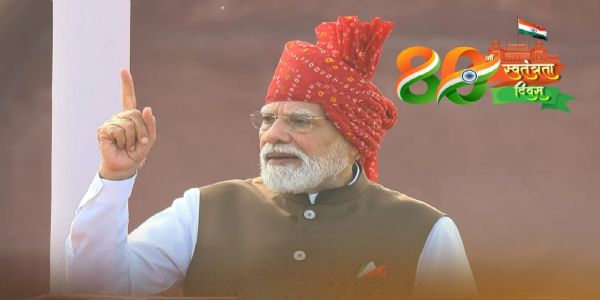
New Delhi, 15 August (H.S.): Prime Minister Narendra Modi on Friday called the seven key areas identified for building a developed India the “Saptadhara of Strength”, saying their collective potential would give the country new momentum and take it to new heights over the next five to seven years, helping establish India as a strong, self-reliant and capable nation on the global stage.
Addressing the nation from the ramparts of the Red Fort on India’s 80th Independence Day, Modi pointed to the ongoing transition in global geopolitics and its wider implications.
“The world is engaged in turning whatever it possesses into a weapon. Resources, petrol, diesel, fertilisers, medicines, technology chips and even geographical territories are being weaponised,” he said.
The Prime Minister said India was emerging as an accepted and respected country globally. He highlighted India’s stable political mandate, stable government, vibrant democracy, strong judicial system and Constitution as the country’s key strengths, saying the world was increasingly recognising these capabilities.
He noted that India had moved towards Free Trade Agreements (FTAs) with around 40 countries since 2014, describing this as a major opportunity that the country must fully utilise.
“We have to reach the world. Every Indian product must reach global markets. Whether it is textiles, machinery or medicines, we cannot afford to miss this opportunity. However, we must meet and surpass global standards. We must offer products that are better than what we receive from the world,” PM Modi said.
Calling for the seven-pronged strategy,PM Modi said, “From the ramparts of the Red Fort today, I invoke this Saptadhara of Strength before the nation. Over the next five to seven years, we will use the strength of these seven streams to achieve what could not be accomplished in the past five to seven decades, giving the country new heights, new momentum and the capability to cross new milestones.”
Manufacturing: Building a Complete Value Chain
Describing manufacturing as the first pillar of the Saptadhara,PM Modi said India must substantially expand its manufacturing sector.
Along with increasing production, India must manufacture everything from small components to large finished products, he said. The entire value chain should be developed within the country, from components and parts to complete products.
India must emerge as a trusted hub of the global supply chain, from design to manufacturing, Modi said.
He stressed the need for globally competitive factories, user-friendly products and attractive packaging, adding that “zero-defect” and high-quality manufacturing should become India's hallmark.
Every industrialist, entrepreneur and MSME must understand that India's global identity should be built on reliability and quality, he said.
“There can be no compromise on quality. Therefore, our mantra must be quality,” Modi said, adding that quality would become the foundation of India's global brand value.
Agriculture, Food Production and Processing
PM Modi identified agriculture, food production and food processing as the second pillar of the Saptadhara.
He said Indian farmers now had access to expanding global markets because of FTAs and urged them to move from the farm to export markets.
“We have to reach those markets. We have to move from the farm to the export market,” he said.
The Prime Minister also encouraged farmers to strengthen chemical-free agriculture, noting that demand for such products was expected to rise globally. Agricultural products that meet international standards would be able to access global markets more easily, he said.
Technology and Innovation
Technology and innovation constitute the third pillar, Modi said, pointing to artificial intelligence, quantum technology, space, robotics and data centres as rapidly emerging fields.
He said emerging technologies were opening up an entirely new economic landscape and India should not merely become a market for the world but should establish itself as a global innovation hub.
India had already demonstrated its capabilities through UPI and Digital Public Infrastructure, he said, adding that the country must now take its digital public technologies to every corner of the world.
India must remain at the forefront of next-generation communication technologies, Modi said, setting a goal for Made-in-India 6G to reach every part of the country and calling for accelerated efforts in this direction.
Gati Shakti: Seamless Connectivity
The fourth pillar is Gati Shakti, Modi said, stressing the need for fast and seamless connectivity across the country.
He called for cities to be connected through high-speed rail and for the development of modern highways, inland waterways, airports and multimodal logistics systems.
Ports, he said, should not merely function as places for loading and unloading cargo. India must move towards port-led development, transforming ports into centres of wider economic activity.
Defence Strength and Self-Reliance
Defence strength is the fifth pillar of the Saptadhara, according to Modi.
He said India had realised, and the world had also recognised, that there was no alternative to self-reliance in defence.
India should aim to become a global supplier by developing next-generation defence technologies, he said. The country must strengthen capabilities in drones, counter-drone systems and hypersonic defence technologies.
Cybersecurity, he added, had also emerged as an important dimension of national defence and offered an opportunity to harness the capabilities of India's young population for the country and the world.
Green and Blue Economy
The sixth pillar comprises the green and blue economies, which can also generate large numbers of green jobs, Modi said.
He called for India to achieve global-scale capabilities in green hydrogen, renewable energy, energy storage, green mobility and green manufacturing.
India also has enormous potential in the blue economy because of its extensive coastline, he said, highlighting fisheries, coastal tourism and ocean technology as areas with significant scope for expansion.
India's Soft Power
The seventh pillar is India's soft power, Modi said.
He described yoga as one of the most prominent elements of India's soft power, noting that it had connected people across the world with India and was increasingly becoming a source of global energy and wellbeing.
India's spiritual centres, Ayurveda, holistic healthcare and the Heal in India initiative could also help showcase the country's capabilities globally, he said.
Handicrafts, culture, films, the creative sector, visual effects, animation, gaming and digital content also offer India an opportunity to establish itself as a global creative force.
Modi highlighted the growing significance of the World Audio Visual & Entertainment Summit (WAVES), saying the world was gradually looking towards India for the event, which would showcase the country's soft power and creative industries to a global audience.
He also pointed to India's vast natural wealth and more than 100 national parks, saying the country had significant potential to attract international tourists but had not yet fully utilised it.
India must use its soft power to attract tourists from across the world and showcase its capabilities internationally, he said.
The Prime Minister also highlighted sports and the growing “concert economy” as emerging opportunities.
India should explore hosting major global sporting events, he said, adding that the concert economy was expanding rapidly and attracting young people. Artists from around the world increasingly wanted to perform in India, presenting a major opportunity that required appropriate infrastructure and systems.
India Must Build Global Champions
Modi stressed that the nation does not comprise the government alone but includes every citizen.
He called for a national target of having 50 Indian companies among the Fortune 500 over the next decade.
India's banking sector is expanding, and at least one Indian bank should feature among the world's top five banks, he said.
Similarly, India should aim to have one or two pharmaceutical companies among the world's five largest pharmaceutical firms.
Modi also called for Indian consulting and accounting firms to feature among the world's leading firms and said Indian technology companies should become global leaders.
“Our brands should be such that the world is attracted to them. Our brands should become an identity of our country and India should become a destination for the world,” the Prime Minister said.
---------------
Hindusthan Samachar / Jun Sarkar
15 Aug 2026
‘Potential of youth if not utilised, they will be burden to the society’: Dr Mohan Bhagwat

15 Aug 2026