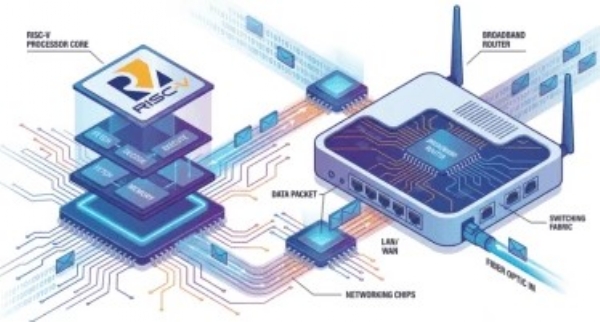
New Delhi, 15 August (H.S.): Chennai-based semiconductor startup Ahisa Digital Innovations, supported under the Design Linked Incentive (DLI) Scheme, has developed a broadband chip named ‘Vihaan’, based on the indigenous VEGA microprocessor. The company achieved first-silicon success for the chip on Independence Day and will now move towards making it production-ready, with production tape-out targeted for 2027.
The Union Ministry of Electronics and Information Technology said ‘Vihaan’ is a networking system-on-chip (SoC) designed for fibre broadband. The chip aims to provide indigenous technology required to expand fibre broadband connectivity to households across India.
Ahisa Digital Innovations is a fabless semiconductor startup engaged in designing chips for broadband networking and security applications. The company taped out ‘Vihaan’ on Republic Day and achieved first-attempt silicon success on Independence Day.
The company has also received backing from investors. Earlier this year, Ahisa raised around Rs. 40 crore from the Tamil Nadu Emerging Sector Seed Fund, managed by the Tamil Nadu Infrastructure Fund Management Corporation (TNIFMC), along with other private investors. The funds are being used for product development and expansion in the semiconductor sector.
According to the government, semiconductor chip design plays a crucial role across the semiconductor value chain. It can contribute up to 50 per cent of total value addition, while accounting for around 15 to 35 per cent of the Bill of Materials (BOM) cost of electronic products.
Keeping this in view, the government is supporting Indian startups through the DLI Scheme to develop chips for a range of strategic and commercial applications. These include satellite communications, drones, surveillance cameras, defence and aerospace systems, automotive applications, the Internet of Things (IoT), artificial intelligence systems, telecommunications equipment and smart meters.
Companies supported under the DLI Scheme have so far completed more than 30 chip-design tape-outs and raised over $100 million in venture capital investment. Meanwhile, advanced chip-design tools have been made available to 455 institutions, including 350 academic institutions and 105 startups.
Under the Chips to Startup (C2S) programme, 71 academic institutions have also completed 245 chip-design tape-outs. The initiative aims to build a future-ready skilled workforce for India's semiconductor sector.
The ministry also highlighted several other recent achievements under the DLI Scheme. These include Vervesemi Microelectronics' BLDC motor-controller chip based on an indigenous microprocessor, Netrasemi's 12-nanometre vision SoC, OptoML's 12-nanometre compute-in-memory SoC and IndiseMici's Bluetooth BLE 6 chip module.
The government's objective is not limited to designing individual chips but to building an entire semiconductor ecosystem covering design, manufacturing, advanced packaging, equipment, materials, research and skilled human resources. In July 2026, Semicon 2.0 was approved with an outlay of Rs. 1,27,500 crore.
The achievements of companies such as Ahisa demonstrate that chips designed in India are no longer confined to laboratories. They are being fabricated, tested and validated, and are progressing towards customer trials and large-scale production.
---------------
Hindusthan Samachar / Jun Sarkar

15 Aug 2026
‘Potential of youth if not utilised, they will be burden to the society’: Dr Mohan Bhagwat
15 Aug 2026