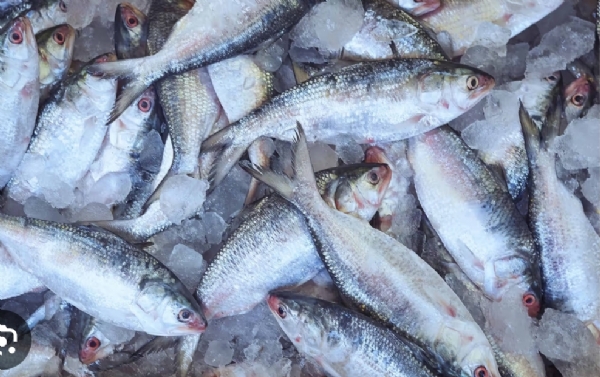
New Delhi, 12 August (H.S.): The iconic hilsa fish, which had almost disappeared from the upper reaches of the Ganga for decades, has made a significant comeback. The discovery of hilsa near Tanda Khurd village in Uttar Pradesh’s Chandauli district is being viewed as an important development for the river’s ecosystem, aquatic biodiversity and the livelihoods of fishing communities dependent on the Ganga.
Historically, hilsa migrated from the Bay of Bengal through the Ganga to Varanasi, Prayagraj and areas further upstream. However, the commissioning of the Farakka Barrage in 1975 severely disrupted its migratory route, leading to a sharp decline in hilsa populations across the middle and upper stretches of the Ganga.
The Indian Council of Agricultural Research (ICAR) said on Wednesday that a long-term conservation and restoration programme for hilsa has been jointly undertaken by the ICAR-Central Inland Fisheries Research Institute (ICAR-CIFRI), Barrackpore, and the National Mission for Clean Ganga (NMCG) since 2019.
Under the programme, more than 385,000 juvenile and adult hilsa had been released into the river by June 2026. In addition, over four million fertilised eggs were introduced into the Ganga as part of efforts to strengthen the species’ population.
The initiative has also involved the release of approximately 940,000 hatchery-produced spawn. Researchers have undertaken fish tagging, monitoring and migration studies, while artificial breeding and stock enhancement techniques have been employed to support hilsa conservation and rehabilitation.
According to the research institute, monitoring between 2023 and 2025 recorded released hilsa migrating upstream as far as Mirzapur. The discovery of two hilsa in Chandauli has now provided stronger evidence that the species may be gradually reclaiming portions of its historic migratory range. The two fish were reported to have a combined weight of 740 grams.
Hilsa is a sensitive migratory species, and its presence in the upper Ganga is considered an important biological indicator of improvements in river connectivity, habitat quality and overall ecological conditions.
Dr Pradeep De, Director of ICAR-CIFRI, said the restoration of fisheries resources should be viewed as part of a broader effort towards ecological recovery and sustainable livelihoods. He stressed the need to consider fish migration, riverine habitats, biodiversity, water management and the needs of fishing communities together while planning conservation measures.
The return of hilsa could improve fish availability and create additional livelihood opportunities for communities dependent on the river. The development could also serve as a model for restoring other native and migratory aquatic species in the Ganga, strengthening efforts to revive the river’s ecological health.
---------------
Hindusthan Samachar / Jun Sarkar

12 Aug 2026
PM Modi Urges Youth to Learn from Life Struggles at Launch of Ram Nath Kovind’s Autobiography

12 Aug 2026