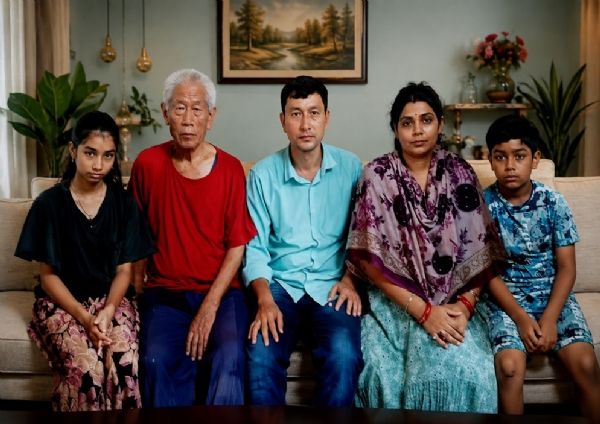
Tirodi, Balaghat, 10 August (H.S.): In the quiet, remote village of Tirodi in Madhya Pradesh’s Balaghat district, a remarkable story of war, migration, belonging and bureaucracy continues to unfold. Fourteen-year-old Kanak Wang and his eight-year-old brother, Praneet, have never set foot on Chinese soil. They were born and raised in India, speak the local Bundeli dialect of Hindi and regard India as their home.
Yet, despite their deep-rooted connection with the country, the administrative system has left them struggling to obtain a basic document, a caste certificate. The reason is deeply technical. Their paternal lineage traces back to their grandfather, Wang Qi, a former Chinese soldier who came to India during the aftermath of the 1962 Sino-Indian War. Under the prevailing revenue regulations, officials say there is no recognised Indian caste in the children's paternal lineage. Consequently, they have been unable to establish the caste status required for several educational and welfare-related purposes.
A Soldier Who Crossed the Border in the Aftermath of War
The story began more than six decades ago. In January 1963, when the bitterness of the 1962 Sino-Indian War had barely subsided, Wang Qi, a young surveyor associated with the Chinese People's Liberation Army (PLA), crossed into Indian territory in the Tawang sector of Arunachal Pradesh.
Indian security forces detained him. As the war had already ended, he was not treated as an ordinary prisoner of war. Instead, he was regarded as a person of enemy origin and was suspected of espionage. What followed was the beginning of a prolonged ordeal that would ultimately change the course of his entire life.
Years Behind Bars, Then an Unexpected New Home
Wang Qi underwent legal proceedings and spent approximately seven to eight years in Punjab's Central Jail and other prisons in Rajasthan. Thousands of kilometres away, his family in China believed that he had died during the war. Chinese official records eventually listed him as dead. When Indian authorities released Wang Qi from prison in March 1969, however, he was not immediately deported to China. Instead, he was ordered to settle in Tirodi, then a remote mining area in Balaghat district.
Suddenly confronted with an unfamiliar environment, a different language and an entirely new society, Wang Qi had to rebuild his life from nothing. He adopted the local name 'Raj Bahadur' to integrate more easily into the community. He established a small flour mill and grocery shop to earn a living.
Marriage, Family and a New Sense of Belonging
It was in Tirodi that Wang Qi met Sushila, a woman from the local Kunbi community, which falls under the Other Backward Classes (OBC) category in India. The two married and started a family. One of their children was Vishnu Wang, the father of Kanak and Praneet.
Over the years, India ceased to be merely the country in which Wang Qi had been stranded. It became his home. His family, livelihood, relationships and memories were all rooted in Tirodi. Yet there remained a fundamental contradiction in his official status: while his life was increasingly Indian, government records continued to classify him as a foreign national.
After 54 Years, a Reunion in China
In 2017, international media attention brought Wang Qi's extraordinary story into the spotlight. His decades-long separation from his family in China attracted widespread attention in both countries.
After waiting 54 years, Wang Qi finally travelled to his ancestral province of Shaanxi, accompanied by his son Vishnu and other family members.
The reunion with his siblings after more than half a century was profoundly emotional. The story received extensive coverage in the Chinese media and appeared, for a brief moment, to offer closure to a life shaped by war and separation. But the bureaucratic ordeal did not end with his return to his ancestral homeland.
Neither Fully Reclaimed by China Nor Fully Settled in India
When Wang Qi sought his outstanding salary and pension from the Chinese government and military, the Chinese Ministry of Defence reportedly asked him to produce original military service documents dating back to the 1960s.
Those documents had been lost amid the upheaval surrounding the war. Without the required records, China declined to provide him with financial assistance or a military pension. In effect, the man who had once served in the Chinese military was left without the recognition he had expected from his country of birth. Wang Qi eventually returned to India. By then, his family, children, grandchildren and decades of memories were firmly rooted in Tirodi.
An Elderly Man Facing the Threat of Deportation
His return to India, however, did not resolve his legal predicament. Wang Qi had never acquired definitive Indian citizenship documents or a voter identity card. Instead, the Indian authorities had been granting him temporary visas and extensions on the basis of a Chinese passport issued by the Chinese Embassy in 2013.
The situation took a more serious turn when the Foreigners Regional Registration Office (FRRO), under the Ministry of Home Affairs, reportedly issued a notice to his son, Vishnu, stating that Wang Qi's visa had expired and warning of deportation if his legal status was not regularised. Now 86 years old, Wang Qi faces the possibility of being removed from the country where he has spent the overwhelming majority of his adult life.
The Third Generation Pays the Price
The most poignant consequence of this six-decade-old legal and administrative uncertainty is now being borne by the youngest members of the family. Kanak and Praneet need caste certificates for school-related requirements, scholarships and future higher education opportunities. Their father, Vishnu Wang, approached the local revenue authorities to obtain the certificates. The application was rejected, with officials citing the existing rules governing the determination of caste status.
Under the prevailing administrative framework, caste status is generally determined through the paternal lineage. In this case, however, the paternal line leads back to Wang Qi, a man of Chinese origin. Since China does not have India's caste system, the authorities say there is no recognised caste lineage that can be established through the paternal side.
A Mother's Indian Identity, But No Certificate Through the Maternal Line
The family argues that both the children's mother and grandmother belong to the Indian Kunbi community. Yet officials maintain that issuing a caste certificate on the basis of maternal lineage would not conform to the applicable revenue rules. This has created an extraordinary administrative deadlock.
The children were born in India. They have grown up in India. Their language, social environment, education and everyday lives are Indian. Nevertheless, their grandfather's foreign origin has become the decisive factor in determining whether they can obtain a document that may directly affect their educational future.
Caught Between Two Administrative Worlds
The situation has consequently created a profound identity dilemma for the family.
The children have no lived connection with China, yet their paternal lineage is linked to a Chinese national. At the same time, their family has spent generations in India, but their legal and administrative position does not provide them with access to every benefit available to families with an established Indian caste lineage.
For Vishnu Wang, the situation has become particularly painful.
He has repeatedly maintained that he was born in India, considers himself Indian and respects the country's laws. But faced with the prospect that bureaucratic technicalities could obstruct his children's education and opportunities, he has reportedly expressed his frustration in stark terms.
'Then Send the Entire Family Back to China'
Vishnu's message is both emotional and deeply challenging: if administrative complexities are going to prevent his children from receiving education and basic rights, then the government should dismantle the maze of paperwork and deport the entire family, including his elderly father, to China.
The statement reflects not a desire to abandon India, but the desperation of a family caught in a legal grey zone that has persisted across three generations.
When Rules Collide With the Reality of a Family's Life
The Wang family's experience raises difficult questions about the relationship between administrative rules and lived reality. Can a family that has spent more than half a century in India, formed marital and social relationships here, raised children here and developed deep roots in an Indian community continue to be treated solely through the technical lens of a foreign national's lineage?
And when the consequences of such classification fall upon children who had no role whatsoever in the events of 1962, should the administration have room to consider humanitarian circumstances? These are not simple questions. The rules governing citizenship, foreign nationals, caste certification and access to welfare benefits exist for legitimate administrative purposes. At the same time, exceptional cases can expose gaps where rigid application of rules collides with extraordinary human circumstances.
The Children's Future Must Not Become a Casualty of History
India's judicial system has, in certain exceptional circumstances, recognised the relevance of maternal lineage in matters concerning social identity and legal rights. Yet at the grassroots level, revenue officials are required to work within established rules and documentary requirements. That is precisely where the Wang family's predicament has become so difficult.
For officials, the problem may be a matter of documents, lineage and regulations. For Kanak and Praneet, however, it is about school, scholarships, higher education and the possibility of building a secure future. The two children are growing up in Tirodi, playing in its streets and living an entirely Indian childhood. They know little of the 1962 conflict that set their family's extraordinary journey in motion. Yet the consequences of that distant war continue to follow them.
A Six-Decade-Old File and an Uncertain Tomorrow
Wang Qi's story began with a border crossing during the turbulent aftermath of a war. It continued through imprisonment, separation from his family, an unexpected life in a remote Indian village, marriage, children and grandchildren. Six decades later, the central question is no longer about a soldier who crossed a border in 1963. It is about a family that has spent generations trying to establish where it belongs.
The tragedy is that the youngest members of the family may now inherit the consequences of a conflict they were never part of. As Kanak and Praneet continue their childhood in Tirodi, a decades-old war, conflicting nationality records and an inflexible bureaucratic framework threaten to overshadow their aspirations.
Their story ultimately presents a larger question for the Indian administrative system: when an extraordinary human life does not fit neatly into an ordinary government file, should the file prevail, or should the system find a humane way to accommodate the reality of that life?
---------------
Hindusthan Samachar / Mayank Chaturvedi

10 Aug 2026
Kerala’s Seafood exports bring in nearly Rs 7,000 cr as global demand holds firm
Kerala’s Seafood exports bring in nearly Rs 7,000 cr as global demand holds firm..