- ‘The Rising Bharat’ National Seminar Deliberates on the Indian Knowledge Tradition, Hindutva, Economy, Tribal Pride and Contemporary Discourses
- More than 160 Research Papers Presented; Four Padma Shri Awardees, Vice-Chancellors of Over 12 Universities and 38 Heads of Departments Participate
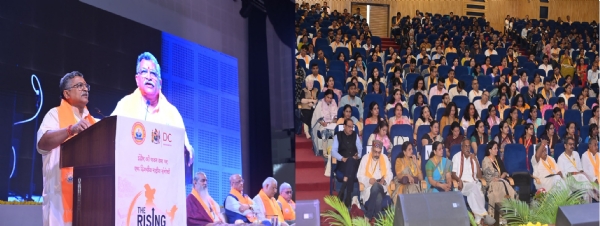
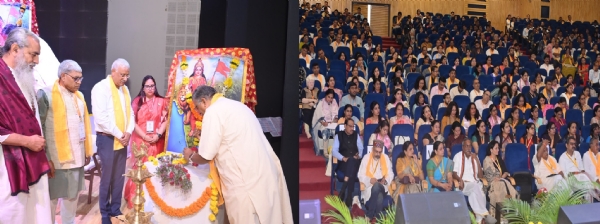
Indore, 10 August (H.S.): The historic and culturally rich land of Malwa in Madhya Pradesh witnessed an unprecedented confluence of knowledge, research and intellectual discourse when more than 600 PhD holders gathered on a single day and on a single platform at the national seminar organised on the theme ‘Gyanam Param Balam- The Rising Bharat’.
Organised by the World Association of Hindu Academicians (WAHA), the event was described by the organisers as a historic gathering of the academic community. Information shared by the organisers on the previous day stated that the simultaneous presence of such a large number of researchers and PhD holders was itself a unique achievement. Held in Indore, the land associated with the justice and good governance of Ahilyabai Holkar, the seminar provided a broad platform for connecting the Indian knowledge tradition with contemporary academic discourse.
The Direction of a Strong Nation Will Emerge from Educational Institutions
The keynote speaker and prominent thinker Milind Parande, while highlighting the global relevance of India’s cultural philosophy, Hindutva and the Indian knowledge tradition, said that understanding India’s own knowledge tradition and philosophical outlook is essential for the country’s progress. He said there was a need to develop positive and empowering discourse within the country’s educational institutions that connects India with its cultural and intellectual foundations and takes the nation towards its supreme glory.
He particularly emphasised that the humanistic discourse of Hindutva should not remain confined to the emotional level, but should be presented before the world through scientific and academic methods. According to him, the enlightened sections of society and the country’s educational institutions have a highly important role to play in this endeavour.
‘A Maha Kumbh of Intellectual Discourse on the Land of Ahilya’
The inaugural session was presided over by renowned industrialist Vinod Agrawal. Describing the conference organised in this historic city of Ahilyabai Holkar as essential for the revival of the nation and its educational institutions, he said that such events can play an important role in introducing the new generation to India’s authentic cultural perspective and heritage.
The special guest of the seminar and Vice-Chancellor of Devi Ahilya University, Rakesh Singhai, described the integration of the Indian knowledge tradition into education as an important step. He said that research on the Indian knowledge tradition in the context of the New Education Policy could provide a new direction to future academic discourse. According to him, meaningful dialogue between the Indian perspective and modern education can form the basis for wide-ranging transformation in the education system.
Diverse Dimensions of India Reflected in More Than 160 Research Papers
More than 160 research papers were presented during the technical and intellectual sessions of the seminar. These covered a wide range of subjects, including literature, art, science, engineering, astronomy, chemistry, archaeology, computer science, sociology, politics, climate, management, journalism, dance, medical science, geography, astrology and philosophy.
Professors and researchers from Alirajpur, Dhar, Khandwa, Khargone, Barwani, Burhanpur and Indore in the Malwa-Nimar region, as well as from various parts of the country, presented different aspects of Indian society, culture, science and contemporary challenges through their research. As a result, the conference evolved beyond a purely cultural discourse into a multidisciplinary academic dialogue.
Women’s and Tribal Discourses Draw Attention
Women’s discourse was also among the important sessions of the seminar. Keynote speaker Nupur Deshkar presented her views on women’s consciousness and its nature from the Indian perspective. She placed the role of women in the Indian tradition and its social and cultural dimensions at the centre of the discourse.
In the tribal discourse, Laxman Singh Markam and Prakash Uike presented their views on the glorious history, culture and traditions of tribal society. The session underlined the need to view tribal society within the broader context of Indian civilisation and cultural discourse.
Discussion on India’s Growing Role in the Global Economy
In the session focused on the Indian economy and global market forces, prominent thinker and editor of the national magazine Organiser, Prafull Ketkar, and thinker Jitendra Gupta were the keynote speakers. They analysed India’s economic policies and the country’s growing role on global economic platforms. The discussion also considered the opportunities and challenges before India amid the changing global economic landscape. Thus, alongside culture and philosophy, equal importance was accorded to the economy, science, technology and social issues at the conference.
Historic Presence of Vice-Chancellors, Heads of Departments and Principals
The scale of the event can be gauged from the fact that it was attended by four Padma Shri awardees, Vice-Chancellors of more than 12 prominent universities in the country, 38 Heads of Departments and principals of 27 colleges. This gave the event broad representation from the academic community. On the occasion, a grand, colourful souvenir was also published and released, containing material related to the theme, research and intellectual discourse of the seminar.
Arrangements for such a large academic gathering were kept highly organised. The entire programme was coordinated by Dr Sandhya S. Chouksey. The programme commenced with her welcome address. At the conclusion, national poet and prominent participant in the discourse Mukesh Molwa expressed gratitude to the scholars and guests who had arrived from across the country. He also undertook the responsibility of editing the historic souvenir of the seminar. Yash Patidar was responsible for the technical arrangements.
An Effort to Give a New Direction to Academic Discourse
Thus, the one-day seminar ‘Gyanam Param Balam, The Rising Bharat’ placed before everyone the possibility of a broad academic dialogue on the Indian knowledge tradition, modern education and the future of the nation. The central message of the conference remained that the foundation of any strong nation is also built upon its knowledge, research, education and cultural self-awareness. The invocation of ‘Gyanam Param Balam’ emerged here as an effort to carry this very idea from the academic platform to wider society.
---------------
Hindusthan Samachar / Mayank Chaturvedi
10 Aug 2026