New Delhi, 10 August (H.S.): The government aims to raise the annual income of handloom weavers to Rs 10 lakh and transform the sector beyond its traditional boundaries to meet the demands of modern markets, Union Textile Ministry Secretary Neelam Shammi Rao said on Monday.
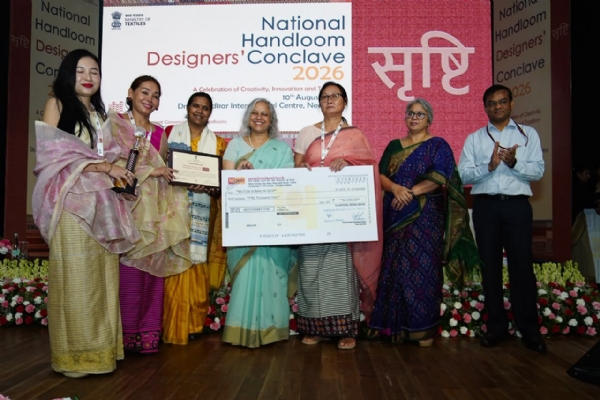
Rao made the remarks while inaugurating the National Handloom Designers Conclave 2026 at the International Ambedkar Bhawan in Delhi. The event focused on strengthening the handloom sector, increasing the earnings of weavers and encouraging younger generations to carry forward the country’s rich weaving tradition.
She said many weavers have traditionally remained confined to producing similar types of sarees, colours and patterns, while the market has evolved into a diverse and multi-layered ecosystem. Alongside traditional handloom production, she noted, a growing number of weavers are adapting their skills and products to changing consumer preferences.
Rao also highlighted the emergence of a premium segment driven by collaborations between designers, companies and weavers, creating new opportunities for high-value handloom products.
According to the Textile Ministry secretary, the limited income of weavers remains one of the biggest challenges facing the handloom sector. She said government schemes, improved access to raw materials and marketing support currently enable many weavers to earn between Rs 1 lakh and Rs 3 lakh annually, which largely helps sustain their livelihoods.
She presented a practical approach to achieving the target of Rs 10 lakh in annual income, explaining that weavers would need to generate products worth approximately Rs 20-30 lakh to reach that level of earnings. She said this could be achieved through better designs, improved quality and stronger access to international markets.
Rao called for greater collaboration among designers from Weaver Service Centres (WSCs), the National Institute of Fashion Technology (NIFT), Visva-Bharati, Indian Institutes of Handloom Technology (IIHTs) and other art and design institutions.
She also said an application-based tool was being developed in collaboration with the Indian Institute of Technology (IIT) to modernise the handloom industry. The tool is expected to allow designers and weavers to visualise how a finished pattern would appear on a garment before the weaving process begins.
The secretary also emphasised the need to integrate basic stitching and decorative embroidery into the production process to promote the concept of ready-to-wear handloom products.
She stressed the importance of using social media marketing effectively to take handloom products to international and niche markets. She also called for startups and young entrepreneurs to be connected with handloom clusters and for Weaver Service Centres and handloom centres to be developed as modern design ateliers.
Several sessions were organised during the conclave, focusing on innovation, design and opportunities for the handloom sector. Winners of the National Handloom Design Contest 2026 were also felicitated for their innovative designs and creative contributions to the sector.
Dr M. Beena, Development Commissioner for Handlooms and Handicrafts, Deputy Director General Akhilesh Kumar, officials associated with the textile sector, designers and National Award-winning weavers were also present at the event.
---------------
Hindusthan Samachar / Jun Sarkar
10 Aug 2026