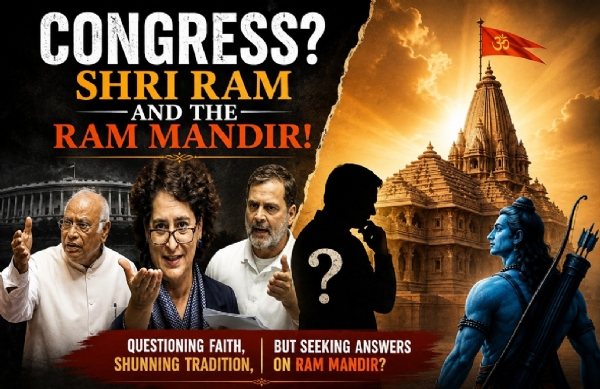
Congress-Bhagwan Ram: Can a Contested Past Sustain a Moral High Ground?
Holding the government accountable in Parliament is a natural part of the democratic process; however, when a political party adopts an aggressive stance on an issue regarding which its own historical record has repeatedly been mired in controversy, several ethical questions naturally arise. This holds true even when the Congress appears to be attacking the government in Parliament today over issues related to the Ram Mandir.
Persistent disruptions have characterized the proceedings in both the Lok Sabha and the Rajya Sabha recently. While the right to dissent is indisputable in a democracy, this right cannot justify the continuous stalling of parliamentary proceedings. According to parliamentary data, approximately ₹9 crore of public money is spent daily on about six hours of parliamentary proceedings. This works out to an expenditure of roughly ₹1.5 crore per hour and ₹2.5 lakh per minute. Whether the House functions or not, this cost is borne by the nation's taxpayers. In this context, the question of accountability towards democracy also comes to the fore.
Amidst the current deadlock, the Congress is raising issues regarding alleged irregularities in the offerings and management of the Ram Mandir. If any irregularities have occurred in the administration of a religious trust or temple, an impartial inquiry must be conducted and action taken against the guilty in accordance with the law. Yet, a parallel question is equally significant: does the Congress's own political history grant it the moral standing to take the lead in speaking on the issue of Bhagwan Shri Ram and the Ram Mandir?
2007: When Ram Setu Became a Subject of National Debate
In 2007, the Congress-led United Progressive Alliance (UPA-1) government was in power at the Centre. The government was advancing the Sethusamudram Shipping Canal Project, which aimed to develop a new maritime route for ships between the Gulf of Mannar and the Palk Strait. The project proposed dredging a section of Ram Setu. This sparked the controversy and led the matter to the Supreme Court.
In an affidavit submitted to the Supreme Court in September 2007, the Central Government stated that the ‘Valmiki Ramayana’ and ‘Ramcharitmanas’ were not historical documents upon which the historical existence of Bhagwan Shri Ram could be proven. It further asserted that Ram Setu was not evidence of a man-made bridge but rather a chain of naturally formed sand shoals.
This affidavit proved to be deeply hurtful to the religious sentiments of millions of people. Widespread protests erupted across the country. From seers and saints to various social organizations-political parties, many condemned the move as an attempt to deny the existence of Bhagwan Shri Ram. Faced with an intense public backlash, the Central Government was ultimately compelled to withdraw the affidavit.
Statements That Exacerbated the Controversy
The Ram Setu controversy was not confined to the courts alone. At the time, senior Union Minister Kapil Sibal publicly stated that there was no concrete scientific evidence to support the claim that Ram Setu was man-made. Meanwhile, M. Karunanidhi, leader of the Dravida Munnetra Kazhagam (DMK), a key ally of the UPA government, made a highly controversial remark questioning the existence of Bhagwan Shri Ram. In a sarcastic tone, he asked which engineering college Ram had attended and what degree he held, had he indeed built the bridge. Although Karunanidhi was not a member of the Congress party, he was one of the most influential allies of the UPA government and a minister from his party, T.R. Baalu, was overseeing the Sethusamudram project. Consequently, these statements were viewed in the context of the UPA government's political sensitivities at the time.
This entire episode reinforced the perception that the Congress viewed Bhagwan Ram and the cultural symbols associated with Him not through the lens of faith, but rather as subjects of political and legal discourse. This is precisely why, whenever the Congress demands answers from the government in Parliament regarding the Ram Mandir today, these past incidents inevitably become part of the conversation. This gives rise to a moral question, the answer to which lies less in political accusations and counter-accusations, and more in the party's own historical conduct.
Even after the Ram Setu controversy, the issue of Bhagwan Ram and the Ram Janmabhoomi has continued to cause political discomfort for the Congress from time to time. Questions were raised, in particular, regarding the party's role during the final judicial phase of the Ayodhya dispute. In December 2017, during the Supreme Court hearings on the Ram Janmabhoomi case, senior advocate and Congress leader Kapil Sibal appeared on behalf of the Sunni Waqf Board. He urged the court to defer the hearing of this sensitive matter until after the Lok Sabha elections, arguing that the dispute could have political repercussions.
Although the court ultimately did not accept this plea, the incident fostered the perception that the Congress viewed the issue more through a political lens than as a matter for judicial resolution. Subsequently, when construction of the Shri Ram Janmabhoomi temple in Ayodhya began following the Supreme Court's historic verdict, it was expected that the occasion would be viewed as a matter of cultural heritage, transcending political boundaries. However, that did not happen.
Staying Away from the Consecration Ceremony: Was It Merely a Political Decision?
The historic consecration ceremony of Ram Lalla took place in Ayodhya on January 22, 2024. Beyond being a religious ritual, it was a cultural celebration marking the culmination of centuries of waiting and a long judicial process for Hindus and Indians across the globe. Saints, scholars, eminent personalities from various fields and representatives of numerous political parties from India and abroad participated in the event. However, amidst all this, the Congress party declined the invitation. Party General Secretary Jairam Ramesh issued an official statement describing the event as a political program of the Bharatiya Janata Party (BJP) and the Rashtriya Swayamsevak Sangh (RSS).
This raised a new question. If the Congress viewed it as a political party's event back then, why is the same party so vocal today regarding the management of the Ram Mandir and related issues? If the temple's inauguration was deemed political, would the current parliamentary deadlock over the temple not also be considered political? It is this very contradiction that places the Congress party's current stance under scrutiny.
Statements by Leaders and Emerging Political Perceptions
Statements made by several senior Congress leaders regarding the Ram Mandir and Bhagwan Shri Ram have also sparked controversy from time to time. In December 2023, Sam Pitroda, the then-Chairman of the Indian Overseas Congress, questioned whether the Ram Mandir was a genuine issue for the country, expressing concern that the entire nation was preoccupied with the temple and the lighting of lamps. The act of lighting lamps before the deity worshipped by millions seemed to irk Sam Pitroda. Was this not an insensitive remark regarding the religious sentiments of millions of devotees?
Former Union Minister Mani Shankar Aiyar also publicly questioned the historicity of Ram Janmabhoomi, asking how it could be ascertained that Bhagwan Ram was born at the exact spot where the Babri Masjid once stood. He expressed direct skepticism regarding the birthplace of Shri Ram. Subsequently, in August 2026, Congress MP Pramod Tiwari questioned the religious ritual of the ‘Pran-Pratishtha’ of Ram Lalla, terming it inauspicious.
In a similar vein, highly objectionable remarks made by Rahul Gandhi regarding Bhagwan Ram during a discussion at Brown University in the US in May 2025 also became a subject of widespread debate. He described Bhagwan Ram as a mythological and fictional character.
An Ethical Question Before the Congress
Against the backdrop of these events, whenever the Congress corners the government in Parliament over allegations concerning the Ram Mandir's offerings and management, its own past naturally confronts it. If any financial or administrative irregularities have occurred, an impartial inquiry must be conducted and action taken against the guilty in accordance with the law. No one can object to this; however, political morality is not defined solely by current allegations, it is also shaped by past conduct.
In this context, Parliamentary Affairs Minister Kiren Rijiju rightly observed that those who once opposed Ram and the Ram Mandir should first apologize to the nation for their past statements and stances. Undoubtedly, in Indian society, Bhagwan Ram symbolizes propriety (maryada), justice, sacrifice, duty and cultural unity; therefore, viewing any issue related to Him merely through a political lens would be a grave error in understanding the sentiments of the Indian people.
Today, the biggest question facing the Congress is not whether it can raise questions about the Ram Mandir's management, that is its right in a democracy. The real question is whether it has ever introspected on those past decisions, government affidavits and statements by its leaders that led a large section of the country to believe the Congress was uncomfortable with the faith associated with Bhagwan Ram.
No one should forget that in a democracy, rights and responsibilities go hand in hand. If a political party claims moral high ground in the present without reckoning with its past, the credibility of its arguments inevitably comes under scrutiny. Perhaps this is why, with every political attack the Congress launches today regarding the Ram Mandir, its own history appears to stand in parallel and it is that very history that poses the most difficult question: that the Congress, at the very least, should not speak of morality and ethical values.
---------------
Hindusthan Samachar / Mayank Chaturvedi
10 Aug 2026
Kerala’s Seafood exports bring in nearly Rs 7,000 cr as global demand holds firm
Kerala’s Seafood exports bring in nearly Rs 7,000 cr as global demand holds firm..