New Delhi, 09 July (H.S.):
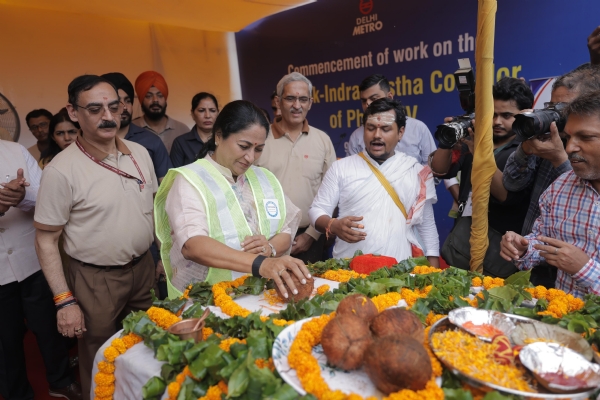
Delhi Chief Minister Rekha Gupta on Thursday inaugurated the construction of the DChief Minister Rekha Gupta Launches Construction of Inderlok–Indraprastha Metro Corridorelhi Metro Rail Corporation's (DMRC) Inderlok–Indraprastha Metro Corridor at the Sarai Rohilla Metro Station project site. The occasion marked the commencement of diaphragm wall construction at Sarai Rohilla Metro Station, the first phase of this major infrastructure project. She said that the Delhi Metro is not merely a public transport system but the foundation of a developed Delhi.
The Chief Minister said that under the leadership of Prime Minister Narendra Modi, India is witnessing rapid development of modern, world-class infrastructure. She added that, in line with this vision, the Delhi Government is working in close coordination with the Central Government and the Delhi Metro Rail Corporation to further strengthen the capital's public transportation network.
She said the 12.377-kilometre Inderlok–Indraprastha Corridor will be a fully underground extension of the Delhi Metro's Magenta Line (Line 8). The corridor will comprise 10 modern underground stations at Inderlok, Daya Basti, Sarai Rohilla, Ajmal Khan Park, Jhandewalan Mandir, Nabi Karim, New Delhi, Delhi Gate, Delhi Secretariat–IG Stadium, and Indraprastha.
According to the Chief Minister, upon completion of the project, the total length of the Magenta Line will increase to nearly 89 kilometres, making it the longest line in the Delhi Metro network. It will also have the highest number of interchange stations and underground stations, significantly improving travel speed, convenience, and connectivity across the capital.
The corridor will be integrated with seven major Delhi Metro lines, providing seamless connectivity across the city. Interchange facilities will be available with the Red and Green Lines at Inderlok, the Magenta Line at Nabi Karim, the Yellow Line and Airport Express (Orange Line) at New Delhi Station, the Violet Line at Delhi Gate, and the Blue Line at Indraprastha Station.
The new metro corridor will provide improved connectivity to several important locations, including Sarai Rohilla Railway Station, New Delhi Railway Station, the Delhi Secretariat, Jhandewalan Temple, Arun Jaitley Stadium, Indira Gandhi Indoor Stadium, Delhi Gate, Kartavya Path, India Gate, the National War Memorial, and the Central Vista.
Sarai Rohilla Station will be one of the most significant stations on the corridor. It will connect densely populated areas of Central Delhi, educational institutions, commercial establishments, Karol Bagh Market, Liberty Cinema, Desh Bandhu Gupta Road, and other key localities to the modern metro network, making public transport more accessible and efficient for residents.
The Chief Minister said that the continued expansion of the Delhi Metro network is also a major step towards environmental sustainability and cleaner urban development. As more people opt for public transportation, dependence on private vehicles will decline, helping reduce traffic congestion, fuel consumption, and carbon emissions. She said this would contribute to improving Delhi's air quality and strengthening environmental conservation efforts.
She reiterated that the Delhi Government's objective is to provide the capital with a world-class, modern, and environmentally sustainable public transport system that ensures safe, convenient, and reliable mobility for every citizen.
---------------
Hindusthan Samachar / Jun Sarkar