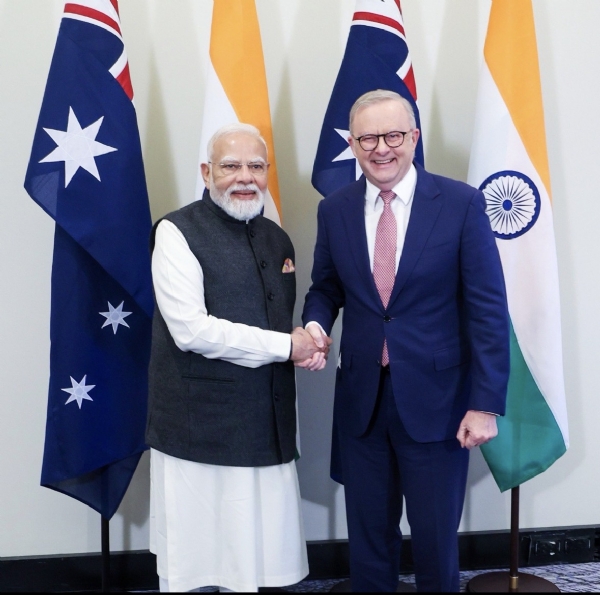
Melbourne/New Delhi, 09 July (H.S.): India and Australia have announced the launch of the Australia–India Partnership on Cyber, Critical Technologies and Supply Chains (PACTS) to elevate bilateral cooperation in cybersecurity, critical technologies, and resilient supply chains. The new framework will replace the 2020 Australia–India Framework Arrangement on Cyber and Cyber-Enabled Critical Technology Cooperation.
According to the Prime Minister's Office (PMO), both countries acknowledged that secure supply chains, critical technologies, and cybersecurity have become fundamental pillars of economic growth and national security. They also recognised their growing importance in shaping global standards and values. With this objective, India and Australia have decided to broaden and deepen their existing cooperation through the launch of the PACTS partnership.
During his visit to Australia, Prime Minister Narendra Modi, following bilateral talks with Australian Prime Minister Anthony Albanese in Melbourne, said in the joint statement that the new partnership would strengthen national and regional security, provide partner countries with greater digital choices, build more resilient critical supply chains, and enhance global cybersecurity capabilities. He said the partnership would place security, trust, inclusivity, and democratic values at the centre of all its initiatives.
The two countries have identified five key pillars for cooperation under the new framework. These include supply chain resilience and diversification, critical technologies, cybersecurity, digital resilience, and defence research collaboration.
Under the supply chain resilience and diversification pillar, India and Australia will work to strengthen secure and trusted supply chains. The initiatives include developing trusted vendor frameworks, enhancing the security of submarine cable networks across the Indo-Pacific, promoting joint research on semiconductor supply chain security, and establishing reliable supply chains for critical minerals.
In the field of critical technologies, the two countries will expand collaboration in artificial intelligence (AI), space technology, telecommunications, biotechnology, and advanced materials. They have agreed to work together to develop international standards for safe and trustworthy AI based on democratic values, strengthen research and innovation partnerships, and explore opportunities for joint projects in the space sector.
Under the cybersecurity pillar, India and Australia will enhance cooperation in combating cybercrime, preventing malicious cyber activities, protecting critical national infrastructure, and coordinating on cyber-related issues within the framework of the United Nations. The two countries have also agreed to establish an integrated bilateral mechanism for cooperation in cybersecurity and information and communication technologies (ICT), as well as dedicated incubator hubs to promote cyber skills development.
In the area of digital resilience, India and Australia will jointly develop and promote Digital Public Infrastructure (DPI)-based solutions across the Indo-Pacific region. The partnership will support collaborative projects in sectors such as clean energy, healthcare, social security, education, skill development, and digital transformation.
Under defence research cooperation, both countries will work to develop a shared understanding of multidimensional defence challenges and future capability requirements. Institutional collaboration between Australia's Defence Science and Technology Group (DSTG) and India's Defence Research and Development Organisation (DRDO) will be strengthened. The two sides also agreed to promote greater engagement between their defence innovation ecosystems and start-up communities.
Oversight of the PACTS partnership will be jointly undertaken by the Deputy Secretary of the International and Security Group in Australia's Department of the Prime Minister and Cabinet and India's Deputy National Security Adviser. Senior officials from both countries will meet annually to review progress across the partnership and identify new areas of collaboration.
Both countries said the PACTS partnership will provide fresh momentum to bilateral cooperation in cybersecurity, critical technologies, and resilient supply chains, while making a significant contribution to stability, security, and economic prosperity across the Indo-Pacific region.
---------------
---------------
Hindusthan Samachar / Jun Sarkar

10 Jul 2026
PM Modi, Albanese Visit Melbourne Cricket Ground, Reaffirm People-to-People Ties Through Sport
10 Jul 2026
PM Modi Extends Birthday Wishes to Rajnath Singh, Hails His Contribution to India's Defence Strength
10 Jul 2026