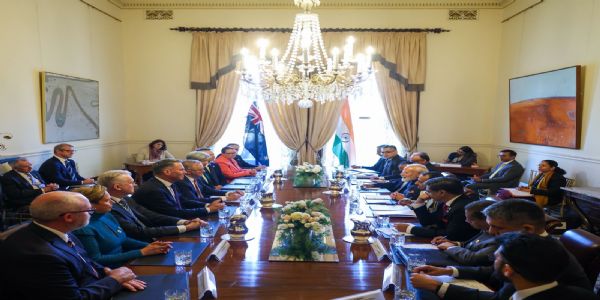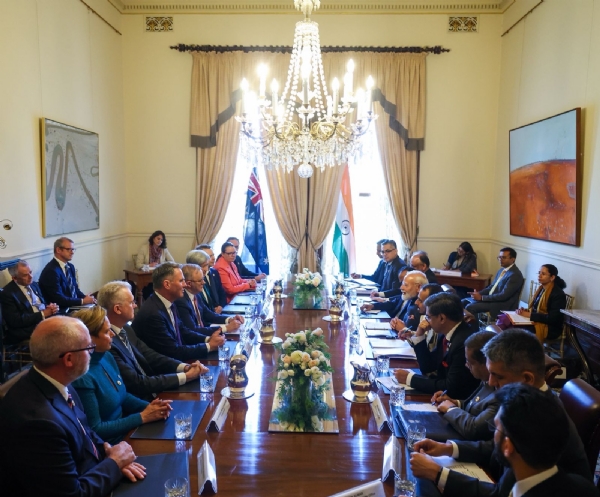
Melbourne/New Delhi, 09 July (H.S.): India and Australia on Thursday adopted 18 major agreements and initiatives under their Comprehensive Strategic Partnership, covering a wide range of sectors, including defence, maritime security, energy—particularly civil nuclear cooperation—cybersecurity, education, skill development, mining, science, technology, and cultural heritage.
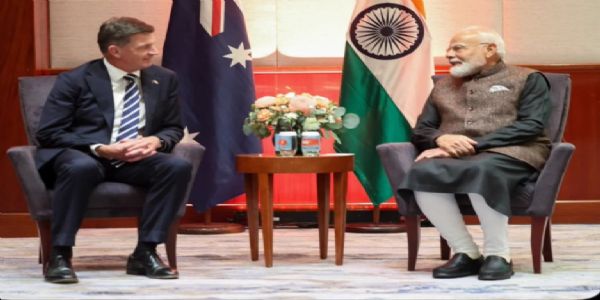
Prime Minister Narendra Modi held substantive bilateral talks with Australian Prime Minister Anthony Albanese in Melbourne. Among the key outcomes of the meeting, Australia agreed to supply uranium to India under the bilateral civil nuclear cooperation framework. Australia also announced the return of three ancient Indian artefacts, while both countries expanded the scope of their defence cooperation by incorporating several new areas of collaboration.
During the discussions, the two leaders reviewed the significant progress achieved under the India–Australia Comprehensive Strategic Partnership. In the joint statement issued after the talks, Prime Minister Modi said, We have decided to expedite negotiations on the Comprehensive Economic Cooperation Agreement (CECA).
The Prime Minister also outlined the shared perspectives of both nations on key global issues. He said India and Australia believe that terrorism is not merely a threat to any one country but a grave challenge to humanity as a whole. He added that both nations remain unwavering in their shared resolve to combat terrorism.
He further said that India and Australia believe that the ongoing conflicts and tensions in different parts of the world can only be resolved through dialogue and diplomacy. The two countries reaffirmed their commitment to strengthening peace, stability, freedom of navigation, and a rules-based order across the Indo-Pacific region. They also agreed to deepen cooperation under the Australia–Canada–India Technology and Innovation Partnership.
The process of repatriating Indian cultural heritage also received a major boost, with Australia agreeing to return three ancient artefacts from Tamil Nadu. These include a granite sculpture of Nandi, the sacred bull and vehicle of Lord Shiva, dating from the 11th–12th century; a bronze sculpture of Bhadrakali with a trident from the 11th century; and a basalt sculpture of the six-headed Skanda (Kartikeya) dating from the 12th century.
Among the major agreements concluded between the two countries was the renewal of the Joint Declaration on Defence and Security Cooperation. The renewed framework will strengthen military interoperability, maritime domain awareness, defence industry collaboration, cybersecurity, counter-terrorism cooperation, humanitarian assistance and disaster relief, and broader cooperation across the Indo-Pacific region.
The two sides also agreed on a Maritime Security Cooperation Roadmap, a Joint Statement on Energy Security, the finalisation of administrative arrangements under the India–Australia Civil Nuclear Cooperation Agreement, and the Partnership for Cyber, Critical Technology and Supply Chains (PACTS). Additional agreements were signed to enhance cooperation between the Indian Coast Guard and the Australian Maritime Border Command, as well as for the deployment of an Indian military instructor at the Australian Defence College during 2028–29.
In the fields of education and skill development, Australia will support the establishment of a Centre of Excellence for Mining and Mining Equipment at the National Skill Training Institute in Bhubaneswar. Flinders University will establish a campus in Bengaluru, while Victoria University will set up an educational campus in Gurugram.
The two countries also signed agreements to strengthen the quality of vocational education, scientific research, geosciences, traditional knowledge, film education, and innovation. In addition, a Rooftop Solar Training Academy in Gandhinagar will be operationalised with Australian cooperation to provide specialised training for India's growing green energy sector.
---------------
Hindusthan Samachar / Jun Sarkar
10 Jul 2026
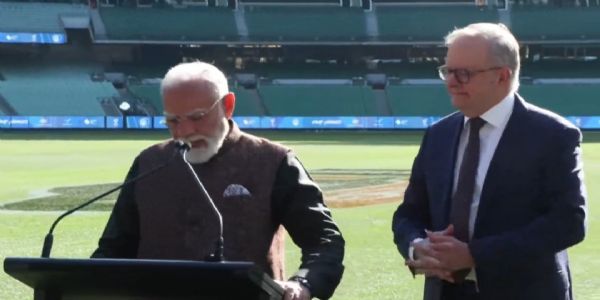
PM Modi, Albanese Visit Melbourne Cricket Ground, Reaffirm People-to-People Ties Through Sport
10 Jul 2026
PM Modi Extends Birthday Wishes to Rajnath Singh, Hails His Contribution to India's Defence Strength
10 Jul 2026