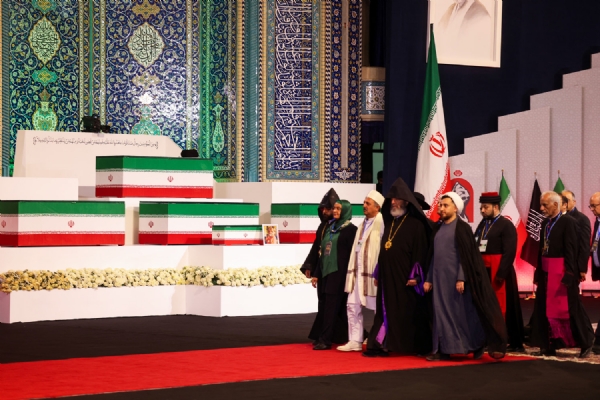
Tehran, 04 July (H.S.): Iran has commenced a week-long series of funeral ceremonies for its late Supreme Leader, Ayatollah Ali Khamenei, with thousands of mourners, senior Iranian officials and foreign dignitaries gathering in the capital to pay their final respects. The ceremonies began on Friday and will continue until his burial on Monday, July 6, following his death in Israeli and U.S. airstrikes on February 28.
Khamenei's body has been placed in state at the Imam Khomeini Grand Mosalla in Tehran, one of the country's largest religious and ceremonial complexes. Authorities have implemented extensive security measures around the venue, deploying riot police and erecting barricades as large crowds assembled overnight ahead of the public viewing.
Iranian President Masoud Pezeshkian, Parliament Speaker Mohammad Bagher Ghalibaf, senior military commanders and leading clerics were among the first to offer prayers before the coffin. Ahmad Vahidi, the commander of Iran's Islamic Revolutionary Guard Corps, also made a rare public appearance during the ceremonies, marking one of his first appearances since the recent regional conflict.
The funeral has drawn delegations from across Asia and the Middle East. Representing India, Union Minister of State for External Affairs Pabitra Margherita and Bihar Governor Syed Ata Hasnain attended the mourning ceremony on Friday, conveying condolences on behalf of the Government and the people of India. The Indian delegation also expressed sympathy to the families affected by the recent conflict in West Asia.
Pakistan Prime Minister Shehbaz Sharif arrived in Tehran alongside Army Chief Field Marshal Asim Munir and other senior officials to attend the ceremonies. Former Russian President Dmitry Medvedev, acting as a special envoy of Russian President Vladimir Putin, also paid tribute to Khamenei. Delegations from Saudi Arabia, Afghanistan and several other countries attended the mourning events, highlighting the regional significance of the funeral despite continuing political tensions.
The funeral proceedings are taking place against the backdrop of a fragile ceasefire between Iran, the United States and Israel after months of military confrontation. Although hostilities have largely subsided, Iranian leaders have warned that Tehran could resume military measures if the terms of the ceasefire are not respected.
Regional tensions remain elevated. On Friday, Yemen's Houthi movement warned Saudi Arabia against alleged violations of its airspace, threatening to target Saudi airports and strategic facilities if any aggression occurred. Meanwhile, Israel's military announced that it had carried out strikes on Hezbollah positions in southern Lebanon in response to attacks on its troops.
Energy markets reacted cautiously to the evolving situation. International oil prices edged slightly higher on Friday as investors monitored diplomatic efforts aimed at preserving stability in the region ahead of the U.S. Independence Day holiday.
According to Iranian authorities, Khamenei's remains will remain at the Grand Mosalla until Monday before the final burial ceremony on July 6. Millions of mourners are expected to participate in the public funeral, making it one of the largest state ceremonies in Iran's recent history. The event is widely seen as both a national farewell to the country's longest-serving leader and a significant moment in shaping Iran's political future following the appointment of its new Supreme Leader.
---------------
Hindusthan Samachar / Jun Sarkar

04 Jul 2026