Dr. Mayank Chaturvedi
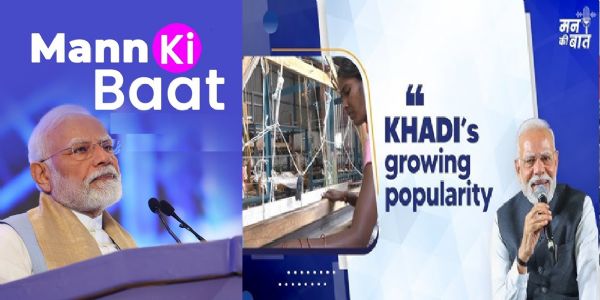
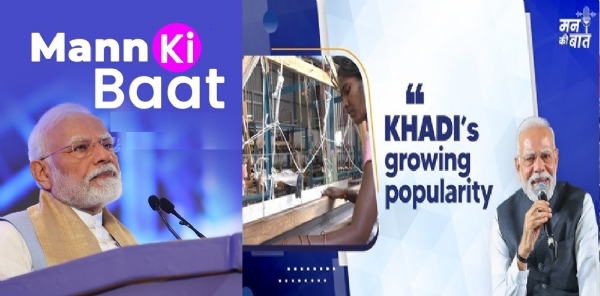
“I would particularly like to mention ‘Khadi’. We all know that ‘Khadi’ was very dear to Mahatma Gandhi. In recent years, ‘Khadi’ has become quite popular. Its sales have increased six-fold over the last 12 years. This sales figure has now reached nearly ₹8,000 crore. I urge all of you to definitely buy at least one product made of Khadi, handloom, or handicraft during the upcoming festive season.”- Prime Minister Narendra Modi, “Mann Ki Baat” (136th Episode).
In essence, Prime Minister Narendra Modi’s call to purchase Khadi, handloom, and handicraft products goes beyond a mere message to wear Khadi; it is an effort to strengthen the rural economy, economically empower women, gain global recognition for traditional Indian skills, and transform the resolve for an Atmanirbhar Bharat into a mass movement. If the country's more than 1.4 billion citizens were to purchase Khadi or a product made by a local artisan even once a year, it could become a catalyst for lasting economic transformation in the lives of millions of rural families. Undoubtedly, this call by the Prime Minister needs to be understood in every household today.
Khadi is an idea for nation-building
The history of Khadi in India tells a story of freedom, self-respect, and economic self-reliance. When cloth from British mills snatched away the livelihoods of Indian weavers, Mahatma Gandhi turned the “Charkha” into a symbol of the freedom movement. For him, Khadi embodied the philosophy of “Swadeshi”, dignity of labor, equality, and self-reliance. The sound of the spinning wheel instilled self-confidence across villages and turned the boycott of foreign cloth into a mass movement; consequently, when India attained full independence, the Khadi and Village Industries Commission (KVIC) was established in 1956 to give an organized structure to this tradition. If we look specifically at Prime Minister Modi's tenure, he has connected Khadi with the new generation by championing the mantra Khadi for Nation, Khadi for Fashion. Consequently, Khadi has transcended its traditional confines, such as kurtas, to reach the global market in the form of designer wear, jackets, sarees, shirts, bags, footwear and various modern products.
The most significant impact of this shift is visible in India's rural economy. Given that employment opportunities in villages are often limited beyond agriculture, Khadi and village industries have become the backbone of livelihoods for millions of families. According to government data, the number of people engaged in this sector has risen from approximately 13 million (1.30 crore) to over 20.4 million (2.04 crore) in the last decade.
The Central Government has also launched several ambitious schemes to elevate the Khadi and textile industries to new heights. World-class integrated textile parks are being developed under the 'PM MITRA' scheme, with the potential to generate lakhs of jobs. The 'SAMARTH' scheme is equipping youth and women with modern skills, preparing them to meet the industry's requirements.
Similarly, through the Prime Minister's Employment Generation Programme (PMEGP), bank loans and government subsidies are being provided to rural youth and entrepreneurs to set up industries. Meanwhile, the 'SFURTI' scheme is developing clusters of traditional industries and linking them with modern technology, improved packaging, and global markets. These initiatives have transformed Khadi from a mere legacy into a powerful engine for the future economy, a sector where women are the greatest strength.
In fact, women account for over 80 percent of participation in spinning activities. Solar charkhas, self-help groups, and modern training programs have empowered rural women to become entrepreneurs. Today, thousands of women are earning a respectable income within their own villages, thereby enhancing both their families' economic status and their own social standing. The Prime Minister's call to purchase Khadi during the festive season is significant because a Khadi kurta or a handicraft product bought in a city directly channels income to a rural artisan's household. This is a model of economic development that empowers millions of Indians financially.
It is also important to understand that Prime Minister Modi's message holds not only economic significance but is also deeply important from social and cultural perspectives. When a citizen chooses to buy fabric woven by a local weaver, a product crafted by an artisan, or an item made by a rural woman instead of a foreign brand, they strengthen a family's livelihood, a village's economy and India's cultural heritage.
In conclusion, as the world shifts towards eco-friendly and local products, India possesses a model in Khadi that integrates employment, environmental conservation, women's empowerment, rural development and cultural pride. Therefore, the appeal made by Prime Minister Narendra Modi in 'Mann Ki Baat' is truly a national campaign that every household should embrace. If every Indian resolves to prioritize Khadi, handloom, and handicraft products during festivals and special occasions, it will undoubtedly infuse new hope, prosperity, and confidence into the lives of millions of artisans across the country.
Hindusthan Samachar / Mayank Chaturvedi