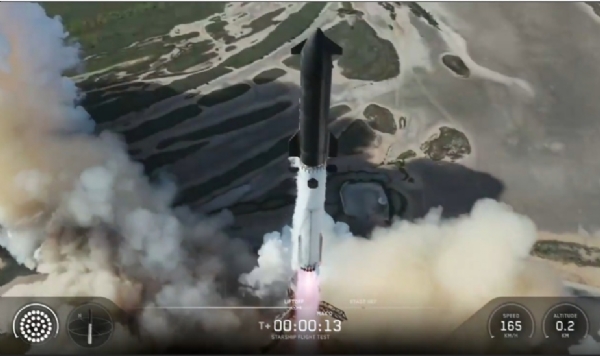
Texas, 25 July (H.S.): SpaceX’s Starship rocket successfully lifted off from Texas on Friday for its 13th test flight, marking another major step in the company’s efforts to develop a next-generation spacecraft capable of supporting future lunar missions, satellite expansion and deep-space exploration.
The massive Starship system, standing around 400 feet (122 metres) tall, launched from SpaceX’s Starbase facility in Texas at approximately 6:50 p.m. Eastern Time. During the test mission, the spacecraft aimed to demonstrate several advanced onboard capabilities, including the first suborbital deployment of new Starlink satellites.
The mission involved the Super Heavy booster launching the Starship upper stage into a suborbital trajectory. The approximately one-hour flight was designed to test the vehicle’s performance during launch, space operations and atmospheric re-entry before a planned splashdown in the Indian Ocean.
Around 10 minutes after liftoff, Starship reached a speed of nearly 16,400 miles per hour (26,400 kilometres per hour) while travelling through space. The Super Heavy booster then attempted its return manoeuvre towards Earth.
According to SpaceX, the booster impacted the Gulf of Mexico harder than expected during its return, although it successfully reignited more engines compared with its previous unsuccessful recovery attempt in May.
The latest test flight is the 13th Starship mission conducted by SpaceX since 2023 and represents a crucial milestone for the company’s long-term ambitions. The spacecraft is being developed to support the expansion of the Starlink satellite network, carry humans to the Moon under NASA’s Artemis programme, and potentially deploy large numbers of advanced satellites in orbit.
SpaceX has continued conducting Starship test flights to improve the reliability, safety and performance of the vehicle as it works towards making fully reusable space transportation a reality.
Hindusthan Samachar / Jun Sarkar