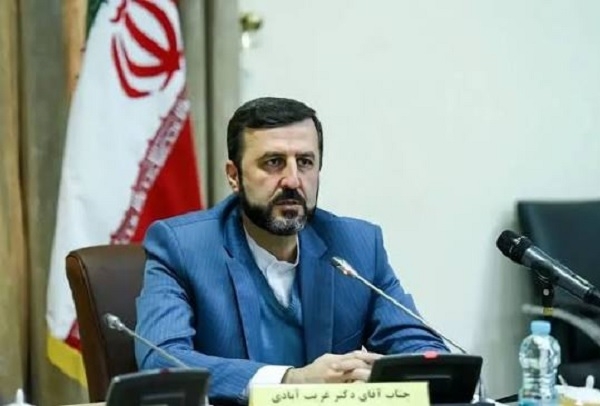
Tehran, 02 July (H.S.): Iran's Deputy Foreign Minister Kazem Gharibabadi has said that lasting security in West Asia cannot be achieved through the United States' military presence but through the elimination of external interference and greater cooperation among regional countries.
According to Iranian state media outlet Press TV, Gharibabadi made the remarks on the social media platform X on Wednesday following a security dialogue held in Bahrain under the leadership of the United States Central Command (CENTCOM). Military officials from 12 countries participated in the meeting, discussing regional security, defence cooperation and commercial shipping through the Strait of Hormuz.
Gharibabadi said the military summit in Bahrain could not establish a legitimate security framework or ensure lasting stability in the Persian Gulf. He asserted that sustainable regional security would only be possible if external interference ended, the United States withdrew its military presence, the sovereignty of all regional countries was respected and the region's evolving geopolitical realities were acknowledged.
Referring to the Strait of Hormuz, Gharibabadi said the strategically important waterway falls under Iran's jurisdiction and not under the authority of the United States Central Command.
Iran further claimed that restrictions had been imposed on navigation through the Strait of Hormuz from the initial days of its conflict with the United States and Israel.
According to the Iranian account, on June 17, Iran and the United States signed a memorandum of understanding through Pakistan's mediation. Under the agreement, both countries committed to ending hostilities on all fronts and continuing negotiations aimed at reaching a final agreement within 60 days.
Under the reported 14-point agreement, Iran committed to ensuring the safe passage of commercial vessels through the Strait of Hormuz without tolls for at least 60 days and to restoring normal maritime traffic through the strategic waterway within 30 days. However, Iran maintained that its sovereignty over the Strait of Hormuz would remain fully intact. It added that the strategically important maritime corridor would not return to the pre-conflict arrangement and would continue to be administered by the Islamic Republic of Iran in accordance with international law.
---------------
Hindusthan Samachar / Jun Sarkar

02 Jul 2026