




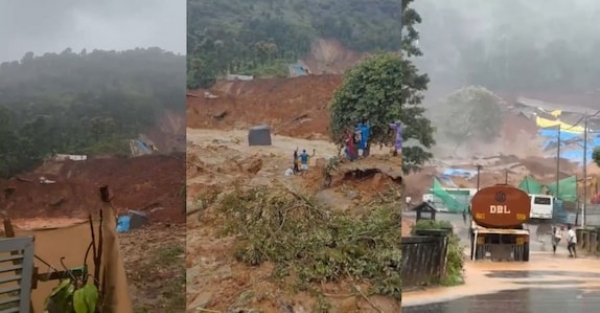
Wayanad, 19 July (H.S.):The Kerala High Court-appointed Amicus Curiae has urged a detailed examination of the process through which the contractor for the Kalladi–Meppadi twin-tunnel project in Wayanad was selected, following the July 7 landslip that claimed seven lives and injured several others.
In a report submitted to the High Court in its suo motu proceedings on the 2024 Wayanad landslides, Senior Advocate Renjith Thampan questioned whether adequate due diligence was carried out before awarding the Engineering, Procurement and Construction (EPC) contract to Dilip Buildcon. The report raises concerns over the company's previous infrastructure projects that reportedly suffered major structural failures and calls for greater scrutiny of contractor selection for projects in disaster-prone regions.
Among the instances cited is the 2021 collapse of an under-construction flyover at Anakapalle in Andhra Pradesh, where two girders fell, killing two workers and injuring three others. The report notes that an expert committee constituted by the National Highways Authority of India (NHAI) had attributed the collapse to inadequate anchorage of girders and identified lapses by officials of the concessionaire. It also points to the company's disqualification from the 2026 Bengaluru tunnel road tender, whose eligibility norms barred firms linked to previous structural collapses.
The Amicus has sought the State government's response on whether the contractor's past record was disclosed and assessed during the bidding process and whether enhanced monitoring mechanisms were put in place in view of its history. It also recommends that future tenders for projects in hazard-prone areas incorporate stricter eligibility criteria similar to those adopted for the Bengaluru project.
The report further warns that compensation under the Contractor's All Risk (CAR) insurance policy could be contested if investigators establish wilful violation of statutory directions or deliberate disregard of repeated warnings, including five written communications issued by the Wayanad District Disaster Management Authority (DDMA).
To ensure timely relief, the Amicus has recommended that the State provide interim compensation to the victims' families without waiting for insurance claims to be settled, while retaining the right to recover the amount from the contractor or insurer later.
The report has also directed Konkan Railway Corporation Ltd. (KRCL), the Kerala Public Works Department (KPWD) and the contractor to produce the CAR insurance policy and related documents, confirm that the insurer has been informed of the incident, furnish details of all claims filed, and preserve all material evidence at the accident site except where rescue and safety operations require otherwise.
The report concludes that the July 7 landslip was not an unavoidable natural disaster but one that had been repeatedly anticipated through official warnings. It states that the tragedy “was foreseen, in writing, five times over,” underscoring the need for accountability and stronger safeguards in infrastructure projects undertaken in ecologically sensitive areas.
---------------
Hindusthan Samachar / Arun Lakshman