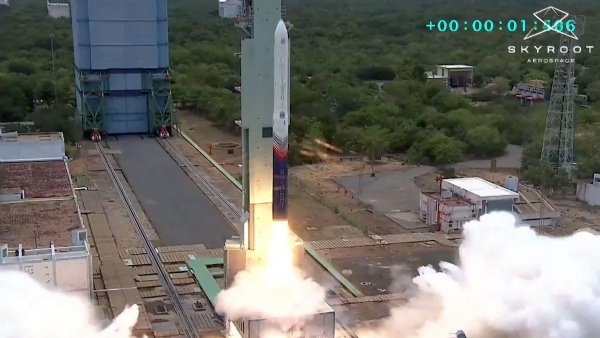
Sriharikota, 18 July (H.S.):
India’s space sector reached a significant milestone on Saturday with the launch of Skyroot Aerospace’s Vikram-1, marking the country’s first major step towards privately developed orbital launch capabilities. The mission represents the growing contribution of private enterprises to India’s ambitious space programme and reflects the transformation of the sector from a government-led domain into a collaborative ecosystem involving startups, researchers, and industries.
The launch comes at a time when India’s space economy is witnessing rapid expansion. Valued at nearly $8.4 billion, the sector has attracted hundreds of startups since the government opened space activities to private players in 2020. These companies are working across areas such as satellite manufacturing, launch services, space-based applications, propulsion technology, and advanced research.
India’s journey in space has evolved from its early satellite experiments to complex missions exploring planets, the Moon, and the Sun. The country created history in 2014 by becoming the first Asian nation to successfully place a spacecraft in Mars orbit through the Mars Orbiter Mission. The mission showcased India’s technological capability and cost-effective approach to space exploration.
The Chandrayaan programme further strengthened India’s position in global space research. After the launch of Chandrayaan-1 in 2008 and the unsuccessful landing attempt of Chandrayaan-2 in 2019, India achieved a landmark success in 2023 when Chandrayaan-3 successfully landed near the Moon’s south polar region. With this achievement, India became the fourth nation after the United States, Russia, and China to accomplish a soft landing on the lunar surface.
India is now preparing for future deep-space missions, including Chandrayaan-4, which aims to bring lunar samples back to Earth, and a planned mission to Venus. The country’s solar observatory mission, Aditya-L1, is also studying the Sun’s outer atmosphere and its impact on space weather.
Apart from space exploration, Indian technology is also being extended to ocean research. The country’s deep-sea exploration initiative aims to send scientists several kilometres below the ocean surface to study marine resources, including strategically important minerals.
Satellite technology remains one of the strongest pillars of India’s space programme. Since launching its first satellite in 1975, the Indian Space Research Organisation (ISRO) has built a global reputation for delivering reliable and affordable space missions. ISRO has successfully launched hundreds of foreign satellites and continues to expand India’s commercial presence in the international space market.
To support future growth, India is strengthening its space infrastructure. The Satish Dhawan Space Centre in Sriharikota continues to serve as the country’s primary launch facility, while a new spaceport is being developed at Kulasekarapattinam in Tamil Nadu.
The government has set ambitious targets for the sector, aiming to expand India’s space industry to around $44 billion by 2033 and $100 billion by 2040. India is also increasing cooperation with global space agencies and countries, including the United States, European nations, Japan, France, Germany, Italy, Saudi Arabia, and Russia.
Private companies are playing an increasingly important role in this expansion. Skyroot Aerospace has emerged as one of India’s leading space startups with Vikram-1, a rocket designed to place small satellites into low Earth orbit. Other companies such as Pixxel, Bellatrix Aerospace, and Agnikul Cosmos are developing technologies ranging from Earth observation satellites and propulsion systems to advanced launch vehicles.
The country’s space and defence sectors are also becoming increasingly interconnected. Technologies developed for rockets, satellite systems, electronics, and navigation are contributing to both civilian and strategic applications. ISRO and defence organisations continue to work together on various technology programmes.
India is also progressing towards human spaceflight through the Gaganyaan mission. The programme aims to send Indian astronauts into low Earth orbit for a three-day mission after completing a series of test flights. The journey of Indian Air Force pilot Shubhanshu Shukla to the International Space Station in 2025 marked an important step in India’s human spaceflight ambitions.
With Vikram-1’s successful launch, India has entered a new phase where private innovation and government expertise are combining to shape the future of the nation’s space ambitions. The mission not only strengthens India’s position in the global space sector but also opens new opportunities for startups and young innovators.
---------------
Hindusthan Samachar / Jun Sarkar

18 Jul 2026