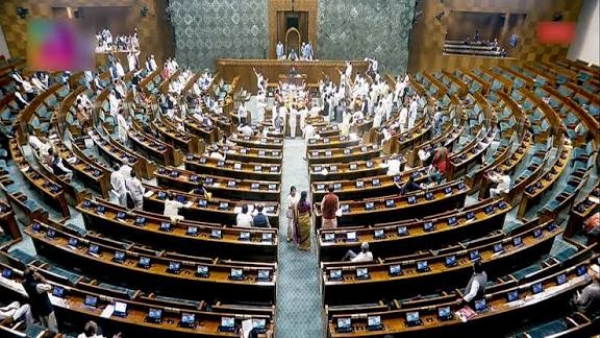
New Delhi, July 18 (HS): The Centre is set to bring an ambitious legislative agenda during the Monsoon Session of Parliament beginning July 20, with several key constitutional amendment Bills and major reform legislations expected to dominate proceedings. However, the government's ability to secure passage of constitutional amendments will depend on whether it can muster the required special majority in both Houses.
Among the major proposals expected during the session are the Constitution (131st Amendment) Bill relating to delimitation and expansion of the Lok Sabha, implementation of the Women's Reservation law, and the Constitution (129th Amendment) Bill seeking simultaneous elections to the Lok Sabha and state Legislative Assemblies.
Former Lok Sabha Secretary General and constitutional expert P.D.T. Acharya said constitutional amendment Bills require much higher parliamentary support than ordinary legislation.
Such Bills require the approval of a majority of the total membership of each House as well as a two-thirds majority of members present and voting. The government is unlikely to push these Bills unless it is confident of securing the required numbers, Acharya said.
He, however, noted that the government is free to introduce constitutional amendment Bills irrespective of whether they are listed in the House agenda.
The proposed Constitution (131st Amendment) Bill seeks to increase the elected strength of the Lok Sabha from 543 seats to around 850 as part of the long-pending delimitation exercise linked to the first Census after 2026. The proposal has already generated political opposition, particularly from southern states including Tamil Nadu, Kerala, Karnataka, Telangana and Andhra Pradesh, which have expressed concerns that population-based delimitation could reduce their proportional representation despite decades of successful population control measures.
The government is also expected to move forward on implementation of the Constitution (106th Amendment) Act, popularly known as the Nari Shakti Vandan Act, which provides for 33 per cent reservation for women in the Lok Sabha and state Legislative Assemblies. Although enacted in 2023, its implementation is linked to the delimitation exercise following the next Census.
Another significant proposal expected during the session is the Constitution (129th Amendment) Bill to facilitate simultaneous elections across the country under the One Nation, One Election initiative. Based on the recommendations of the high-level committee headed by former President Ram Nath Kovind, the proposal seeks amendments to several constitutional provisions governing the tenure of Parliament and state Assemblies.
The Centre is also expected to introduce amendments to the Foreign Contribution (Regulation) Act (FCRA) to strengthen oversight of foreign funding received by non-governmental organisations and religious institutions. The proposed amendments are expected to reduce the validity period of FCRA registration, enhance monitoring of fund utilisation and prescribe stricter penalties for violations.
Apart from constitutional amendments, Parliament is expected to take up several important Bills, including the Income-tax (Amendment) Bill, 2026, the Supreme Court (Number of Judges) Amendment Bill, 2026, the Registration of Births and Deaths (Amendment) Bill, 2026, the Prevention of Insults to National Honour (Amendment) Bill, 2026, and the Micro, Small and Medium Enterprises Development (Amendment) Bill, 2026. The House is also expected to consider the pending Foreign Contribution (Regulation) Amendment Bill, 2026, and the Viksit Bharat Shiksha Adhishthan Bill, 2025.
Despite improvements in its parliamentary strength following recent political realignments, the National Democratic Alliance (NDA) is still short of the numbers required to pass constitutional amendment Bills. In the Lok Sabha, the alliance is estimated to command around 348 members against the approximately 360 votes required for a constitutional amendment based on the current effective strength of the House. In the Rajya Sabha, the NDA and its supporting members are also estimated to remain about a dozen votes short of the special majority required.
The Monsoon Session is expected to witness intense debates on these proposals as the government seeks support for its legislative agenda amid continuing political differences over several constitutional and governance reforms.
------
Hindusthan Samachar / Jun Sarkar
18 Jul 2026